

On your first week as a support worker, a shift can become difficult without warning. A service user refuses personal care, a colleague calls in sick, and the medication round is already running late. You can't solve everything by rushing through the checklist. You need to understand what has changed, decide what must happen first, involve the right person, and leave a clear record.
That is problem solving in health and social care. It isn't a vague personality trait or a phrase to add to your CV. It is a frontline discipline built around safe judgement, person-centred support, escalation and documentation.
Table of Contents
- Why Problem Solving Skills Matter in UK Health and Social Care
- The Five Core Problem Solving Skills Explained
- How These Skills Show Up on a Real Care Shift
- Real-World Case Studies From Health and Social Care
- Showing Problem Solving Skills on Your CV and at Interview
- Weekly Exercises to Strengthen Your Problem Solving Skills
- Building Job-Ready Problem Solving With Cura Academy
Why Problem Solving Skills Matter in UK Health and Social Care
A refusal of personal care might reflect pain, embarrassment, fear, confusion, a change in routine or a safeguarding concern. The safe response isn't to force the task or mark it as “refused”. First, preserve the person's dignity. Then ask calm questions, check the care plan, consider what you can safely do within your role, and tell the senior worker if the concern needs further assessment.
This is why employers look for people who can think under pressure, not only follow instructions. The Care Quality Commission's fundamental standards expect care to be safe, effective, responsive and person-centred. In practice, that means recognising when a routine action no longer fits the person's needs and knowing when to pause, adapt or escalate. Your responsibilities also connect with accurate records and duties around wellbeing, safeguarding and care planning. A useful refresher on the wider principle is this guide to duty of care in health and social care.
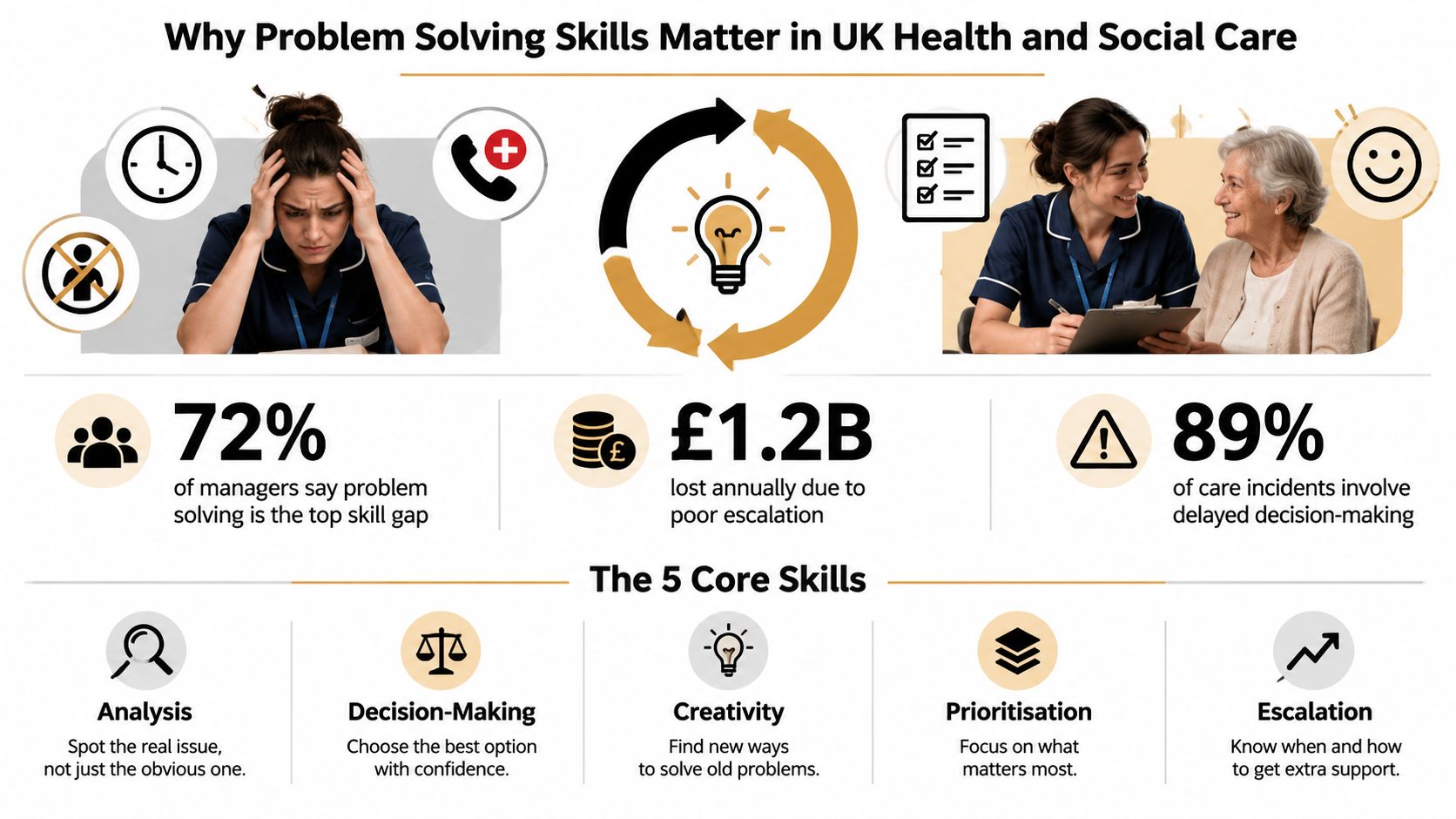
The expectation is visible in UK skills evidence. In England's 2023 Survey of Adult Skills, adults scored an average of 259 points in adaptive problem solving, compared with an OECD average of 251. The report also found that 21% of adults in England were low performers at Level 1 or below, compared with 29% across the OECD, and that only Japan outperformed England among G7 countries. These findings matter in care because frontline workers regularly handle changing needs, incomplete information and competing risks. The national report for England links adaptive problem solving to the kind of flexible thinking used in real work.
What employers are looking for
In a UK government-funded skills analysis, 94% of employers in Wales rated problem solving as important. The same report noted that about a quarter of graduates were viewed as lacking skills including leadership, communication, critical thinking and professionalism, while a fifth of non-graduate new joiners lacked problem-solving ability. The UK data skills gap report shows that employers treat judgement as a measurable workplace expectation.
On shift, that expectation appears in small actions:
- Notice the change: Compare what you see now with the person's usual presentation.
- Stay within competence: Don't diagnose, administer outside your training or make promises you can't keep.
- Escalate clearly: Tell the senior worker, nurse, manager or emergency service when the risk requires it.
- Document the facts: Record what you observed, what the person said, what you did and who you informed.
- Review the outcome: Check whether the action helped and pass the information into handover.
Practical rule: A good solution in care is safe, proportionate, person-centred and traceable in the records.
The Five Core Problem Solving Skills Explained
Think of a busy care shift as running a household where several needs arrive at once. You wouldn't begin by guessing. You'd look around, work out what matters, make a sensible choice, find an alternative if the usual route is blocked, and call for help when the task exceeds your authority. The same sequence applies in care.
Analysis
Analysis means separating the facts from assumptions. A person who is suddenly withdrawn may have dementia, but that isn't the only possibility. Ask what changed, when it started, what you can observe, and what the care plan says about the person's normal behaviour. Look for relevant information in daily notes, food and fluid charts, mobility records and handover.
Decision-making
Decision-making is choosing a safe action from the options available. If a person reports discomfort, you might offer approved comfort measures, check the care plan and report the concern to the appropriate colleague. You shouldn't independently diagnose the cause or change treatment outside your role.
Creativity
Creativity in care doesn't mean ignoring procedure. It means finding a different route that respects the person's preferences and remains safe. If a service user refuses a standard meal, you might offer an approved alternative, change the setting, involve someone they trust or ask about texture and temperature preferences.
Prioritisation
When everything feels urgent, prioritisation protects people from being overlooked. A possible fall injury, a routine request and a delayed non-urgent task don't carry the same risk. Assess immediate danger, call for support and communicate what can safely wait.
Escalation
Escalation is recognising the boundary of your responsibility. A safeguarding concern, acute deterioration, unexplained injury or medication problem may need a senior carer, nurse, manager, GP, NHS service or emergency response. Escalation isn't failure. It is a controlled handover of risk.
The communication underneath all five skills matters. You need to listen, ask open questions and pass on information accurately. These principles are explored further in communication in health and social care.
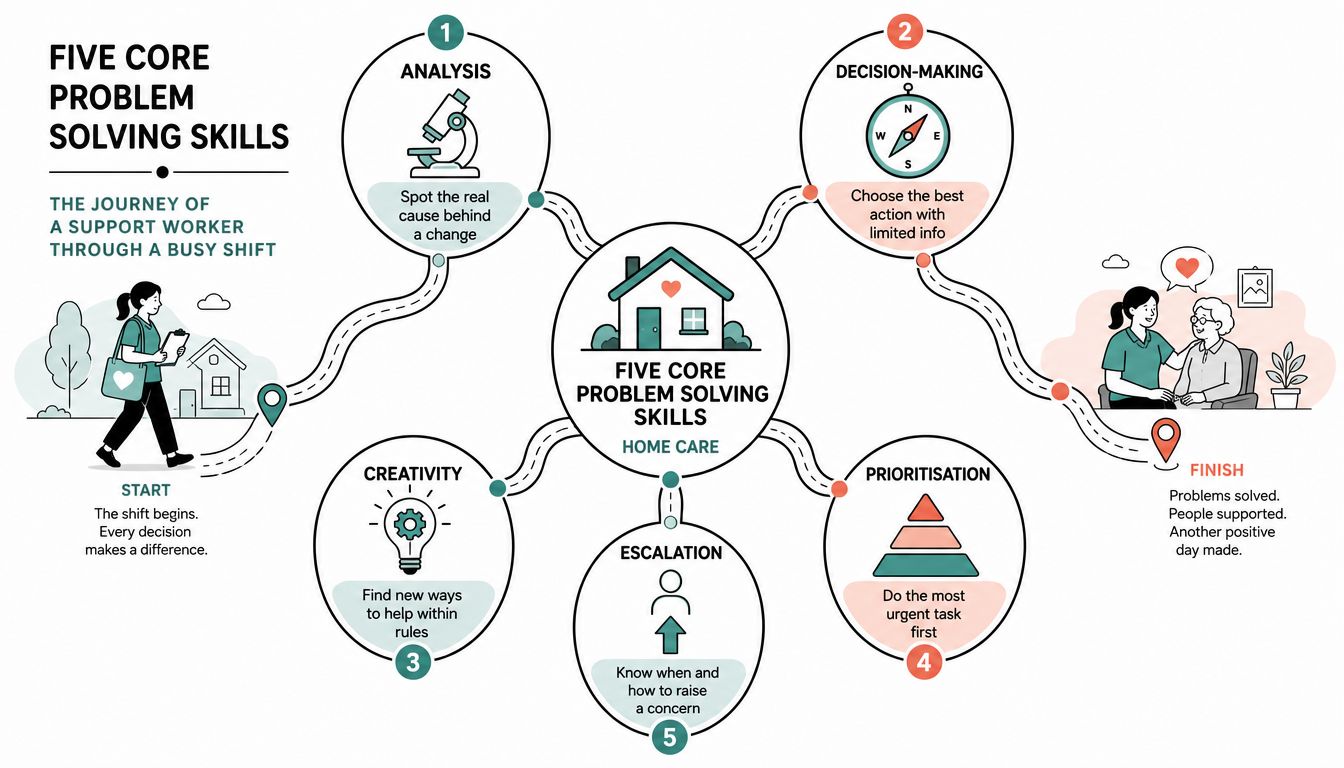
A useful way to remember the sequence is: look, choose, adapt, order and raise. You won't always move through the skills neatly. A new fact can take you back to analysis, or a change in condition can turn a routine decision into an escalation.
How These Skills Show Up on a Real Care Shift
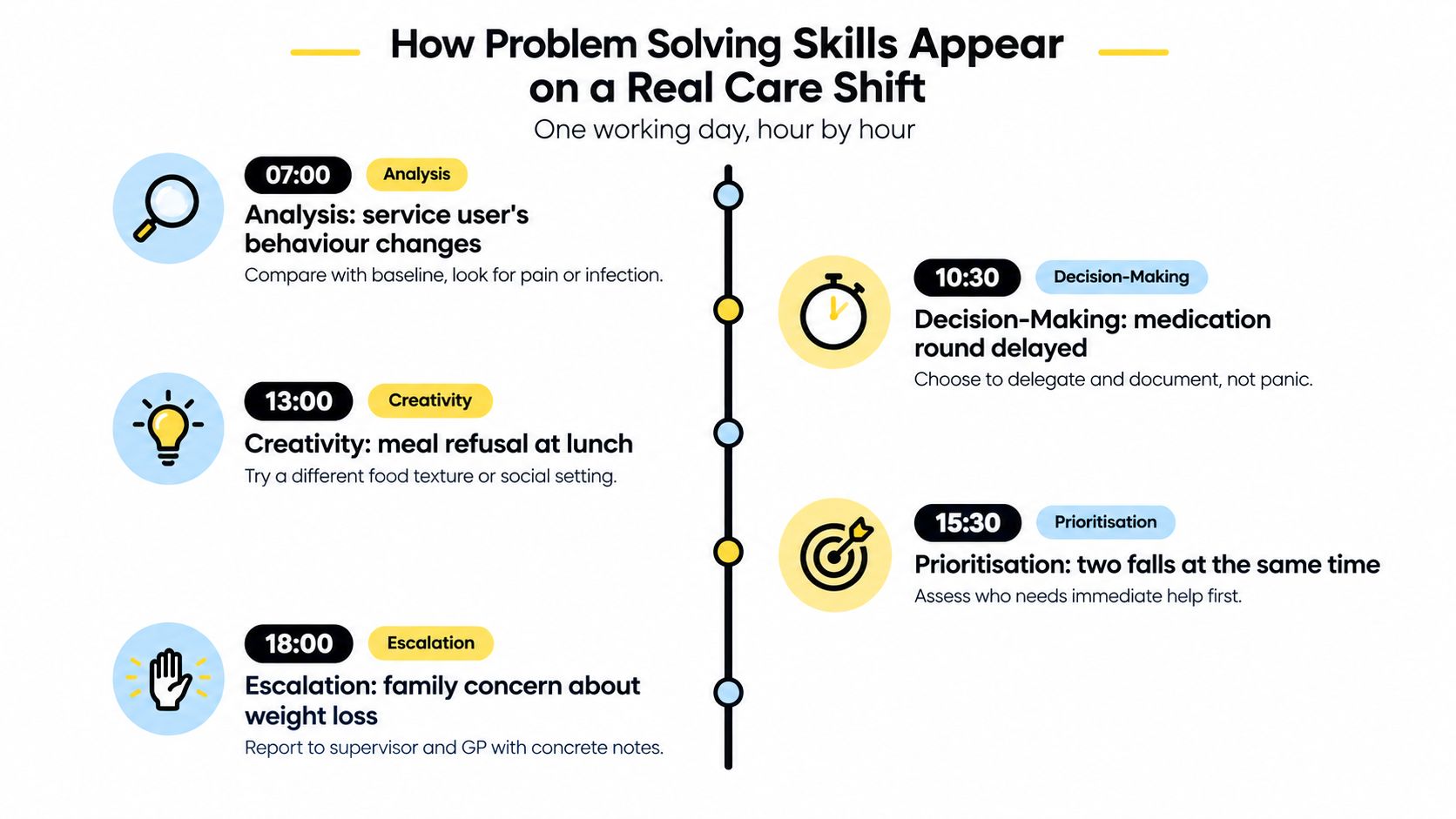
At the start of a shift, analysis might begin before you provide any direct care. You notice that a person who normally greets staff is quiet, holding their abdomen and refusing breakfast. Don't label it as “just a bad mood”. Compare the presentation with the baseline, ask what they need, observe for other changes and report anything concerning according to local procedure.
Later, decision-making may be needed when a medication round is delayed. You check the medication policy and speak to the authorised colleague rather than improvising. The safe decision could involve obtaining guidance, asking another trained worker to assist or documenting the delay and its cause. The important point is that you make the decision within your competence and create a clear trail.
At lunchtime, creativity can help when a person refuses the usual meal. You might ask whether the texture, smell, temperature or environment is the barrier. An approved alternative, a quieter table or a familiar social routine may support choice without pressuring the person. Record what was offered, what was accepted and any continuing concern about nutrition or hydration.
Priorities change as risk changes
Two call bells can sound together while a visitor raises a complaint and a medication window approaches. Prioritisation means identifying immediate harm, calling for assistance and communicating with the people who are waiting. It doesn't mean abandoning other responsibilities. It means making a reasoned order and ensuring delayed tasks are handed over.
Escalation becomes essential when a concern crosses your role boundary. If someone has a possible serious injury, sudden clinical deterioration or a safeguarding disclosure, follow the service procedure and contact the appropriate senior or clinical professional. Use direct facts rather than conclusions. Say what you saw, what the person said, when it happened and what action has already been taken.
The record is part of the solution
A problem that isn't recorded may disappear from the next handover. Daily notes should explain the observation, the person's response, the action taken, who was informed and what needs checking next. Avoid judgemental phrases such as “difficult” or “attention-seeking”. Write observable information, including the person's own words where relevant.
Write for the colleague taking over from you. They need enough accurate information to continue safe care without guessing.
Real-World Case Studies From Health and Social Care
The following scenarios show how the same pattern can produce very different results. They are training examples, not reports of named individuals or verified incidents.
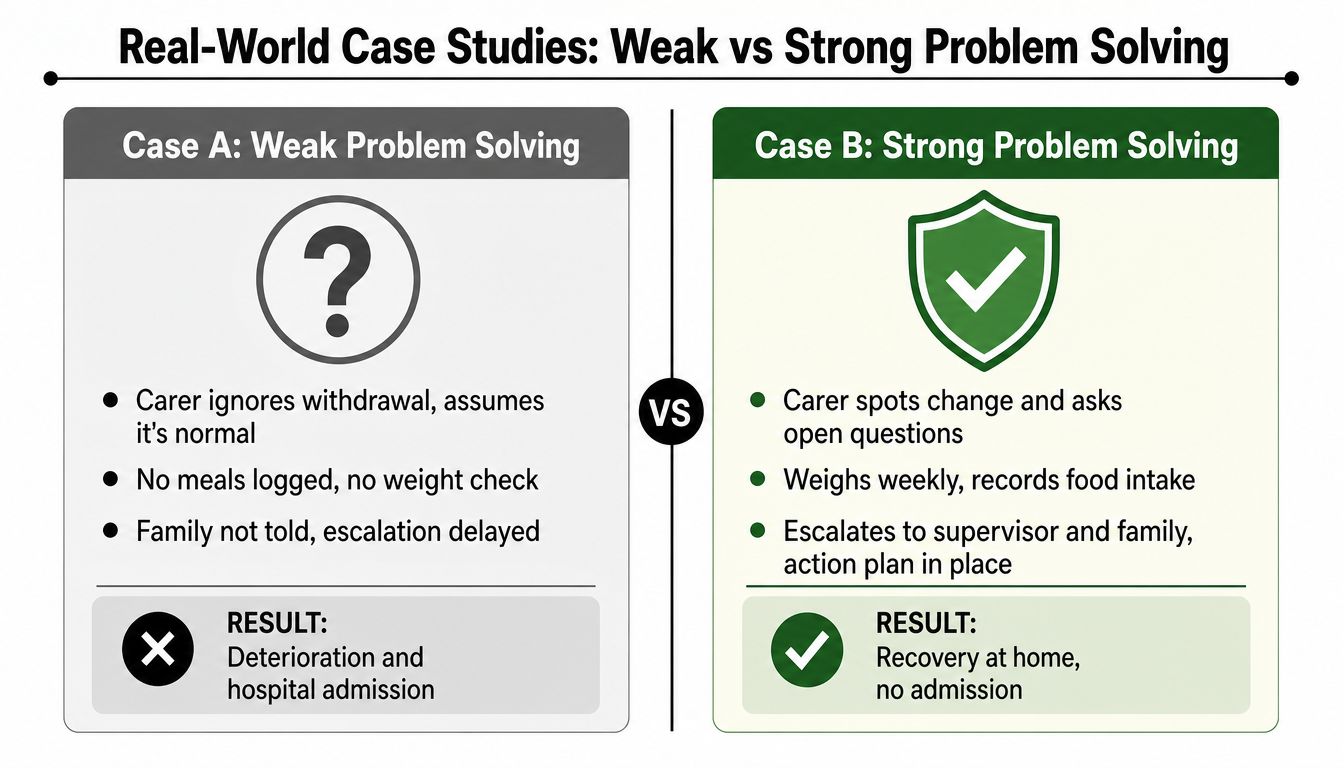
Case A shows the cost of assuming
A domiciliary carer notices that a service user has become withdrawn and is skipping meals. The carer assumes it is a bad day, does not record the reduced intake, doesn't check whether the family has noticed and fails to flag the change to the office or senior worker.
Over the following week, the person's condition worsens. They are admitted to hospital with dehydration, and a safeguarding concern is raised because the pattern was not acted on. The weakness wasn't just that the carer missed a diagnosis. The failure was in observation, documentation and escalation.
A safer note would have recorded the date and time, what food and fluid were offered, what was declined, the person's presentation, any words they used, and who was contacted. A worker should never invent a clinical explanation, but they must report a meaningful change through the agreed route.
Case B shows a controlled response
In a residential home, a support worker notices the same broad pattern. The person is quieter than usual and leaves most of a meal untouched. Instead of treating the change as routine, the worker checks the food intake chart, reviews recent notes and asks open questions about pain, toileting and how the person feels.
The worker informs the nurse using an SBAR structure. The handover identifies the situation, relevant background, the assessment observations and the requested response. The worker documents the reduced intake, behaviour change, questions asked, answers given, nurse notification and agreed monitoring plan. The nurse then decides what clinical assessment is required.
What the comparison teaches
Strong problem solving doesn't guarantee that every concern ends without further treatment. It does ensure that the right people receive timely, factual information. The support worker has not diagnosed a urinary tract infection or promised a particular outcome. They have identified a change, checked relevant records, escalated appropriately and supported continuity.
| Weak practice | Strong practice |
|---|---|
| Assumes the change is normal | Compares it with the person's baseline |
| Leaves gaps in the notes | Records observations and responses |
| Waits for the issue to resolve | Raises the concern through the correct route |
| Uses vague descriptions | Uses factual, respectful language |
| Keeps the concern to themselves | Includes the next action in handover |
This is what compliance looks like at ground level. It isn't paperwork added after care. The record shows how you noticed risk, respected the person and acted within your role.
Showing Problem Solving Skills on Your CV and at Interview
A CV shouldn't only say that you are a “good problem solver”. That phrase gives an employer no evidence. Describe the situation, your action, the care terminology involved and the result, without claiming outcomes you can't prove.
Use action verbs such as identified, observed, assessed, recorded, escalated, communicated, reviewed and contributed. If you have a documented outcome, include it. If you don't, describe the action accurately rather than inventing a measurable improvement.
| Weak statement | Strong problem-solving rewrite |
|---|---|
| Helped service users with daily tasks | Identified a change in a service user's presentation, recorded factual observations, followed the care plan and escalated concerns to the senior worker |
| Worked well under pressure | Prioritised immediate safety during competing requests, communicated delays clearly and completed accurate handover notes |
| Supported people with meals | Monitored food choices and intake, explored person-centred alternatives and reported ongoing concerns through the agreed route |
| Good communication skills | Used structured handover information to explain observations, actions taken and follow-up required |
For interview preparation, use the STAR method. Keep the situation brief, explain your responsibility, describe your actions in order and finish with the verified result. Don't present yourself as the person who made a clinical decision if that decision belonged to a nurse or manager.
A domiciliary care example
Situation: “During a home visit, I noticed that a person who usually ate well was quieter and left their meal untouched.”
Task: “I needed to support their dignity, check what they wanted and decide whether the change needed reporting.”
Action: “I asked open questions, checked the care plan, recorded what was offered and declined, and contacted the office because the change was outside the person's usual presentation. I shared the facts rather than suggesting a diagnosis.”
Result: “The concern was passed to the appropriate colleague, and the next worker had clear information for follow-up.”
A senior support worker example
Situation: “A resident's food intake and engagement had changed over several observations.”
Task: “I needed to identify the pattern, support the team and ensure the nurse received useful information.”
Action: “I reviewed the relevant charts and notes, asked staff to record consistently, used SBAR for the handover and documented who had been informed and what monitoring was agreed.”
Result: “The concern entered the appropriate clinical and management pathway, and the team had a shared plan.”
For more practice with structured answers, use these care worker interview questions. Employers often listen for the same details that make care safe: what you noticed, what you did, who you involved, what you recorded and what happened next.
Weekly Exercises to Strengthen Your Problem Solving Skills
You can build judgement through small, repeatable practice. The exercises below don't replace supervision, policy or workplace training. They help you become more deliberate before a real shift tests you.
Analysis exercise
Spend ten minutes reviewing one care plan or anonymised scenario. Write down three observations and one action. Keep observations factual, such as “declined breakfast” or “needed repeated prompts”, rather than “was uncooperative”. Then ask what information is missing.
Decision-making exercise
Choose a common care situation with two reasonable options. For example, a person wants to delay washing while another scheduled task is approaching. Write a short note to a colleague explaining which option best respects the person's choice, maintains safety and stays within the care plan.
Creativity exercise
Select one routine task, such as supporting a meal, encouraging hydration or preparing for bedtime. Suggest one small change that could make the task more person-centred. Check the idea against risk controls and local policy. Creativity means improving the route, not bypassing safeguards.
Prioritisation exercise
Create a mixed list containing a possible injury, a routine cleaning task, a request from a visitor and a documentation task. Sort each item into urgent, important or queued. Explain why the order might change if new information appears. This builds the habit of reassessing rather than clinging to the first plan.
Escalation exercise
Once a week, rehearse a two-minute SBAR handover aloud. Use a fictional scenario and include the person's current situation, relevant background, your factual assessment and what you need from the listener. Practise saying, “I'm concerned because...” without adding an unsupported diagnosis.
Keep a short reflective note after each exercise. Ask yourself what you assumed, what evidence you used, what you would document and who would need to know. Reflection turns an event into learning that can support supervision and interview examples.
Building Job-Ready Problem Solving With Cura Academy
Problem solving becomes more reliable when it sits inside a wider care foundation. A new support worker needs to understand person-centred practice, confidentiality, safeguarding, duty of care, infection prevention, moving and handling, medication boundaries and accurate records before trying to manage complex situations independently.
A sensible learning order mirrors the decisions you make on shift:
- Start with compliance and person-centred care: Learn the standards, responsibilities and boundaries that define safe support.
- Develop reflective practice: Review what happened, what you noticed and what you would change.
- Strengthen communication: Practise open questions, active listening, professional recording and structured handover.
- Build decision-making: Work through scenarios involving changing needs, competing priorities and incomplete information.
- Move towards leadership and escalation: Prepare for supervision, delegation, incident review and supporting colleagues.
For someone entering care, a foundational pathway can make the connection between training completion and interview readiness clearer. An experienced carer moving towards a senior role may need more emphasis on reflective practice, team communication, risk recognition and consistent escalation. Someone aiming for team leadership can focus on coaching others, reviewing patterns in records, supporting reablement decisions and improving how the service responds to recurring problems.
Cura Academy provides structured UK health and social care learning, including Care Certificate standards, mandatory refreshers and role-specific courses such as Basic Life Support and Dementia Awareness. Its subscription model gives learners access to training in one place, while one-off bundles can help people choose a practical sequence without guessing which course comes next. The platform also supports compliance preparation, onboarding readiness and learning pathways for people seeking care work.
A seven-day action checklist
- Choose your route: Select the care role or progression stage that matches your next job goal.
- Complete one scenario-based module: Focus on a topic connected to judgement, safeguarding, communication or person-centred care.
- Write two STAR answers: Use real experiences, or clearly label practice scenarios as examples.
- Draft three CV bullets: Include an action, a care-specific process and an outcome you can support.
- Book a tutorial or review: Ask for feedback on your escalation language, documentation examples and interview answers.
The best problem solvers aren't the workers who try to handle everything alone. They're the workers who notice early, think clearly, respect choice, use the care plan, record accurately and involve the right person at the right time.
Cura Academy offers structured UK care training, Care Certificate learning, mandatory refreshers and role-specific courses that help you turn problem solving skills into demonstrable job readiness. Visit Cura Academy to choose a pathway, complete practical learning and prepare for safer, more confident care work.