
A morning visit can turn into a lesson in privacy and dignity before the first cup of tea. You may be helping someone wash and dress while a relative waits in the room, another staff member passes the open doorway, and the care plan sits on a shared device. The difference between good and poor practice might be as small as knocking, waiting, lowering your voice, or asking whether the person wants their daughter to stay.
Those actions matter because care involves the person's body, home, relationships, information and choices. A rushed task can leave someone feeling exposed or ignored. A calm explanation, a covered body and a genuine choice can help the same person feel safe and in control.
Privacy and dignity in care are not soft extras or manners added after the practical work. They shape person-centred care, trust, independence and safeguarding. They also apply when staff are communicating by phone, recording information digitally, handing over in a busy corridor, or checking on someone who can't currently express consent.
Table of Contents
- Introduction Why Privacy and Dignity Matter on Every Shift
- What Privacy and Dignity Really Mean in Social Care
- Your Legal and Ethical Duties Around Privacy and Dignity
- Key Ways to Protect Privacy and Dignity Every Day
- Real World Examples That Show Privacy and Dignity in Action
- Tricky Situations Digital Privacy and Supporting People Who Lack Capacity
- Putting Learning Into Practice With Bite Size Training Activities
Introduction Why Privacy and Dignity Matter on Every Shift
A person receiving care may need help with tasks they once managed privately. Washing, dressing, using the toilet, taking medication or discussing a health concern can all involve vulnerability. The worker's approach determines whether the person remains an active adult in their own life or feels reduced to a list of tasks.
Suppose you enter a bedroom without knocking because you've used a key to get inside. The resident is still in bed and wants a few minutes before getting up. You pull back the curtains, begin gathering clothing and tell them you're running late. Nothing may be physically unsafe, yet the person has lost control over their space, timing and body.
A more respectful approach starts differently. Knock, wait, greet the person using their preferred name, explain why you're there and ask how they'd like to begin. If a family member is nearby, check whether the person wants them involved before discussing personal care.
A useful shift question: “What can I do to help this person stay in control?”
Privacy protects boundaries. Dignity protects worth. They overlap, but neither depends only on a closed curtain. A quiet handover protects information. A patient explanation supports dignity. Offering time, choice and encouragement can protect independence even when the person needs substantial physical assistance.
The standard applies across care homes, hospitals, supported living, domiciliary care and agency work. The Health and Social Care Act 2008 Regulations and privacy and dignity standards helped establish privacy and dignity as a legal and regulatory expectation in England rather than an optional example of excellent practice.
Frontline staff are the people who make that expectation visible. A policy can require respect, but the person receiving care experiences the knock, the tone of voice, the covered body, the private conversation and the choice offered at the bedside.
What Privacy and Dignity Really Mean in Social Care
Start with a simple image. Privacy is like having your own front door. You decide who enters, what they see, what they hear and what information leaves the room. Dignity is how someone behaves when they come through that door. They recognise you as a person, speak to you respectfully and allow you to remain involved in your own life.
Privacy has several parts:
- Privacy of the body: The person gives permission before staff enter personal space or begin intimate care.
- Privacy of the environment: Doors, curtains and screens protect the person from unnecessary observation.
- Privacy of information: Records, conversations, phone calls, emails and messages are shared appropriately.
- Privacy of choice: The person has a say in timing, clothing, communication and the way support is delivered.
Dignity is the experience created by those actions and attitudes. Someone may have a curtain around their bed but still feel undignified if staff speak over them, use a patronising tone or discuss them as though they aren't present. Conversely, a respectful conversation can preserve dignity when a task must be completed quickly for safety.
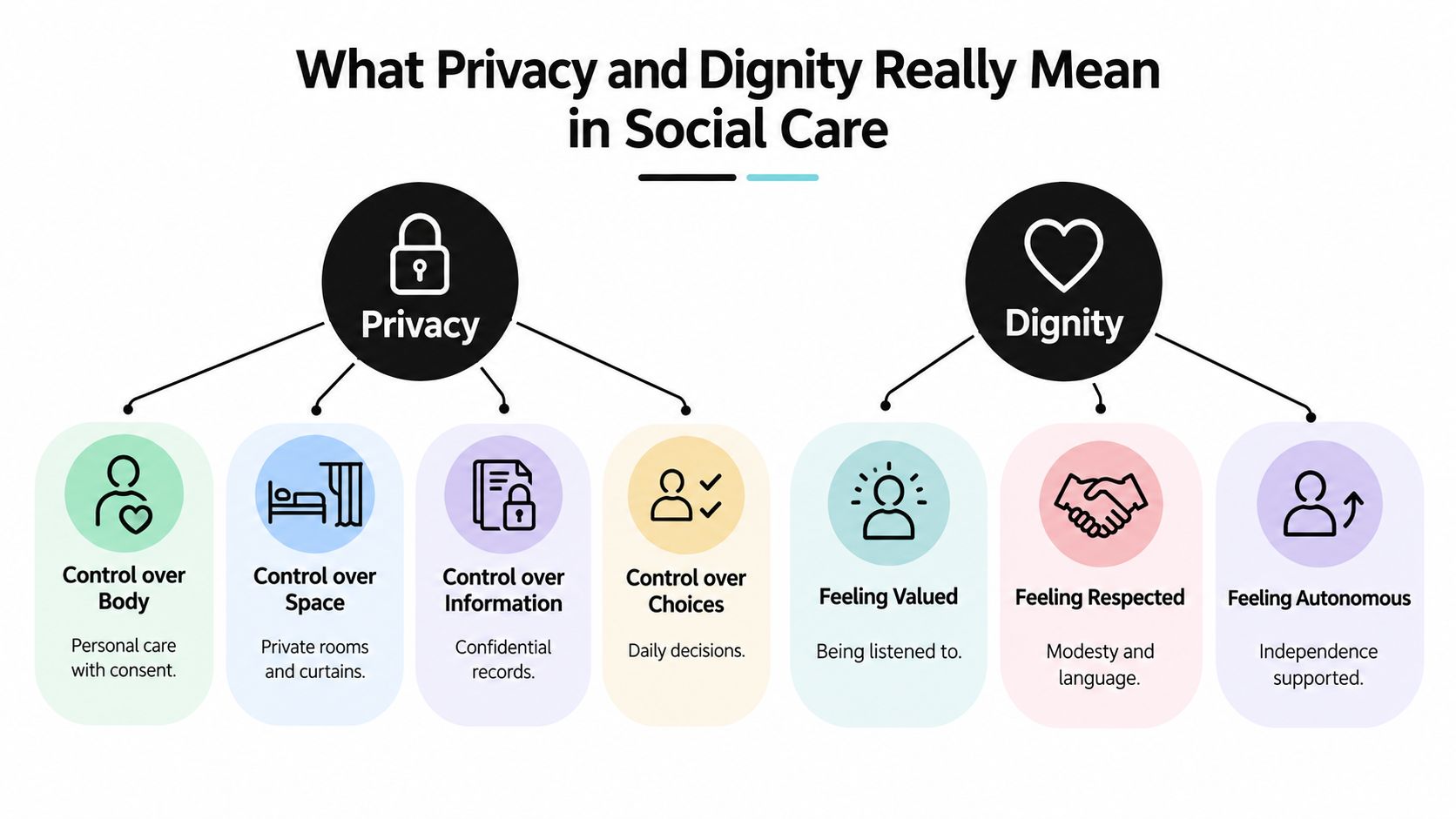
Privacy gives people control
Control doesn't mean a person must do everything alone. It means staff involve them in decisions and ask before taking over. If someone can wash their face, choose their clothes or explain how they prefer their hair arranged, the worker should support that ability rather than automatically doing the task.
Information privacy needs the same care as physical privacy. A person's diagnosis, continence needs, family circumstances and support plan are personal. Staff should treat a care record as something entrusted to them, not as information available for casual conversation.
Dignity shapes the manner of care
Dignity appears in ordinary details. Use the person's preferred name, listen without interrupting, explain what you're doing and avoid talking about them in front of others as if they're absent. Respect cultural, religious and personal preferences as part of routine care, not as inconvenient exceptions.
A helpful test is to ask yourself whether you'd want the same action taken if you were receiving support. That test isn't perfect, because people have different preferences, but it prompts the right follow-up question: “How does this individual want care to happen?”
Your Legal and Ethical Duties Around Privacy and Dignity
In England, privacy and dignity moved beyond good practice into a formal legal and regulatory expectation through the Health and Social Care Act 2008 (Regulated Activities) Regulations 2014. The requirement that service users are treated with dignity and respect applies across health and social care settings, including personal care, communication, safeguarding and the protection of independence and confidentiality. The NHS Constitution also recognises a right to privacy and confidentiality.
For frontline staff, this means the standard isn't measured only by intention. Inspectors and managers can look at what staff do. Did the worker knock? Did they seek permission? Was the person covered? Could other people hear the handover? Did the care record reflect the person's preferences?
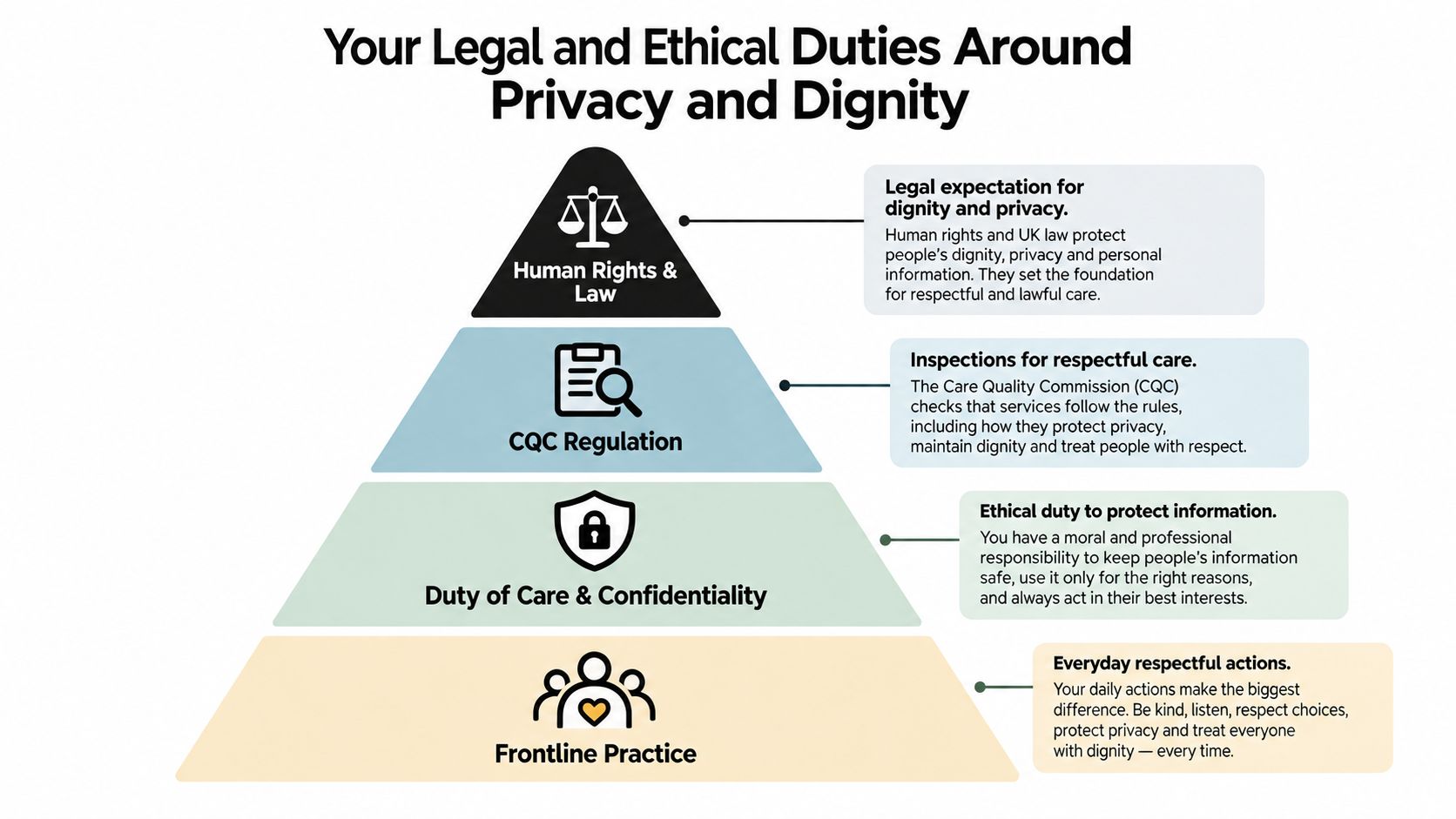
Regulation becomes visible through behaviour
CQC Regulation 10 remains a live compliance standard. It requires providers to treat people with dignity and respect, protect privacy, treat people as equals, and support autonomy and independence. A breach may begin with a small routine shortcut, but repeated shortcuts can show that a service hasn't embedded respectful care into its systems.
The Care Certificate makes the expectation practical. Learners must understand what privacy and dignity mean, recognise situations that compromise them and demonstrate behaviours such as knocking before entry, seeking permission before entering personal space, positioning curtains correctly, using an appropriate speaking volume and discussing care where others can't overhear. The Care Certificate standards therefore give providers an observable benchmark for induction and assessment.
Ethically, confidentiality means sharing information only for a legitimate care reason and with people who need it. Staff should know how their organisation handles records, disclosures, concerns and incidents. For a practical companion on information handling, read confidentiality and data protection in care.
Why inspection history still matters
Regulation can change everyday practice when leaders train staff, monitor delivery and respond to concerns. A committee report citing the Commission for Social Care Inspection recorded that services meeting privacy and dignity standards increased from 82% in 2002–03 to 91% in 2006, a nine-point gain documented by the Nuffield Trust's account of respect and dignity.
That progress doesn't mean the work is finished. Current patient experience data show why staff must keep practising these skills.
Key Ways to Protect Privacy and Dignity Every Day
Good intentions become reliable care through repeatable actions. The following habits work in most settings, but always follow the person's care plan and your employer's policy.
- Knock and wait: A key safe, open door or familiar relationship doesn't remove the person's right to control entry. Knock, identify yourself and wait when possible. If there's no response and you have a genuine safety concern, follow the agreed procedure and explain what you're doing.
- Use curtains and screens correctly: Pull curtains fully, check for gaps and consider who can still see across the room. A curtain isn't useful if staff leave the person exposed while fetching equipment.
- Protect modesty: Keep the person covered with a towel, gown or clothing wherever possible. Expose only the area needed for the task, and tell them before you uncover it.
- Keep information confidential: Don't discuss diagnoses, continence, medication or family matters in corridors, lifts, communal lounges or within earshot of visitors. The NHS guidance on privacy and dignity emphasises private communication, need-to-know sharing and permission before disclosure.
- Offer choice: Ask whether the person wants a shower or wash, which clothes they prefer, who should assist and what they can do themselves. Choices should be genuine, not questions where the answer makes no difference.
- Communicate respectfully: Explain each action, use the person's preferred name and adjust your pace or communication method. Don't discuss a person's care with another worker while the person lies nearby.
The same principles apply to documentation. Lock or log out of shared devices, position screens so visitors can't read them and avoid leaving paper notes visible. Don't photograph records or care tasks on a personal phone.
Practical rule: If a conversation would feel inappropriate in front of a stranger, move it to a private place or change how you communicate.
A quiet handover may require planning. Use a designated private space where available, keep your voice low and share only what the next worker needs to provide safe care. If the environment is busy, consider whether information can be passed through an approved secure system instead.
Watch this short learning resource before practising the behaviours with a colleague:
Respectful boundaries also protect staff and the people they support. Review professional boundaries in care alongside your privacy training, especially if your role involves home visits, personal devices or frequent family contact.
Real World Examples That Show Privacy and Dignity in Action
A resident is preparing for a wash in a care home. A worker enters while talking to a colleague, leaves the door open and starts moving toiletries without asking. The task may be completed, but the resident has had little say over who enters, what is moved or how much of their body is exposed.
The better approach is quieter. The worker knocks, waits, greets the resident, checks who they want present and asks how they prefer the wash to happen. They close the door, prepare equipment first and keep the resident covered between tasks. The person can then participate at their own pace.
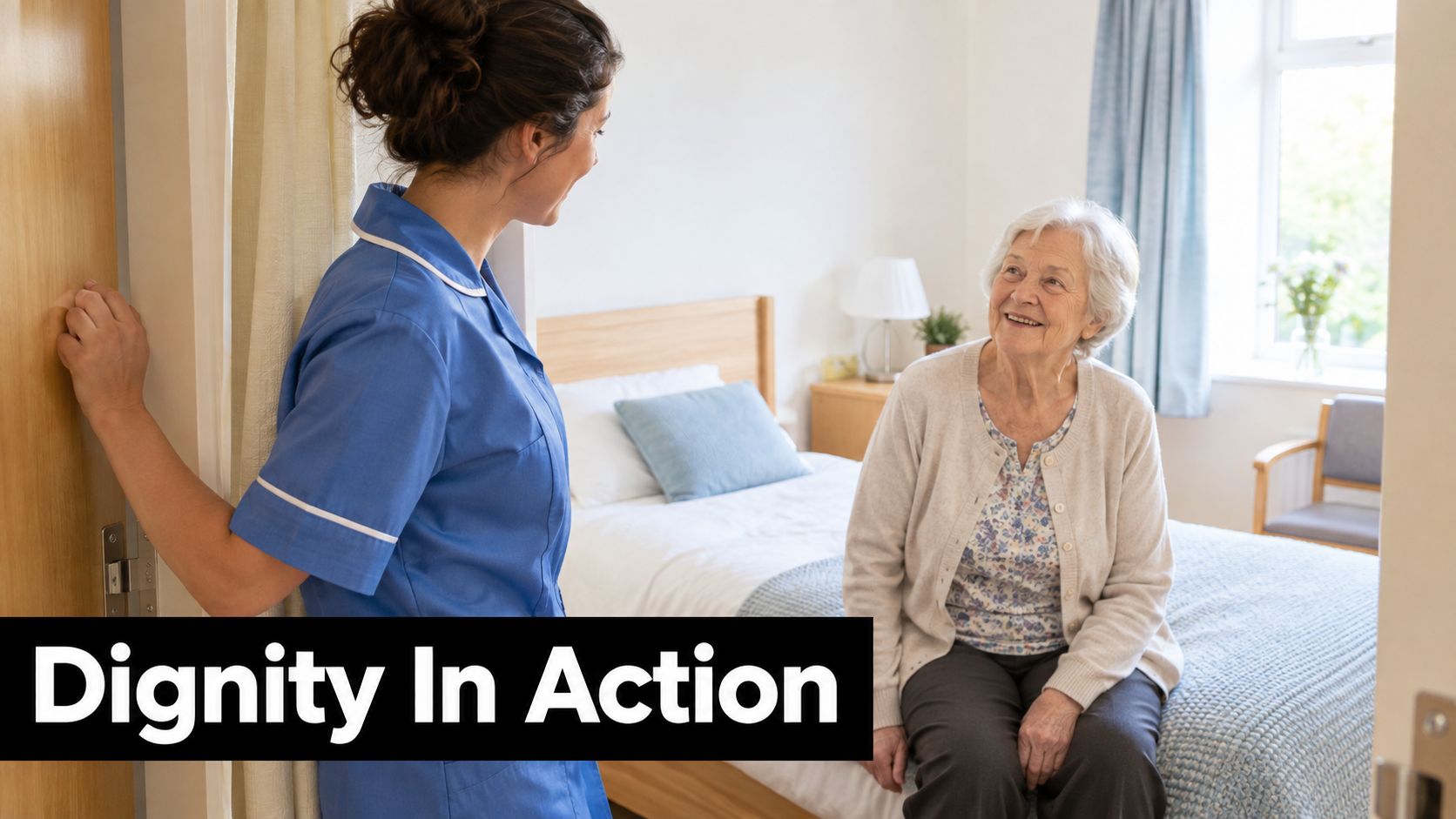
A domiciliary visit
A care worker arrives at someone's home and finds a neighbour in the kitchen. The worker needs to discuss a change in medication. Speaking freely because the neighbour seems friendly could disclose private information.
The worker can greet the neighbour warmly without assuming permission to share details. They ask the person receiving care whether they'd like the neighbour to remain, move to a private area if possible and record or report the medication issue through the approved process. The person's home remains their private space, even when other people are present.
A hospital bay and reception desk
At reception, a patient wants to ask about a sensitive condition. The desk is busy, and people are standing nearby. The staff member repeats the question loudly, inviting others to hear it.
A discreet response could involve lowering the voice, asking the patient to step to a quieter area or offering a suitable private channel. CQC patient-experience data show that only 45% of respondents said they definitely had enough privacy when discussing their condition or treatment at reception in the cited 2022 data, as reported in the CQC state of health and adult social care report. The environment creates part of the risk, but staff can still reduce it.
Continence care and mealtimes
During continence care, a worker may focus so closely on completing the task that they forget to explain each step. The person may be unable to see what is happening but can still hear tone, understand words and feel whether staff are treating them as an adult.
At mealtimes, dignity can be lost in a different way. Staff may clear a person's belongings or move their meal without asking because the room is busy. Asking before touching personal items, explaining support and allowing the person to choose where practical preserves both control and respect.
Tricky Situations Digital Privacy and Supporting People Who Lack Capacity
Privacy doesn't stop at the curtain. It follows information across phones, email, social media, electronic care records and family messaging groups. UK guidance recognises that digital communication is part of privacy and that information should be shared on a need-to-know basis under GDPR principles.
A family member may ask for a WhatsApp update. A colleague may use a shared tablet. A team may hand over through a group chat that includes agency staff who aren't involved in the person's care. Convenience doesn't establish permission.
Use practical controls:
- Check the recipient: Confirm who is receiving the message and whether they're authorised to receive the information.
- Use approved systems: Don't move care updates to personal messaging accounts because the formal system feels slower.
- Protect screens and devices: Lock devices when unattended, avoid visible notifications and don't leave records open in communal areas.
- Keep messages limited: Share the necessary care information, not unrelated personal details.
- Record consent and decisions: Follow local procedures for consent, disclosure and incidents.
The governance burden is substantial. The CQC received over 185,000 notifications in 2024/25, a 15% year-on-year increase, according to SCIE guidance on privacy in care. That context reinforces the need for disciplined information handling, but it doesn't change the central rule: share safely, lawfully and only for a clear care reason.
When consent isn't straightforward
A person may be asleep, unconscious, living with dementia or unable to communicate a decision at a particular time. Lack of capacity for one decision or one moment doesn't mean staff can ignore privacy. Explain what you're doing, use the least intrusive approach and follow the care plan and organisational procedure.
Night checks illustrate the balance. Staff may need to confirm that someone is safe, but entering loudly, switching on bright lights or exposing the person unnecessarily can undermine private life. Check what the care plan says, consider whether the method is proportionate, and document why a check was needed and how privacy was protected.
If a family member asks for information, don't assume that being related gives automatic permission. Check the person's recorded wishes, the legal and organisational framework, and whether disclosure is necessary for health and social care reasons. For help understanding decision-specific capacity, use guidance on assessing mental capacity.
Putting Learning Into Practice With Bite Size Training Activities
A short team activity can reveal more than a long policy reminder if it uses realistic situations. Ask staff to work in pairs and practise a bedroom entry. One person acts as the resident, the other knocks, waits, introduces themselves and asks permission. The resident then gives a preference, such as wanting the door closed or needing more time, and the worker responds without rushing.
Use a quick handover exercise next. Give the team a busy corridor, an open office or a shared tablet as the setting. Ask:
- What information does the next worker need?
- Could another person overhear or read it?
- What approved alternative would protect confidentiality?
- What should be recorded if information was disclosed incorrectly?
A ten-minute privacy check
Ask each worker to identify one risk in their normal shift and one control they can apply immediately. Possible answers include a device left open, a half-drawn curtain, a loud handover or a family member present during personal care.
A supervisor can then observe a routine interaction and record whether the worker:
- knocked and waited;
- explained the task;
- gained permission before entering personal space;
- protected the person's body and surroundings;
- offered a meaningful choice;
- used respectful language;
- secured information after the interaction.
Avoid turning the exercise into a fault-finding inspection. The purpose is to make invisible habits visible and give staff a chance to correct them before they become normal practice.
Reflection for supervision
Invite the worker to finish these sentences:
- “One action that helped the person stay in control was…”
- “One privacy risk I noticed was…”
- “Next time, I'll…”
- “I need more guidance on…”
Managers can use the answers to update care plans, improve handover arrangements and target refresher learning. The Care Certificate's practical approach works well here because staff can demonstrate behaviours, receive feedback and repeat the task until it becomes reliable.
For structured learning, Cura Academy offers training aligned with the Care Certificate Privacy and Dignity standard, alongside other care courses and refresher learning for people preparing for or continuing in frontline roles.
Visit Cura Academy to build practical privacy and dignity competence through structured care training. Choose learning that supports Care Certificate preparation, refresher development and confident day-to-day practice across health and social care settings.