
A distressed person is pacing near the nurses' station. Their voice is rising, another resident is moving closer, and a new agency worker is trying to remember what the policy says about “reasonable force”. The experienced colleague doesn't rush in. They create space, ask one person to speak, move potential hazards, call for support, and keep watching the individual's breathing, posture and level of distress.
That moment captures the true purpose of physical intervention training. It isn't about learning to fight or controlling people through force. It's about making safer decisions under pressure, using prevention wherever possible, and knowing how to reduce harm if physical contact becomes unavoidable. A certificate may show that someone attended training, but competence appears in the seconds when risk changes and staff must act with judgement.
Table of Contents
- Why Practical Judgement Matters in Care Settings
- Defining Physical Intervention and Legal Boundaries
- Core Components of Accredited Training Courses
- De-escalation and Alternatives to Restraint
- Real-Time Safety Monitoring and Injury Prevention
- Sector Differences and the Impact of Trainer Background
- Recording Competence for Employer Compliance
Why Practical Judgement Matters in Care Settings
A support worker knows that a person they care for becomes distressed when routines change. The team has a plan, and the plan recommends calm communication, reduced noise and time away from a busy communal area. During a late shift, however, the person sees an unfamiliar worker enter the room, knocks over a chair and reaches towards another resident.
The new worker remembers that intervention should be a last resort. They also know that someone could be injured if the situation continues. What they need now isn't a definition from a workbook. They need to judge whether the immediate risk is increasing, which staff member should communicate, whether there's a safe exit route, and when to request assistance.

Policy knowledge and live decisions
A policy can tell staff what their organisation expects. It can explain that force must be necessary, proportionate and recorded. It can outline who to contact after an incident. Those instructions matter, but they don't remove the need for situational awareness.
In a live event, staff may need to notice that a person's hands have tightened, that they're scanning the room, or that another person's presence is increasing their distress. They may need to distinguish an angry tone from an immediate assault risk. They must also recognise when their own position is unsafe and step back rather than trying to manage the situation alone.
UK SIA guidance describes this as dynamic risk assessment. Staff assess the risk of assault, consider intervention options, decide whether intervention is justified, identify when assistance is needed, and continue monitoring changing risks during and after the event (SIA physical intervention indicative content).
Practical rule: A technique is only as safe as the judgement surrounding it. The safest response may be communication, space, a colleague's support or withdrawal, not physical contact.
Confidence without overconfidence
Good training gives staff enough confidence to act, but not so much confidence that they treat a hold as the default solution. Scenario work helps learners practise the uncomfortable decisions that policies often leave abstract: when to pause, when to release, when to change position and when to ask someone else to take charge.
That preparation protects the individual in distress, the wider group and the staff team. It also supports a safeguarding culture where intervention is viewed as a serious event requiring care, reflection and accountability.
Defining Physical Intervention and Legal Boundaries
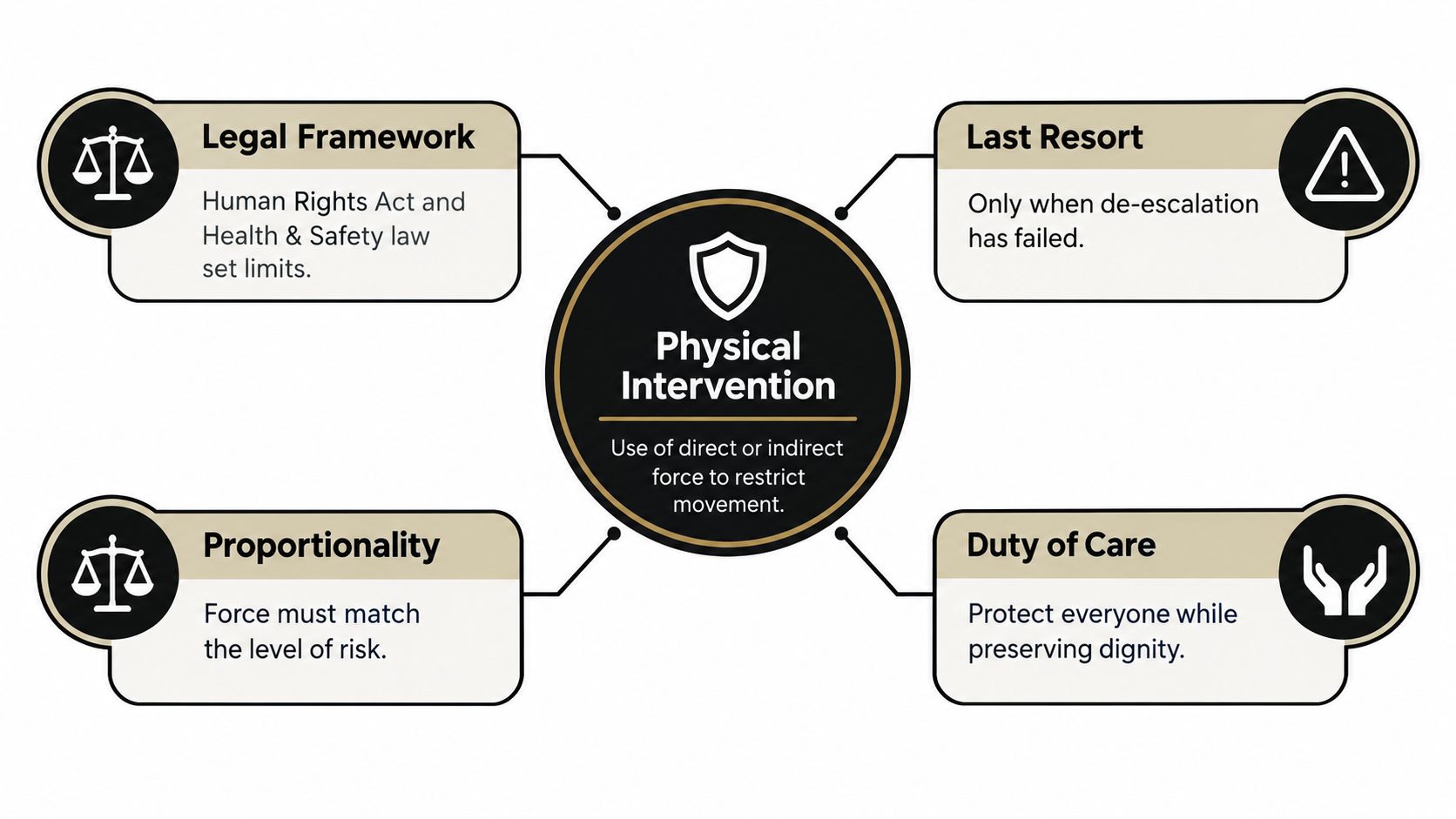
Physical intervention means using direct or indirect force to restrict another person's movement. That can include preventing someone from entering an unsafe area, guiding them away from immediate danger, escorting them, or using an approved restrictive method when there's a serious and immediate risk.
Not every form of physical contact is physical intervention. Helping someone stand, supporting a transfer, assisting with personal care or offering an arm for balance normally forms part of routine care. The difference is the purpose and effect of the contact. If the contact limits a person's movement against their wishes, staff must treat it as a restrictive action and follow the organisation's policy.
Four questions before force
The legal and ethical boundary becomes clearer when staff ask four practical questions:
- What is the immediate risk? Staff should identify the harm they're trying to prevent, rather than intervening because behaviour is loud, inconvenient or non-compliant.
- Have safer alternatives been tried or considered? Space, communication, environmental changes and support from colleagues may resolve the situation without force.
- Is the response proportionate? The action must match the seriousness and immediacy of the risk. More restrictive action requires stronger justification.
- Can the intervention stop now? Once the relevant risk has reduced, continuing to restrict movement may no longer be defensible.
The Human Rights Act, Mental Capacity Act and common law principles of necessity and proportionality form part of the legal context that organisations and training providers must consider. Staff also need to follow local safeguarding procedures, care plans and incident-reporting requirements. A useful introduction to decision-making around capacity is Mental Capacity Act training, but no online course replaces an employer's policy or professional advice for a specific incident.
Last resort does not mean no duty of care
Calling physical intervention a last resort doesn't mean staff should ignore a serious risk. A person may be about to strike another resident, run into traffic or harm themselves. Staff have responsibilities towards everyone present, including the person whose movement is restricted.
The decision still has to be necessary and limited. Force must never be used as punishment, retaliation or a way to secure obedience. Staff should use the least force that can manage the immediate risk, communicate throughout the event and arrange appropriate follow-up afterwards.
Employers should make these boundaries easy to understand. A compliant course should explain what the law permits, what organisational policy requires and what actions are prohibited. It should also make clear that the regulator's minimum standard doesn't remove the employer's responsibility to assess local risks and prepare staff for them.
Core Components of Accredited Training Courses
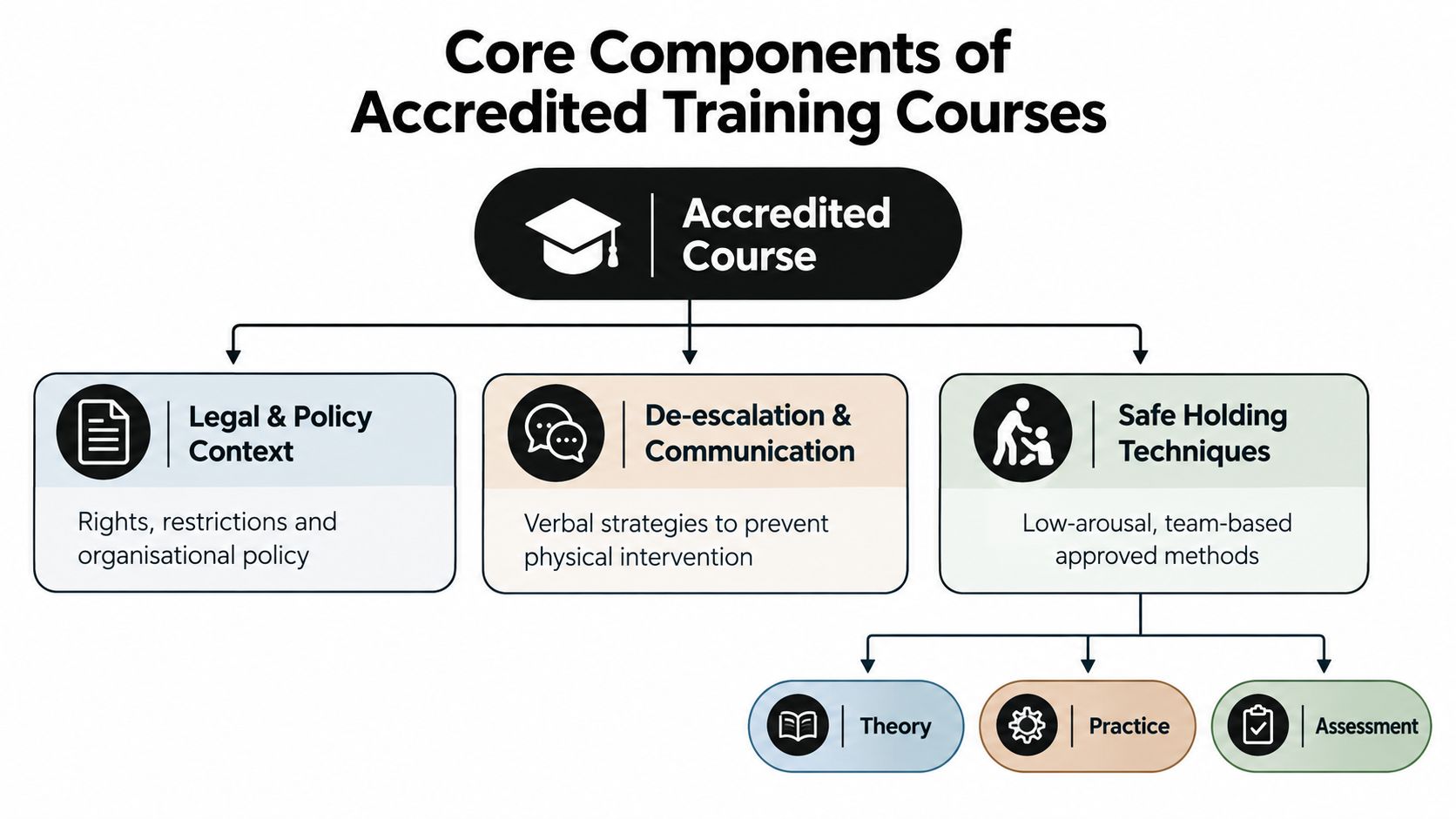
A credible course connects legal knowledge, prevention, practical skills and assessment. Learners should understand the reason for each action, the risk it addresses and the steps that follow physical contact. Techniques taught without that context can leave staff confident in a method but uncertain about whether to use it.
For licence-linked security roles, UK specifications require providers to be approved by an SIA-endorsed awarding organisation. The curriculum must cover non-pain-related personal safety and escorting techniques, with specific risk content such as positional asphyxia. The SIA describes these requirements as a minimum. Employers must add training when their own risk assessment identifies further needs (SIA physical intervention specification).
What learners should practise
A useful syllabus links these areas rather than teaching them as separate boxes:
- Legal and policy context: necessity, proportionality, safeguarding, reporting duties and the limits of the worker's role.
- Personal safety: non-pain-related breakaway and disengagement skills that help staff create distance from grabs or unsafe contact.
- Escorting: approved methods for moving a person away from danger without unnecessary pressure or humiliation.
- Dynamic risk assessment: recognising changing assault risks, reviewing options, deciding whether intervention is justified and identifying when help is needed.
- Team coordination: agreeing who leads, who communicates and who calls for support, so several workers do not give competing instructions.
- Monitoring and aftercare: safety checks, release decisions, medical escalation, reporting and debriefing.
Training should turn policy language into observable decisions. A worker may know that risk must be reassessed, yet still miss a change in breathing, posture, resistance or the surrounding environment during a stressful event. Practice scenarios, supervised feedback and clear stop points help close that gap.
The SIA guidance expects risk to be reassessed during and after an intervention. It also requires immediate airway, breathing and circulation checks when restraint has been applied. These details show whether a learner can act safely, rather than merely repeat terminology.
From accreditation to workplace readiness
The same certificate can prepare people for different risks. A security course may focus on assault in public spaces, while a care employer may need further preparation for dementia, learning disability, mental health, medication, mobility limitations, communication differences or known trauma.
Trainer background affects learning confidence. Staff may engage differently depending on whether the trainer understands care work, security work, disability or trauma-informed practice. A respectful trainer explains why a technique is taught, avoids treating distress as misconduct and makes room for questions without lowering safety standards. That approach helps learners connect formal guidance with the person in front of them.
Employers should compare the syllabus with the workplace risk assessment. Check the approving body, awarding organisation, assessment method, realistic practice, and arrangements for medical or individual support needs. A video can reinforce concepts, but supervised assessment is needed to show whether a learner can recognise changing risk and work safely with colleagues.
De-escalation and Alternatives to Restraint
A resident begins pacing, repeating the same question and speaking louder after a routine change. The policy may describe de-escalation, but it cannot predict which response will reduce this person's distress in that moment. Staff need to read the situation, recognise rising arousal and act before physical contact becomes likely.
Physical intervention training therefore starts with prevention. Pain, fear, confusion, sensory overload, unfamiliar staff, a changed routine or a threatening interaction may all influence behaviour. The cause may not be immediately clear, but repeated questioning, withdrawal, refusal, clenched hands and rapid changes in breathing can show that the current approach is no longer working. These signs do not prove that violence will follow. They indicate a need to adjust the environment and communication.
A worker could lower the noise, move spectators away, offer a familiar object, reduce their speaking volume or allow more time for an answer. Another worker might check the care plan or ask a colleague who understands the person's communication preferences. The practical judgement lies in choosing the least intrusive helpful change, then checking whether the person is becoming calmer.
Trauma-informed practice also affects how confidently staff apply this learning. Distress should not be treated as deliberate misconduct. Staff can use respectful language, avoid crowding, explain each action and offer choices where doing so remains safe. One clear speaker is often easier to process than several people giving instructions. Trainers who understand care work, disability, trauma and the experiences of the people being supported can make these decisions easier to discuss. Their background and communication style may influence whether new or agency staff feel able to ask questions, disclose uncertainty and practise without shame.
Turning guidance into practical judgement
A useful exercise presents a changing scenario rather than a fixed technique. Learners decide what they notice, which environmental change they would try, when to call a colleague and what would make them stop or reconsider. The de-escalation techniques resource offers communication ideas, but practice should reflect the people, staffing patterns and pressures of the learner's workplace.
Scotland's official review found that training uptake was substantial but uneven. 80% of local authorities said training was available to all staff who wished to undertake it, and 70% reported that staff training had been undertaken to support implementation (Scottish Government review).
Among authorities reporting training, all reported de-escalation training, while 86% reported ASN-related training, 76% recording training and 71% restraint training. 73% identified an ongoing need for further professional learning, showing why an initial course should lead to supervised practice, reflection and updates rather than mark the end of development.
After a crisis, staff may need to recognise a medical emergency. If a person is unresponsive but breathing, consult this unresponsive but breathing first aid guidance and follow workplace emergency procedures. Physical intervention training and first aid have different purposes, yet both depend on calm observation and timely action.
Real-Time Safety Monitoring and Injury Prevention
A person is being held after reaching towards another resident. The movement stops, but the situation has not become automatically safe. Their breathing may change, their colour may fade, or their posture may place pressure on a vulnerable area. Physical intervention training must therefore teach staff to recognise changing risk while an action is happening, not only recall a technique from the training room.
Policy guidance gives the boundary: use the least force necessary, avoid pressure on the chest, stomach and neck, check breathing through an ABC assessment, and release the person at the earliest safe opportunity. Staff should continue speaking to the person during the intervention (reducing risk in physical intervention). Those instructions are clear at policy level. In practice, learners need to connect them to visible signs such as altered responsiveness, unusual breathing, colour change, exhaustion, panic or increasing resistance.
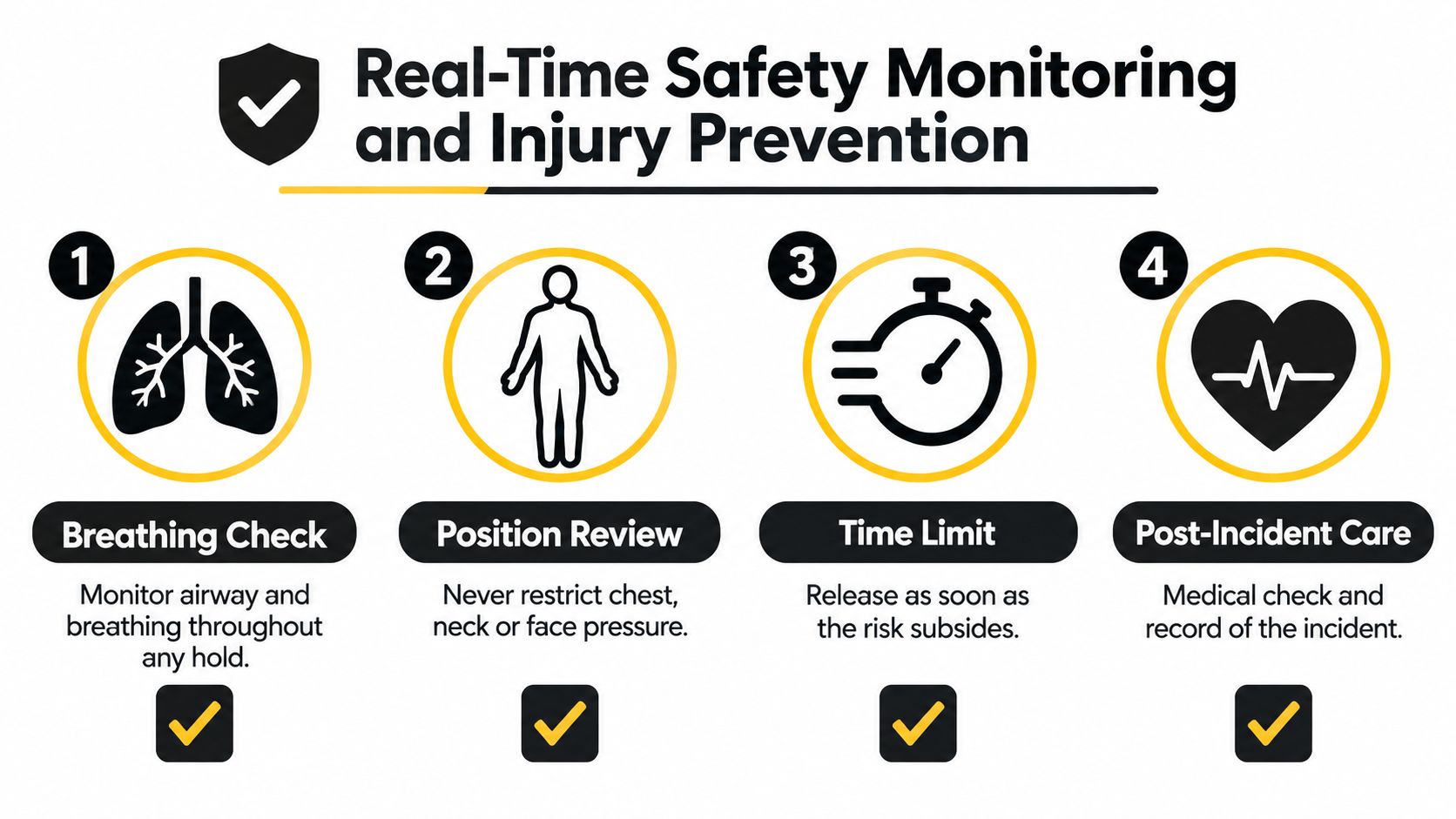
During an approved intervention, one staff member should lead communication while others observe and report concerns. The team needs to keep testing four practical questions: can the person breathe freely, is their position creating pressure, does an immediate risk still exist, and can contact end now? Staff should also notice whether the person needs first aid, medical assessment, reassurance or further observation after release.
That monitoring is active, not a form completed afterwards. If the person becomes unresponsive, develops a breathing problem or shows another medical concern, staff must follow emergency procedures and seek urgent help. A calm voice can support observation, but it cannot replace checking the person's physical condition.
Release deserves equal attention in assessment. A learner may know how to establish a hold yet hesitate when the reason for intervention has changed. Trainers should rehearse moments where the person stops reaching towards another resident, the hazard is removed, or other residents have moved to safety. The person may remain distressed or vocal, while the immediate danger has reduced enough for contact to end.
The difference between a policy statement and safe practice is often a few seconds of recognition. Trainers can build confidence by explaining why each observation matters, using trauma-informed language, allowing questions, and avoiding scenarios that make fear or past experiences harder to disclose. Trainer demographics and personal experience can also influence whether learners see their concerns reflected in the room. A respectful learning environment helps staff speak up when a position, sign or instruction feels unsafe.
The safest technique is one staff can monitor, reduce and stop without delay.
Injury prevention also includes routine work. Care workers move, support and reposition people throughout a shift, so employers should address musculoskeletal risks with resources such as this workstation ergonomics guide. That guidance does not replace intervention training. It supports a wider safety culture that protects staff as well as the people receiving care.
Sector Differences and the Impact of Trainer Background
A secure hospital, a special educational needs setting, a residential care home and a domiciliary visit don't present the same risks. In a hospital, staff may work within a clinical escalation pathway. In education, the focus may include communication with families and consistency across classrooms. In adult social care, workers may support people with dementia, sensory needs, mobility restrictions or long-term trauma. Domiciliary staff may work alone, with limited space and no immediate colleague beside them.
A generic course can introduce useful principles, but staff need to test those principles against the environments where they'll use them. A trainer should ask about doorways, furniture, staffing levels, alarm systems, care plans, lone working and post-incident support. Without that context, learners may remember a movement but not know whether it's appropriate for the person or setting in front of them.
Who stands at the front of the room
Trainer background affects more than presentation style. It can shape which scenarios feel realistic, which risks receive attention and whether learners feel their concerns are understood. Research into UK restraint training found that 71% of trainer respondents were male, while 80.4% worked in health and 19.6% in adult social care (research on gender and restraint training).
Those figures don't prove that one trainer profile produces poor learning. They do raise a useful question for employers: does the training team reflect the workforce and the people being supported? An adult social care worker may reasonably want examples involving personal care, frailty, cultural dignity, communication impairment and the emotional impact of restraint, rather than scenarios designed mainly around security or hospital environments.
Confidence needs psychological safety
Trauma-informed teaching gives learners room to discuss fear, previous experiences and uncertainty without being shamed. It avoids presenting people in distress as problems to be defeated. It also explains how staff can preserve dignity while responding to genuine danger.
Employers should ask providers:
- Sector fit: Have the trainers worked in settings similar to yours?
- Representation: Does the teaching team offer varied perspectives and understand different learner experiences?
- Scenario quality: Do exercises reflect real care plans, environments and communication needs?
- Feedback culture: Can learners question a technique or raise a safety concern without being dismissed?
- Ongoing competence: Does the provider help managers identify gaps after training?
Trainers also need their own professional development. People exploring trainer career growth tips may find broader guidance on building teaching capability, but care employers should still verify specialist experience in restrictive practice, safeguarding and the relevant sector.
Recording Competence for Employer Compliance
A certificate is one part of a competence record. Employers need to show who completed the course, what the course covered, whether practical skills were assessed and how the learning relates to identified workplace risks. Workers need to keep their own evidence organised, especially when moving between care homes, agencies and bank roles.
For security roles, physical intervention became formally embedded in SIA licence-linked training reforms. The regulator states that door supervisors must complete a Physical Intervention Skills module, and from 1 October 2021, applicants need one of the new qualifications or top-up training before applying for a door supervisor or security guard licence (SIA licence-linked training changes). The same reform increased the Security Guarding course from 30 hours over 4 days to 38 hours over 5 days, demonstrating that minimum training requirements can expand when role risks are reviewed.
Build a usable training record
A practical record should include:
- Course identity: Record the provider, course title, awarding or approval route and completion date.
- Learner evidence: Keep the certificate, assessment outcome and any reasonable-adjustment record.
- Risk alignment: Note which workplace risk assessment, policy or role requirement the course supports.
- Refresh planning: Set a review date based on employer policy, role risk, skills confidence and changes in guidance.
- Incident learning: Record debrief outcomes, identified gaps and any additional supervision or training.
- Access control: Store evidence securely so managers, auditors and agency compliance teams can verify it without exposing unnecessary personal information.
A training matrix template can help organisations track mandatory learning across permanent, bank and agency teams. The matrix should distinguish attendance from competence. Someone who completed a course may still need observation, supervised practice or role-specific instruction before working independently.
Employers also need to remember that regulatory minimums don't replace a local risk assessment. A care home may need additional learning on lone working, mobility support or communication needs. A domiciliary provider may need a clear escalation route when a worker can't safely manage an incident alone. Recording those decisions shows that training is connected to real duties rather than collected as paperwork.
For workers, the strongest compliance profile combines current certificates with clear role evidence, honest disclosure of gaps and a willingness to refresh skills. That approach supports safer shifts and gives employers a more reliable basis for deciding whether someone is ready to work.
Cura Academy provides structured online health and social care training, including mandatory learning, core skills, specialist courses and refreshers for care workers and organisations. If you're building a job-ready compliance record alongside physical intervention training, visit Cura Academy to review the available learning pathways.