
Information governance training is an annual mandatory requirement in UK health and social care, with NHS guidance setting a 95% completion and test-pass target for staff, including new starters, locums, temporary workers and students. It supports professional competence and Care Certificate readiness, but passing the annual check doesn't automatically mean someone will make a safe information decision during a busy shift.
A support worker may be preparing medication, answering a relative's question and receiving a handover at the same time. A colleague asks for a service user's address, a GP requests an update, or a paper note is left beside a shared printer. These moments don't feel like formal compliance exercises, yet they test information governance more accurately than a quiz does.
Good training helps staff move from remembering rules to applying them. The practical question isn't only, “Have I completed my course?” It's also, “Do I know what to do with this information, right now, for this person, in this setting?”
Table of Contents
- Why Information Governance Training Matters for Care Workers
- Core Components of Information Governance Training
- Key Legal Frameworks and Standards
- Training Requirements Across Different Care Roles
- Real-World Examples of Information Governance in Action
- Achieving Compliance and Job Readiness
Why Information Governance Training Matters for Care Workers
A care assistant starts a morning shift by reading a service user's care plan, checking medication information and receiving a verbal handover from the night team. Later, a family member asks whether the service user has been unwell, a district nurse calls for an update, and a colleague needs access to the digital record. Each exchange involves personal information, and each one requires judgement about confidentiality, identity, purpose and authority.
Information governance, or IG, gives staff a safe way to make those decisions. NHS England describes it as a framework for using information legally and ethically while keeping it safe, secure, available, up to date and accurate. That definition matters because care depends on information being both protected and usable. Locking every record away would prevent safe care just as surely as leaving records open to anyone.

The annual requirement has a practical purpose
In England, NHS organisations aligned with the National Data Guardian data security standards are expected to train staff annually. Evidence item 3.2.1 sets a 95% target for all staff, including new starters, locums, temporary staff and students, to complete annual Data Security Awareness Training and pass a mandatory test, as described in guidance on information governance and GDPR training.
That requirement makes IG part of workforce readiness rather than an optional professional-development topic. It also recognises that people forget, roles change and working environments introduce new risks. A worker who completed induction months ago may now use a different record system, support a different client group or work across several locations.
Practical rule: Treat the annual course as a checkpoint, not proof that every real-life decision is safe.
Passing isn't the same as applying
A multiple-choice test can check whether someone recognises a secure password or knows that confidential information needs protection. It can't fully test how that person responds when a distressed relative demands details, a colleague asks for information outside their role, or a paper record goes missing.
Supervisors should turn course knowledge into short workplace conversations. Ask staff to explain what they would do, who they would contact and what they would document. That approach respects the pressure of frontline work while making competence visible in the situations where it matters.
Core Components of Information Governance Training
A relative asks for an update while you are helping a service user, a colleague leaves a record open, and a professional requests information by phone. The safe response depends on more than remembering a policy. Training must connect information governance to the decisions staff make during a busy shift.
The Information Commissioner's Office guidance on training programmes says all-staff programmes should cover national and sector-specific requirements, including information requests, data sharing, information security, personal data breaches and records management.
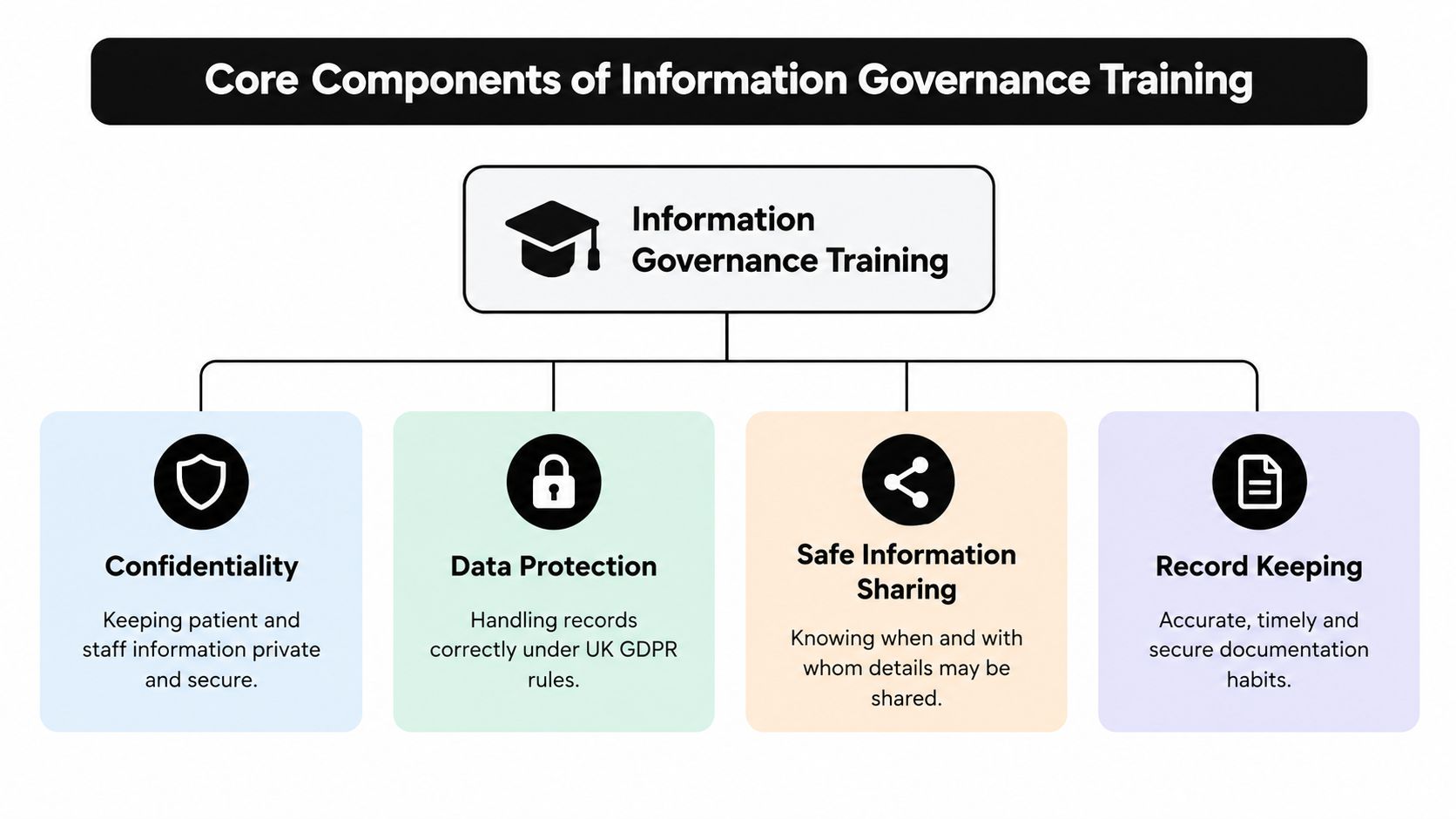
Confidentiality starts with everyday behaviour
Staff need to know who is entitled to receive information and how to prevent accidental disclosure. They should check a caller's identity, avoid conversations in public areas, position screens away from visitors and avoid discussing service users in lifts, corridors or social settings.
Confidentiality breaches can happen without deliberate gossip. An exposed handover sheet, a message sent to the wrong recipient or an unattended workstation can disclose information during ordinary work.
The Caldicott principles and their role in care provide a practical decision-making lens. Before sharing, ask whether the information is needed, whether the recipient has a legitimate reason and whether a safer, less detailed alternative would meet the purpose.
Data protection requires context
Training should show how staff handle personal and special-category information under UK data protection requirements. Frontline workers do not need to memorise every legal provision. They do need to understand lawful handling, data minimisation, accuracy, secure storage and the correct escalation route.
Use a record-based exercise. Ask learners what should be collected, what needs correcting and what must not be copied into an informal message. The discussion should include the reason for each choice, because passing a knowledge check does not prove that a worker will make the same decision under pressure.
Safe sharing protects care as well as privacy
Sharing information is sometimes necessary for safe care. A nurse, GP, social worker or authorised colleague may need relevant details. Problems arise when staff share too much, disclose information to the wrong person, use an unsafe channel or fail to check the purpose.
Training should include requests from relatives, professionals, police, social media contacts and unknown callers. Learners can practise pausing, verifying the request and seeking advice instead of answering immediately.
Records must be accurate and secure
Good record keeping means writing clear, factual and timely notes, correcting errors through the approved process and storing records according to workplace procedures. Records may guide future care and could later be reviewed following a request or investigation.
Incident awareness completes the training. Workers need a simple route for reporting lost paperwork, misdirected emails, unauthorised access and other concerns. Early reporting helps the organisation contain the problem and support affected people.
Refresh training and reassess staff who routinely access personal information. A course certificate proves completion. Observed behaviour, discussion and incident learning show whether the knowledge has become practice.
Key Legal Frameworks and Standards
Information governance sits across several overlapping duties. Staff often encounter these as separate labels, including GDPR, the Data Protection Act, confidentiality, Caldicott principles and the Care Certificate. In practice, they work together to answer three questions: what information is being handled, why is it needed, and how should it be protected?
GDPR and the Data Protection Act
UK data protection law governs how organisations collect, use, store and share personal information. In care, that information can include health details, medication records, contact information and assessments. The law supports principles such as fairness, transparency, purpose limitation, data minimisation, accuracy, security and accountability.
For a frontline worker, these principles translate into practical conduct. Read only what you need for the task, don't copy information into personal apps, challenge unclear requests and report suspected breaches promptly. If a record is wrong, follow the approved correction process rather than hiding the mistake or creating an unofficial version.
The Data Protection Act works alongside the UK GDPR framework and includes provisions relevant to personal information and public functions. Training should avoid presenting these laws as distant legal theory. A worker needs to understand the behaviour expected at the point of access, documentation and disclosure.
Confidentiality and lawful sharing
Confidentiality is a professional and ethical responsibility, not merely a password issue. A person may have a lawful basis to handle information but still share more detail than the situation requires. Consent can be important, yet staff shouldn't assume that consent is the only route for appropriate care-related sharing. Organisational policy and advice from a manager, information governance lead or data protection officer should guide uncertain cases.
The plain-language explanation in confidentiality and data protection guidance for care workers is useful because it connects privacy with everyday conduct. Training should leave workers able to explain why a decision was made, not just repeat that “GDPR says no”.
Care Certificate expectations
The Care Certificate gives new care workers a structured foundation for safe and effective practice. Information handling supports several aspects of that foundation, including communication, duty of care, privacy, dignity, safeguarding and accurate records. An employee who can't protect or use information appropriately may struggle to demonstrate wider workplace competence.
NHS England states that staff with access to personal data must complete appropriate data security and protection induction. Its free Data Security Awareness Level 1 course is available through ESR and the e-learning for health hub, and is suitable for health and care staff. This creates a practical baseline for induction, while employers still need to address local systems, policies and role-specific risks.
The Digital Care Hub also provides free e-learning for adult social care providers in England. It says its staff course is designed specifically for social care staff and meets training requirements within the Data Security and Protection Toolkit, as explained in its adult social care digital learning information.
Compliance therefore involves more than ticking a module complete. Organisations need reliable records, timely induction, accessible refresher learning and evidence that staff understand how to use information safely in their actual role.
Training Requirements Across Different Care Roles
A single annual training check cannot prepare every care worker for the decisions made during a busy shift. Everyone who handles personal information needs the same basic principles, but the practical risks differ. A support worker may need to protect confidentiality during handovers, while a registered manager must also oversee access, escalation, assurance and improvement.
| Role | Primary IG Focus | Typical Training Content |
|---|---|---|
| Care assistant or support worker | Confidentiality during direct care | Secure conversations, care notes, identity checks, authorised sharing and reporting concerns |
| Nurse or clinician | Accurate clinical information exchange | Record accuracy, professional communication, referrals, results and safe sharing with the wider care team |
| Administrator or receptionist | Controlled access and requests | Verifying callers, managing correspondence, subject access requests, secure filing and disposal |
| Agency or bank worker | Rapid orientation to local procedures | Access permissions, local reporting routes, system use, confidentiality and limits of role |
| Supervisor or team leader | Applying and reinforcing standards | Induction checks, coaching, incident escalation, audit evidence and role-based refreshers |
| Registered manager or information governance lead | Organisational accountability | Training plans, risk management, policy implementation, breach response and assurance reporting |
What every worker should be able to do
A baseline course should cover recognition of personal and confidential information, secure credentials, approved systems and incident reporting. Staff also need the local route for advice. Knowing the rule is not enough if a worker cannot identify the right person to contact when a concern arises.
Role-specific learning should then test ordinary care decisions. Staff can practise checking identity before sharing information, recording only what the care record requires, using approved communication channels and stopping when authority is unclear. These exercises expose whether someone can apply the principle under pressure, rather than just recall a definition in an annual quiz.
The ICO's audit findings show why training design matters. 70% of UK multi-academy trusts audited didn't include all core topics in induction or refresher training, 40% lacked sector-specific tailoring, and 60% had no documented training plan or clear delivery timescales and resources, according to the ICO audit outcome report.
Managers need evidence, not attendance alone
Managers should map learning to job tasks, give agency and temporary workers a practical briefing, and confirm that new starters complete induction promptly. The same audit found that in 60% of organisations, IG induction wasn't completed within one month of starting and no minimum pass rate was set.
A certificate may show completion while unsafe habits continue. Managers need evidence from supervision questions, spot checks, incident reviews and staff feedback. They should also revisit training after a near miss or system change, because applying IG well depends on current routines, clear escalation and confidence to pause before sharing information.
Real-World Examples of Information Governance in Action
A support worker receives a telephone call from someone claiming to be a service user's relative. The caller knows the person's name and asks whether they attended hospital. A hurried worker may answer to appear helpful, but a trained worker pauses, checks identity and follows the organisation's procedure before disclosing anything.
That response protects confidentiality without treating the caller as suspicious or dismissing their concern. The worker can explain that information can't be released until the request and authority have been checked, then escalate the call appropriately.

A record left in the wrong place
At the end of a shift, a care worker notices printed notes on a shared desk. They contain enough detail to identify a service user and describe their care needs. The right response isn't to put the papers away and forget the incident. The worker should secure the information, notify the responsible person and record the concern through the organisation's reporting route.
Here, training exposes the difference between awareness and competence. Awareness recognises that the notes are confidential. Competence adds the next actions, protect the record, report promptly, provide accurate facts and cooperate with follow-up.
Guidance on incident reporting procedures in care settings can help organisations make those steps familiar before an incident occurs.
A message sent to the wrong recipient
A coordinator intends to send a care update to a GP practice but selects a similar-looking address. The mistake is noticed shortly after sending. Staff sometimes hesitate to report this because they fear blame, yet delay can make containment harder.
Training should make the reporting pathway clear and supportive. Workers need to know what information to preserve, who to contact and why they shouldn't delete evidence or attempt an unauthorised fix. Managers can then assess the situation, seek specialist advice and take proportionate action.
The family conversation at the front desk
A relative asks a receptionist for details while other visitors stand nearby. Even when the relative is authorised, the setting may not be suitable for a detailed conversation. The receptionist can move the discussion to a private area, verify the person's identity and share only relevant information.
These scenarios show why role-play works better than generic warnings. Staff practise the pause, the verification step and the escalation route. They also learn that protecting information doesn't mean blocking care. It means sharing deliberately, respectfully and securely.
Achieving Compliance and Job Readiness
Job-ready staff can explain the information they need, protect it during routine work, recognise an unsafe situation and act when something goes wrong. They don't rely on a certificate as their only evidence of competence.
Organisations should maintain a documented annual training cycle, include permanent and non-permanent workers, provide appropriate induction and tailor examples to each role. They should also use supervision and incident learning to test whether staff apply the principles after the course has ended.
NHS guidance sets a 95% annual completion and test-pass benchmark, while the ICO findings show that timing, coverage and role-specific design remain practical weaknesses. Meeting the benchmark is necessary, but it isn't the finish line. The stronger standard is a workforce that can make safe, proportionate information decisions under pressure.
For individual workers, the next step is simple: complete the required learning, read your local confidentiality and breach procedures, ask questions during supervision and pause before sharing information when authority or purpose isn't clear.
Cura Academy helps health and social care workers become compliant and job-ready through accessible mandatory training, Care Certificate learning and role-specific courses in one place. Visit Cura Academy to organise your information governance learning, keep essential refreshers current and build a clearer route into compliant frontline work.