

You've arrived for a night shift in a care home, your uniform is ready, your handover notes are open, and you're wondering whether a strong coffee will carry you through until morning. At 3 am, that plan usually meets reality. The corridors are quiet, staffing may be leaner, residents can deteriorate without much warning, and tiredness affects judgement long before you feel unable to continue.
Knowing how to prepare for a night shift means preparing more than your sleep. You need a realistic recovery plan, suitable food and equipment, a reliable handover routine, safe travel arrangements, and current training that allows you to respond confidently when senior colleagues aren't immediately available. In UK care work, personal fatigue is also a workplace safety issue.
Table of Contents
- The Reality of Night Shifts in UK Care
- Structuring Your Sleep and Nutrition Before Clocking In
- Packing for Clinical and Safeguarding Readiness
- Mastering the Handover and First Hour Checks
- Managing Fatigue and Commute Safety During the Shift
- Accelerating Onboarding with Compliant Training
The Reality of Night Shifts in UK Care
At 3 am, a care worker may be checking a resident who has become unusually restless, responding to a call bell, supporting someone to the toilet, recording fluid intake, or escalating a change in breathing. Each task may look routine on paper. The difficulty is that night staffing often gives you less room for delay, fewer people to cross-check your observations with, and a greater need to recognise subtle changes early.
That's why night work shouldn't be treated as an ordinary shift with different hours. The Health and Safety Executive formally treats night work as a workplace hazard. Its guidance says employers must assess the risks of shift work and offer a free health assessment to anyone about to start working nights, as well as to regular night workers. The same HSE guidance on managing shift work explains that the body clock makes night workers more likely to experience sleep loss, poor-quality sleep and fatigue.
Willpower isn't a fatigue-management system. Energy drinks may make you feel more stimulated for a while, but they don't replace protected sleep, a safe shift pattern or a proper break. If you're relying on increasingly strong caffeine to complete every night, the problem may be your rota or recovery time rather than your motivation.
The compliance reality
UK working-time expectations give employers and workers a framework for managing this risk. The Royal College of Nursing notes that a night worker's average working time must not exceed eight hours in a 24-hour period, measured over a 17-week reference period, as explained in the HSE material linked above. The practical message is straightforward. You need enough time to recover, and accepting repeated overtime can undermine both your safety and the quality of care you provide.
The Care Quality Commission's expectations around safe, effective care also make preparation a professional responsibility, not merely a personal preference. A worker who arrives exhausted, misses a change in presentation and leaves incomplete records has created risk for a resident, colleagues and themselves.
Practical rule: Protecting your sleep is part of protecting the people you support.
Before your first night, ask about the planned break, staffing level, escalation route, lone-working arrangements and the timing of the next shift. If the rota gives you inadequate recovery, raise it early with your manager. A safe night begins before you enter the building.
Structuring Your Sleep and Nutrition Before Clocking In
Arriving for a night shift after broken daytime sleep can leave you slow to notice changes in a resident's presentation. Set up a repeatable sleep window before you focus on food. Daylight, household noise and interruptions make daytime sleep easier to disturb, so treat it as protected recovery rather than spare time.
Use the hours before work deliberately:
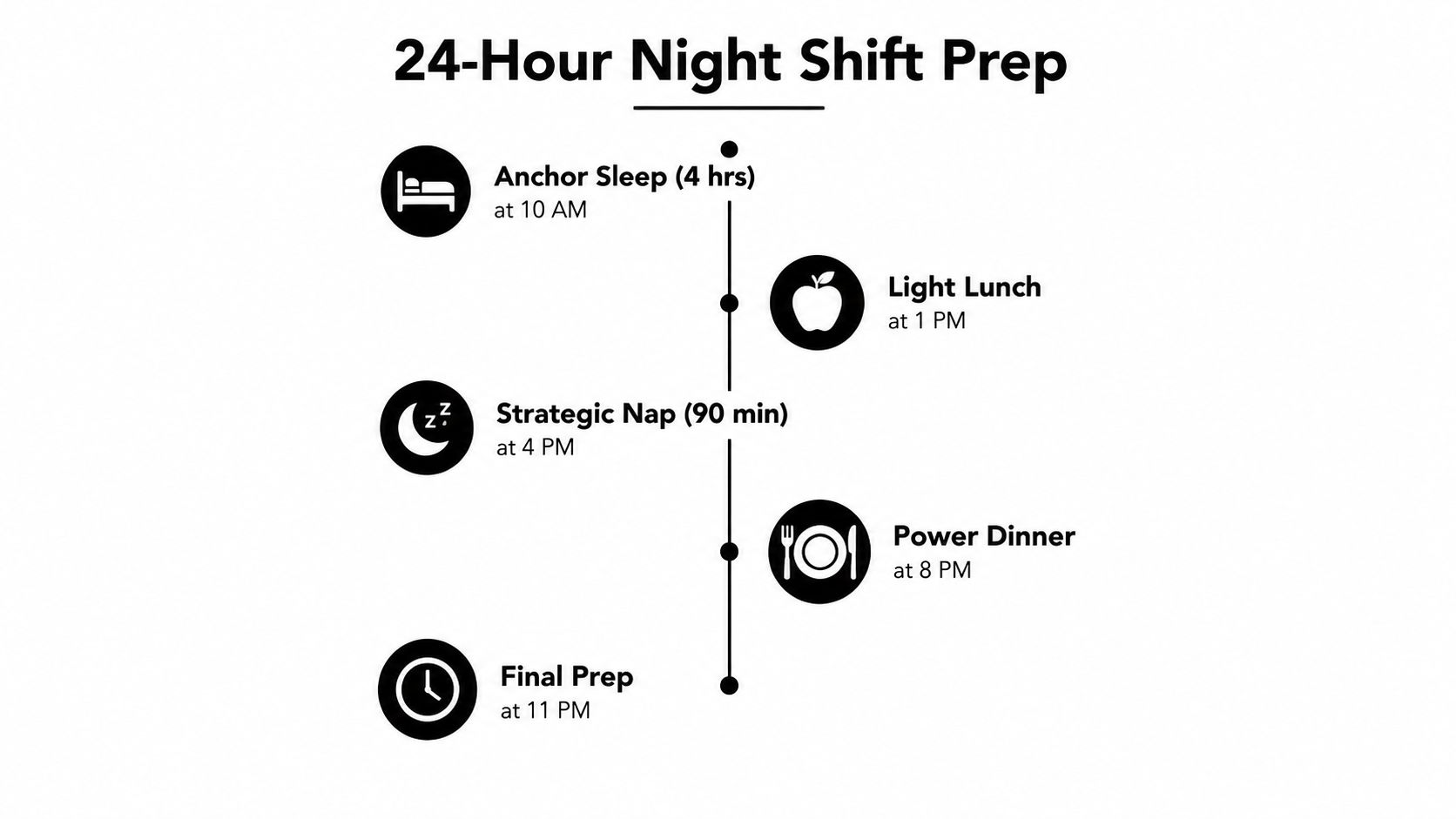
- Morning recovery: After the previous night, travel home calmly and go straight to bed where possible. Keep the bedroom cool, dark and quiet. Tell household members when you are sleeping, silence phone notifications, and use an eye mask or earplugs if they help.
- Midday anchor: If you wake naturally, eat a light meal and keep demanding tasks to a minimum. Save energy for the shift instead of trying to maintain a normal daytime routine.
- Afternoon nap: A planned nap may improve alertness, provided you have time to wake fully before leaving. NHS-linked advice recommends keeping it brief, around 15 to 20 minutes, and no longer than 45 minutes, as summarised by the Society of Occupational Medicine's shift-work advice.
- Pre-shift meal: Eat a balanced main meal before clocking in. Chicken, beans or eggs with brown rice, potatoes or wholegrain bread, plus vegetables, should be easier to sustain through the early hours than a large takeaway or sugary snack.
- During the shift: Pack smaller portions for your allocated break. Yoghurt with fruit, a wholegrain wrap, nuts or soup may be easier to eat and digest than a heavy meal at 3 am.
- After work: If you are hungry, choose something light before bed. Do not use alcohol to force sleep, and limit caffeine late in the shift because it can delay daytime sleep.
Build the rota into your plan
Food cannot compensate for a rota that leaves too little recovery time. UK advice summarised by the Society of Occupational Medicine recommends 11 hours of rest in 24 hours, an average maximum of 48 working hours per week, a 20-minute break for shifts longer than six hours, and an average night shift length of no more than eight hours.
Use these limits when checking your rota, not as targets to stretch. If you repeatedly finish one shift and return before meaningful rest, raise the pattern with your manager. In care work, fatigue can affect observation, judgement, documentation and the quality of handover, so the issue needs addressing before it becomes a safety concern.
For care-specific nutrition and hydration learning, review Cura Academy's nutrition and hydration course. Keep preparation practical. Choose food you can make before a tiring shift, store safely and eat within your allocated break.
Packing for Clinical and Safeguarding Readiness
A new support worker once arrived for a night shift with a full water bottle, a packet of biscuits and a phone at low battery. The bag looked adequate until a resident needed a torch in a dark room, the electronic care-record device needed charging and the worker had to find an emergency contact number quickly. None of those problems was dramatic alone, but together they consumed attention at exactly the wrong time.
Pack for the work you may need to do, not just the work you hope to do. Your employer's policies always take priority, and you must only carry or use equipment that your workplace permits.
A purposeful kit
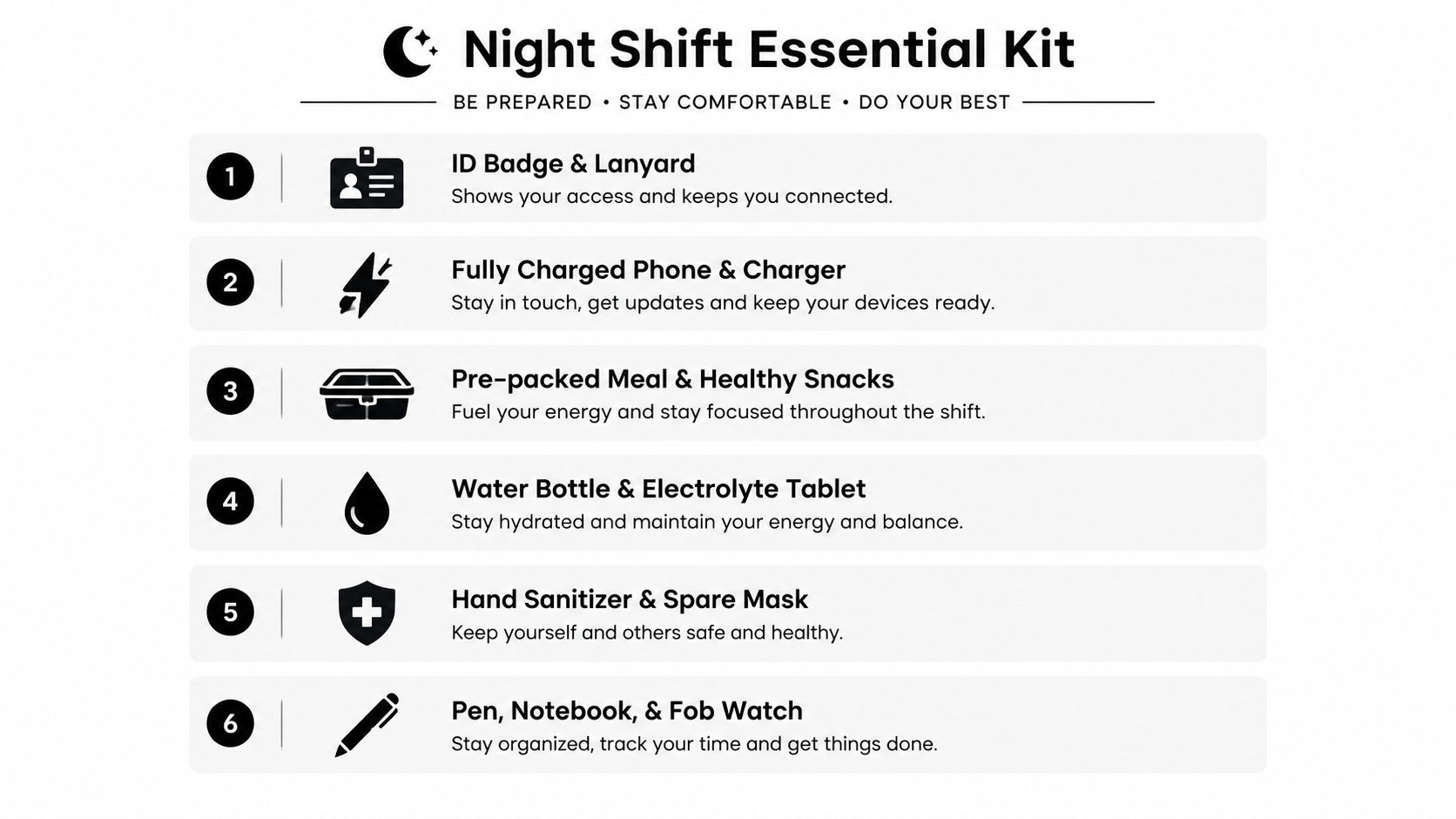
- Identification and access: Take your ID badge, lanyard and any required keys or access fob. Check that your identification is visible and that you know the local process if access fails.
- Light and observation: A small, reliable pen torch can help in dark corridors or during permitted observations. Don't shine it directly into a resident's eyes unless the relevant clinical procedure requires it.
- Communication: Charge your phone, bring the approved charger and check how the service handles emergency communication. Personal phones shouldn't replace the organisation's alarm or escalation process.
- Records: Carry a pen and notebook for temporary prompts, but transfer information into the authorised care record promptly. Don't write identifiable resident information in an unsecured personal notebook.
- Comfort and hydration: Bring water, a prepared meal and snacks that won't create a mess during a short break. Wear suitable footwear and layers so you can move between warmer communal spaces and cooler bedrooms.
- Infection prevention: Follow the service's requirements for hand hygiene, personal protective equipment and spare masks. Carrying extra items is useful only when they're approved and stored correctly.
Safeguarding readiness belongs in the same bag, even though it isn't a physical object. Know who the on-call manager is, where the safeguarding policy is stored, how to report an allegation and what to do if the concern involves a colleague. A disclosure should be listened to calmly, recorded accurately in the person's own words where appropriate, and escalated through the approved route. Don't promise secrecy.
You can refresh the principles through Cura Academy's safeguarding adults training, while still following your employer's local policy and reporting system. Preparation removes the temptation to improvise when the building is quiet and immediate supervision is limited.
Mastering the Handover and First Hour Checks
The first hour often determines whether the rest of the night is organised or reactive. A handover can sound reassuring while leaving out the detail you need. “She's been unsettled” might mean a resident was anxious, in pain, newly confused, short of breath or repeatedly attempting to stand without support. Your job isn't to interrogate the day team. It's to convert general descriptions into safe, observable information.
Start with the service's approved handover format and read the current care plans, risk assessments and communication book. Confirm who is newly admitted, who has changed medication or mobility status, who needs repositioning, who has dietary or continence instructions, and who has an active safeguarding or clinical concern.
Ask for the missing detail
For each higher-risk resident, clarify:
- Baseline: What does normal presentation look and sound like for this person?
- Change: What is different tonight, and when was it first noticed?
- Action: What has already been done, and what response followed?
- Escalation: Who has been contacted, and what should trigger another call?
- Recording: Where has the information been documented?
A good handover also covers practical risks. Ask whether a pressure-relieving mattress is working and set correctly, whether a sensor or call bell has been tested, whether a fluid chart is incomplete, and whether any equipment is awaiting repair. Don't assume that a device is functioning because it's plugged in.
Make the first round a verification exercise
Use the first round to establish a current picture rather than repeating the previous shift's account. Check residents according to the care plan, observe breathing, comfort, position, alertness and environment, and compare what you see with the documented baseline. For someone living with dementia, apparent night-time agitation may reflect their usual pattern, but a new or more intense presentation can also indicate pain, infection, constipation, dehydration or distress.
Protect confidentiality during conversations and documentation. Record facts, actions and outcomes rather than judgemental labels such as “difficult” or “attention-seeking”. If something doesn't fit, seek advice early through the agreed clinical or managerial route.
The principles in this communication in nursing guide apply particularly well at night. Closed-loop communication matters. Repeat back an instruction when the situation is urgent, document who was contacted and record the time and response according to local procedure.
A handover isn't complete because someone has spoken. It's complete when you can explain the resident's current risks, planned care and escalation pathway without relying on memory or assumptions.
Managing Fatigue and Commute Safety During the Shift
Fatigue tends to become most difficult during the quietest part of the night. You may sit down after completing rounds, feel your concentration narrow and then notice that a simple task takes longer than expected. That's the point to use a planned response, not to wait until you're struggling to keep your eyes open.

Use small interventions before performance drops
Keep water available and drink regularly, but don't use excessive fluids as a substitute for rest. Eat the food you packed rather than waiting until you're ravenous. A small, balanced snack during your break is usually easier to manage than a large meal that leaves you sluggish.
Use movement naturally. Walk with purpose during scheduled checks, stretch safely during breaks and avoid remaining in a warm, dim staff room for longer than necessary. Light exposure in the early part of the shift may support alertness, but follow workplace requirements and don't disturb residents unnecessarily.
Caffeine can be useful for some workers, but timing matters. A coffee early in the shift may be less disruptive than one near clocking out. If you need caffeine repeatedly to remain safe, report the fatigue and review your rota, sleep and health rather than escalating the dose.
Fatigue warning: Slower responses, missed details, irritability and repeated checking are work-safety signals, not character flaws.
If you're too tired to complete a safety-critical task reliably, tell the senior on duty. Ask for a brief review of priorities, use your allocated break and follow the organisation's fatigue or incident procedure. Never conceal a near miss because you're worried it will look unprofessional.
The journey home needs its own plan. Night work disrupts the body clock and can create accumulated sleep debt, excessive fatigue and fragmented sleep, as outlined in the TUC night-work research report. Before driving, assess yourself carefully. Heavy eyelids, drifting attention, repeated yawning or difficulty remembering the last part of the route mean you shouldn't just turn up the radio and continue.
If you feel sleepy, stop somewhere safe. Arrange a lift, use public transport, contact someone you trust or take a short nap before making another decision. If commuting after nights repeatedly feels unsafe, discuss alternative arrangements with your employer. The journey is part of the risk assessment, not an afterthought.
Watch this short visual reminder about managing fatigue and recovery before planning your own commute:
Persistent symptoms deserve attention. Parliament's POST briefing on shift work and health states that shift workers experience increased sleepiness during night shifts and poorer daytime sleep, and reports that shift work sleep disorder affects 10 to 30% of shift workers. If you remain excessively sleepy despite protecting sleep, or if fatigue affects driving, clinical review is appropriate.
Accelerating Onboarding with Compliant Training
You can have an excellent sleep routine and still lose access to night shifts if your compliance record is incomplete. Care homes, domiciliary providers and agencies need evidence that workers have the training, checks and role knowledge required for safe practice. Expired mandatory learning can remove you from a rota before your practical ability is even considered.
Treat employability as part of night-shift preparation. Keep a personal record of course completion, renewal dates, DBS information, competency assessments and employer-specific induction. Then check what the organisation requires, because training expectations can vary between residential care, domiciliary care, supported living and agency work.
Make readiness visible
A practical compliance review should include:
- Core learning: Check your Care Certificate standards or equivalent induction evidence, and identify gaps before applying for night work.
- Emergency response: Keep Basic Life Support and other required emergency training current, then confirm whether practical assessment is required by the employer.
- Role-specific knowledge: Dementia awareness, safeguarding, moving and handling, infection prevention and medication-related learning may all affect the work you're permitted to undertake.
- Checks and records: Maintain your Enhanced DBS position and Update Service readiness where relevant, while following the employer's verification process.
- Local competence: Online learning doesn't replace workplace orientation, supervised practice, competency sign-off or knowledge of local escalation procedures.
Cura Academy provides online compliance-focused learning through a £10-per-month subscription, with unlimited access to Care Certificate standards, mandatory refreshers and role-specific courses including Basic Life Support and Dementia Awareness. The platform also supports structured learning pathways and Enhanced DBS and Update Service readiness, giving candidates a single place to organise evidence before employer checks.

Training won't solve an unsafe rota, and a certificate doesn't give permission to perform a task outside your competence. It does remove avoidable onboarding friction and helps you arrive at a night shift with current knowledge, clearer documentation and a stronger understanding of your responsibilities.
Cura Academy offers online Care Certificate standards, mandatory refreshers, Basic Life Support, Dementia Awareness and other care-focused learning through a £10-per-month subscription. Visit Cura Academy to organise your training and compliance preparation before applying for your next night shift.