

You're on an early shift. You walk into a bedroom and find a person half off the bed, clothes wet, dignity gone, and anxiety rising fast. Two colleagues are tied up with other calls, the senior is off-site, and your first instinct is to grab under the arms and “sort it out”.
That's the moment safe lifting is really tested.
Most injuries in care don't happen because someone forgot a textbook phrase. They happen because a worker feels rushed, wants to help, and turns a difficult situation into an improvised lift. If you want to learn how to lift safely in care, start there. Safe lifting is less about strength and more about stopping, assessing, choosing the right method, and knowing when not to proceed.
Table of Contents
- Why Safe Lifting Matters in UK Care Work
- Assessing the Lift Before You Touch the Person
- Body Mechanics That Actually Protect Your Back
- Choosing the Right Transfer Method
- When the Safest Lift Is No Lift at All
- Legal Duties, the Care Certificate and Training Pathways
- Quick Checklists and Next Steps for Safer Shifts
Why Safe Lifting Matters in UK Care Work
That morning-shift scenario is ordinary enough to feel harmless. It isn't. One rushed pull on a shoulder, one twist over a bedrail, one attempt to “just get them up”, and you can injure yourself and the person you're trying to support.
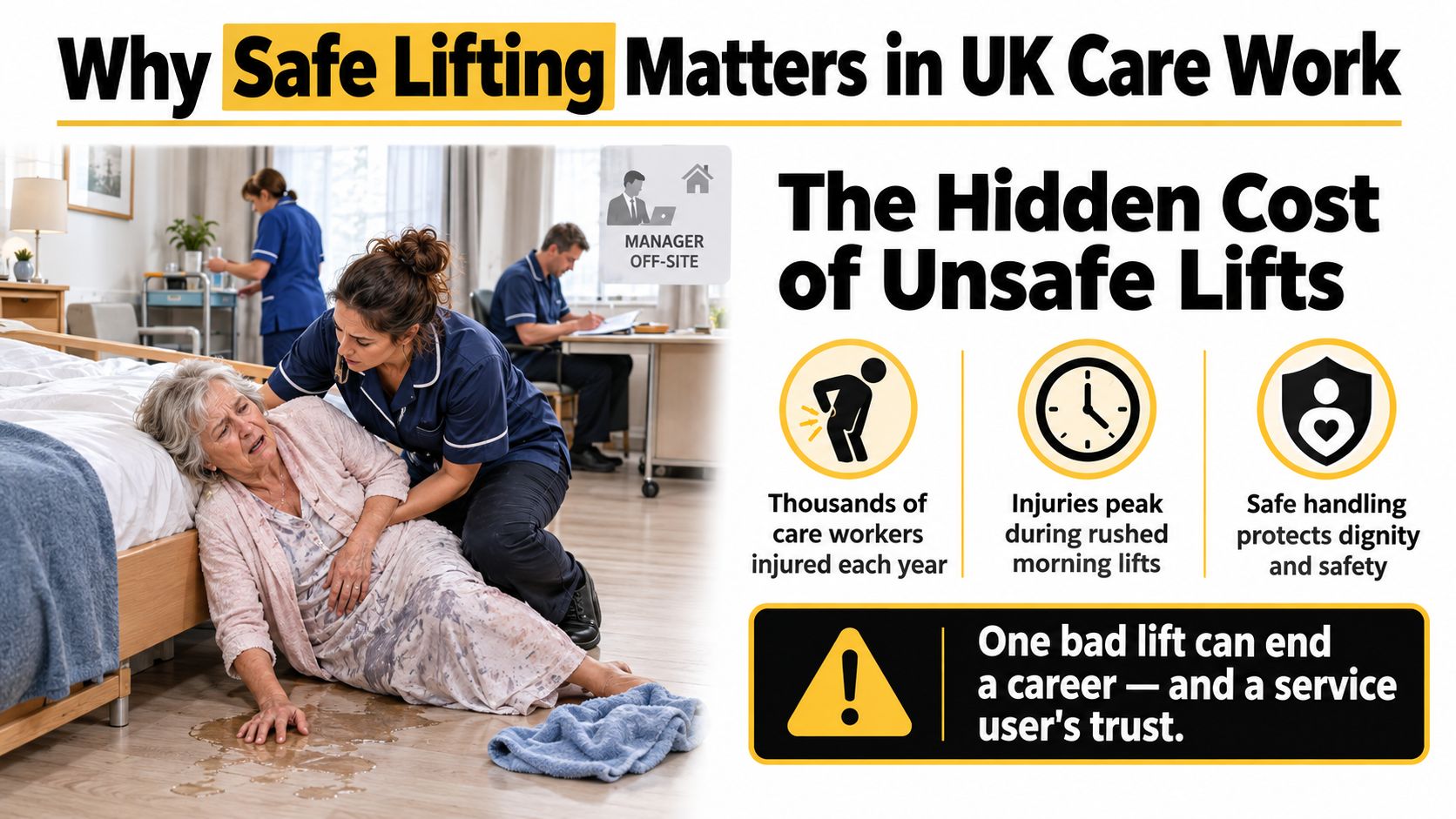
In Great Britain, handling, lifting, or carrying accounts for 17% of all non-fatal workplace injuries, and it is the second most common accident type after slips, trips and falls, according to HSE statistics discussed here. In health and social care, that matters because lifting isn't occasional. It sits inside washing, dressing, repositioning, transfers, falls response, and equipment moves.
Poor lifting harms more than backs
When lifting goes wrong in care, the worker isn't the only one at risk. A poor move can leave a person with skin tears, pain, bruising, fear, or a sudden loss of trust in the staff supporting them. Even when nobody falls, a rough or badly judged transfer can make the next one harder because the person remembers how unsafe it felt.
That links directly to duty of care. Safe moving and handling isn't separate from dignity, consent, or person-centred support. It is part of them. If you need a simple grounding in that wider responsibility, this guide to duty of care is worth reading alongside manual handling practice.
The law treats people as loads too
Under the Manual Handling Operations Regulations 1992, made on 5 November 1992, laid before Parliament on 16 November 1992, and in force from 1 January 1993, manual handling is defined broadly as transporting or supporting a load by hand or bodily force. That includes lifting, lowering, pushing, pulling, carrying and moving. In care, “load” can mean a person as well as an object or animal, and employers must avoid hazardous manual handling where reasonably practicable, assess unavoidable risks, and reduce injury risk as low as reasonably practicable, as set out in the UK regulations.
Practical rule: Safe lifting in care isn't a fitness test. It's professional judgement under legal duty.
The workers who last in care aren't always the strongest. They're the ones who know when to stop, when to fetch equipment, and when to say, “This needs a different plan.”
Assessing the Lift Before You Touch the Person
A good lift starts before your hands make contact. In care, that assessment is usually quick, but it can't be casual. You're not lifting a tidy box with handles. You're dealing with pain, fear, uneven weight, changing ability, clothing, attachments, furniture, and sometimes a room barely big enough to turn in.
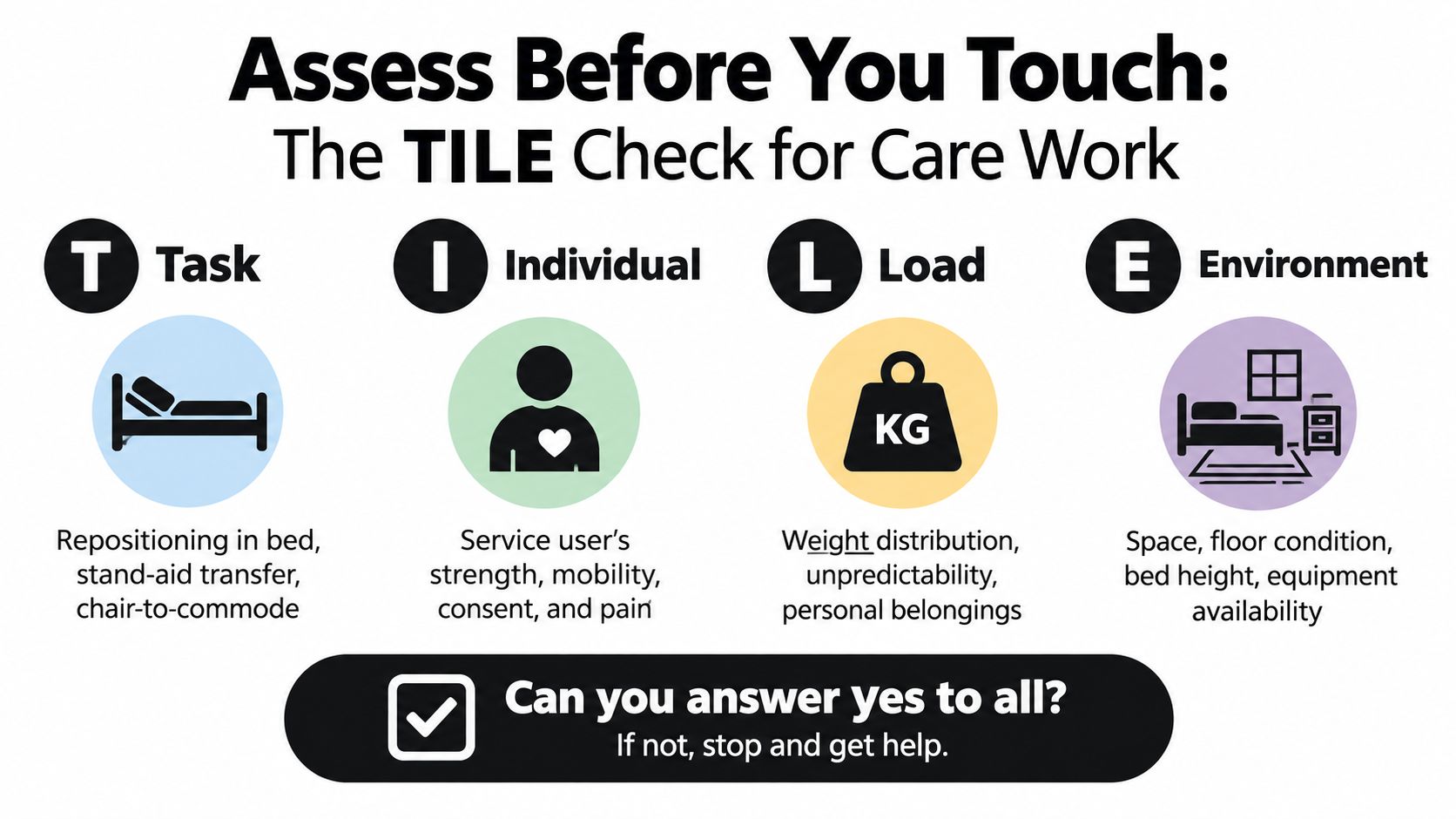
Use TILE like a real-time check
Most carers are taught some version of TILE. It only becomes useful when you apply it to the person in front of you.
-
Task
Are you repositioning in bed, helping with a stand transfer, moving from chair to commode, or responding to a partial fall? These are not the same job. A stand-and-pivot transfer might be fine for one person and completely unsafe for another. -
Individual
Can the person follow instructions? Can they bear weight even briefly? Are they in pain? Are they confused, distressed, or likely to grab at you? Look for catheters, dressings, fragile skin, recent surgery, and fatigue. -
Load
Human loads shift. A person recovering from stroke may collapse to one side. A person with dementia may move suddenly. Someone who says “I can stand” may mean they could stand yesterday. -
Environment
Check bed height, floor condition, clutter, locked brakes, footwear, lighting, and whether the equipment you need is in reach. A narrow ensuite changes the method before you begin.
Ask the questions that change the plan
A proper dynamic risk assessment is not paperwork in the moment. It's your decision point.
Ask yourself:
- Is this a one-person or two-person task
- Do I have the right equipment and do I know how to use it
- If they slump, stumble, or stop weight-bearing, what is my plan
- Is there space to move my own feet without twisting
- Am I about to compensate for missing equipment with my body
The law doesn't give you a fixed legal lifting weight. The HSE is clear that employers must protect workers from hazardous manual handling and that the law does not set fixed weight limits. Risk depends on the task, load, environment, and the worker's capability, which is why assessment matters more than a made-up “safe” number, as explained in the HSE overview of musculoskeletal disorders and manual handling.
If you want to understand how those checks are usually documented and reviewed in care settings, this manual handling assessment guide gives the training context.
If one red flag appears, body mechanics won't rescue a bad decision.
That's the point many new workers miss. Once the assessment tells you the method is wrong, the answer isn't “lift better”. It's “change the plan”.
Body Mechanics That Actually Protect Your Back
Good body mechanics matter. They just don't come first. Once the task is appropriate, the person can participate as expected, and the method is right, then your technique starts doing real protective work.
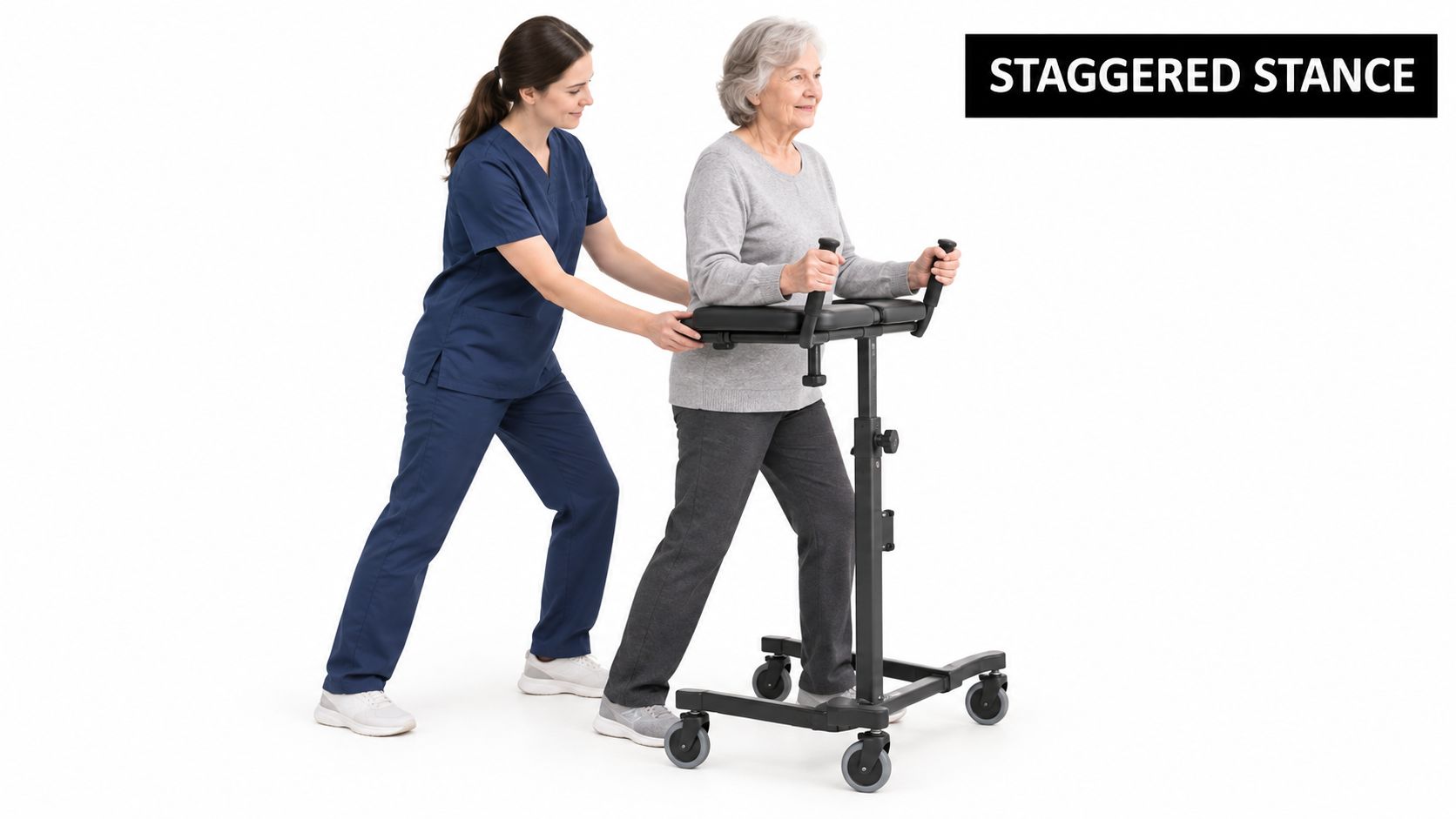
Build a stable base before you move
Start with your feet. Keep them about hip-width apart, with one foot slightly forward if the task needs a forward-backward shift. That staggered stance gives you balance and lets you move with the person instead of reaching for them.
Then organise the working height where you can. Raise or lower the bed if the care plan and equipment allow it. If you bend over a low bed and reach from your shoulders, your back takes the load before the transfer has even started.
The movements that help
A safer lifting sequence follows the HSE-style approach: assess the task, load, environment, and your own capability, then reduce risk by using aids or a colleague, keep the load close, bend the knees, grip securely, and avoid twisting or jerking. The HSE-based guidance also notes that manual handling remains one of the biggest causes of non-fatal workplace injury in Great Britain, accounting for 17% of such cases, and stresses stop, think, assess, plan, then lift smoothly while moving the feet to turn rather than twisting the spine, as summarised in this manual handling booklet.
In practice, that means:
- Keep the person or equipment close so your arms aren't acting like long levers.
- Bend through hips and knees rather than folding at the waist.
- Use your legs to drive the movement when there is actual lifting effort.
- Move your feet to turn instead of planting them and rotating through your trunk.
- Work smoothly. Jerking usually means the plan or setup is wrong.
The moves that look helpful but often cause injury
Some actions are common because they feel instinctive.
They're still poor practice.
- Twisting while holding weight because the chair is slightly behind you.
- Leaning over a bedrail to pull someone up the mattress.
- Yanking a slide sheet from the top end instead of coordinating the move from a stable position.
- Lifting a fallen person under the arms, which can hurt their shoulders and overload your back.
- Trying to “take the weight” suddenly when a person starts to slump.
A lot of safe handling in care isn't a full lift anyway. It's a guided movement, a controlled weight shift, or an equipment-assisted transfer.
This video is useful for watching controlled movement patterns rather than brute-force lifting:
Good technique reduces strain. It does not make an unsafe lift safe.
That's the honest version. If the room is too tight, the person is too unwell, or the equipment is wrong, perfect posture won't fix it.
Choosing the Right Transfer Method
Workers often ask, “What's the safest way to lift?” The better question is, “What's the right transfer method for this person, right now, in this space?” That changes everything.
A one-person standing transfer can be excellent when the person can bear weight, follow instructions, and the route is short and clear. The same method becomes reckless if they're drowsy, painful, or likely to buckle. More hands don't automatically solve that. Two carers doing the wrong transfer are still doing the wrong transfer.
Match the method to the person
A person recovering from stroke may have one strong side and one unreliable side. That can make a pivot transfer possible, but only if the care plan supports it, the stronger side is used well, and both worker and person know the sequence. If not, a stand aid or hoist may be the safer method.
A bariatric transfer changes the equation again. The issue isn't just body weight. It's space, sling fit, furniture width, turning room, and whether the equipment in that building is rated and configured for the task. Improvisation goes badly here.
An urgent bathroom transfer also catches people out. If the person is panicking and only slide sheets are nearby, that doesn't automatically mean “make do”. Slide sheets help reduce friction in bed moves and certain repositioning tasks. They are not a universal answer for every transfer.
Transfer Method Comparison for Common Care Scenarios
| Scenario | Solo | Two-Person | Equipment-Assisted |
|---|---|---|---|
| Person can bear partial weight, follows instructions, short bed-to-chair move | May be appropriate if the care plan allows and the worker can maintain safe positioning | Useful if the person is unsteady or the route is awkward | Stand aid may be better if confidence, endurance, or consistency is poor |
| Wheelchair to commode with limited standing tolerance | Often unsuitable if balance is unreliable | Can help if both workers are coordinated and the plan is clear | Transfer belt, slide board, or stand aid may offer more control |
| Bed repositioning higher up the mattress | Risky if you end up dragging or reaching | Commonly used with coordinated slide-sheet technique | Slide sheets are usually the better option where available |
| Person with very limited weight-bearing | Usually inappropriate | Often still inappropriate without proper equipment | Hoist-based transfer is commonly the safer choice |
| Fall to floor | Not appropriate as a manual lift | Not a substitute for proper falls response | Follow the falls process and use approved equipment or emergency support |
Signs you chose the wrong method
Watch for these cues early:
- The person hesitates or says they can't
- You start holding your breath
- Your trunk twists because the setup is poor
- A colleague grabs spontaneously without a counted plan
- The movement becomes a drag rather than a transfer
When that happens, stop. Reset. The right method should feel controlled, not heroic.
When the Safest Lift Is No Lift at All
Many workers think stopping a lift makes them look incapable. In practice, stopping a bad lift is often the clearest sign that someone understands care work.
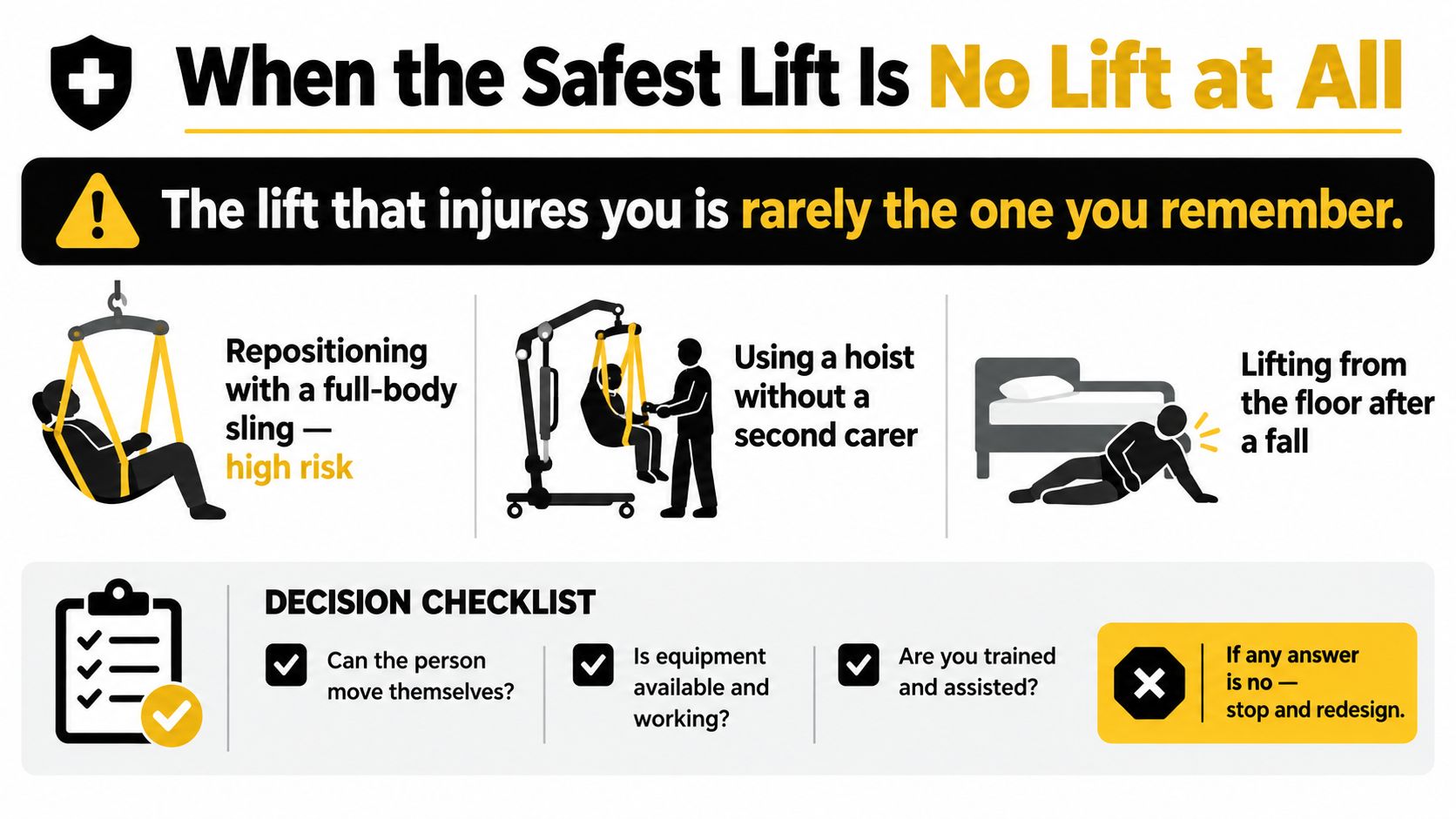
The lift that causes injury is often the improvised one. It's the one done in a wet bathroom, with a wheelchair that won't brake properly, with the wrong sling missing, or by someone who has never been shown that specific hoist. Those are exactly the moments where people try to “manage somehow”.
Red flags that mean stop
The HSE position is clear on principle. Employers should avoid hazardous manual handling so far as is reasonably practicable, provide mechanical help where possible, and reduce risk by changing the task, load, or environment. It also makes clear that guideline figures are not safe limits. That's why the safest lift is often not a lift at all, as set out in the HSE manual handling guidance.
Stop and redesign the move if:
- The person is in pain or frightened
- The floor is wet, cluttered, or cramped
- Brakes don't hold
- The sling is missing, damaged, or the wrong size
- You haven't been trained on that equipment
- The person's condition has changed from the care plan
What to say when you need to escalate
Workers need actual phrases, not slogans.
Try:
“I'm not going to move you this way because it isn't safe. I'm going to get the right equipment and another member of staff.”
Or:
“I can help keep you comfortable, but I can't complete this transfer safely on my own.”
If family members are watching, stay calm and factual. Explain that pausing protects the person as well as the staff. In care, reassurance matters, but so does a firm boundary.
There's a difference between pausing to reassess and refusing recklessly. A safe pause means you seek help, follow the care plan, report the issue, and use the safer option available. That is competent practice.
Legal Duties, the Care Certificate and Training Pathways
New care workers often hear “manual handling” as if it's one box on induction. It isn't. It sits inside your legal duties, your employer's responsibilities, and your day-to-day competence.
What the law expects in practice
In UK care settings, the legal foundation starts with the Manual Handling Operations Regulations 1992 and the wider employer duty to protect staff from hazardous work activity. In health and social care, HSE guidance specifically warns that poor moving and handling can cause back pain and musculoskeletal disorders, which can lead to inability to work. That's why safe-lifting practice matters to workforce retention and frontline safety, as reflected in the regulatory framework and associated HSE guidance.
For you on shift, that usually translates into very practical questions:
- Has the employer assessed the task
- Is the right equipment provided and maintained
- Have you been trained and observed using it
- Is there a safe system of work for this person
- Are changes in need being recorded and escalated
Where the Care Certificate fits
The Care Certificate is where many workers first meet these expectations in a structured way. Moving and assisting safely isn't just a theory answer. It should show up in supervised practice, risk awareness, communication, and evidence that you can follow a care plan without freelancing.
If you need a refresher on how that framework is used in early care training, this Care Certificate overview gives the wider context.
What good training looks like
Competent manual handling training should include more than an online quiz.
A useful pathway usually involves:
- Theory that makes sense. Basic biomechanics, legal duties, and hazard recognition.
- Hands-on practice with the actual equipment used in the workplace, such as slide sheets, stand aids, hoists, slings, and wheelchairs.
- Observed competence so a trainer, senior, or manager can see whether the worker applies the method correctly.
- Refreshers and updates when equipment changes, the setting changes, or poor habits start creeping in.
Online learning can support knowledge. On its own, it rarely proves safe practical handling.
Quick Checklists and Next Steps for Safer Shifts
You won't remember a long article in the middle of a busy morning round. You do need a few checks you can run quickly before a transfer starts.
Pre-lift checklist
Use this before you touch the person:
- Check the plan. What does the care plan say about this transfer, this equipment, and this level of assistance?
- Check the person. Are they alert, consenting, weight-bearing, comfortable, and able to follow instructions?
- Check the task. Is this repositioning, standing transfer, toileting move, or falls response?
- Check the area. Dry floor, clear route, enough turning space, suitable bed or chair height.
- Check the equipment. Brakes on, sling correct, hoist available, slide sheet ready, footwear suitable.
- Check yourself. Are you trained for this method, and do you have enough help?
During-lift checklist
Once the transfer begins, keep it simple:
- Set your base with stable foot placement.
- Keep the person close instead of reaching.
- Count the move if another worker is involved.
- Move your feet to turn.
- Watch the person's response for pain, fear, or sudden weakness.
- Slow down if control starts to go.
Stop-and-call-for-help triggers
If any of these happen, pause and escalate:
- The person suddenly can't assist as expected
- The space forces you into twisting or overreaching
- The equipment is wrong, missing, or not working
- You feel the transfer turning into a drag or dead lift
- Communication between staff breaks down
- You are being asked to do something outside your training
Competent carers don't “push through” a bad transfer. They recognise it early enough to stop.
Next steps that actually improve practice
Keep safe lifting alive in the shift, not just in training records.
- Bring transfer risks into handover so staff know who needs changed support that day.
- Record near-misses. A transfer that almost went wrong is useful information.
- Ask for refresher practice if you haven't used a stand aid, hoist, or slide sheet in a while.
- Check supervision records so your handling competencies are documented and current.
- Speak up early when the care plan no longer matches the person's real ability.
That's how to lift safely in care. Stop first. Decide properly. Use the right method. And when the answer is “not like this”, say it clearly.
If you need to build or refresh those skills, Cura Academy offers practical UK health and social care training that supports compliance, Care Certificate progress, and day-one job readiness. It's a useful place to tighten up manual handling knowledge, keep mandatory learning current, and get better prepared for safer shifts.