

The most common advice about how to get sponsorship in UK care work is now dangerously outdated. “Find a care home abroad, secure a job offer, and apply for a Health and Care Worker visa” no longer describes the normal route for new overseas care workers. From 22 July 2025, new overseas applications for care worker and senior care worker roles under SOC codes 6135 and 6136 were closed under the current rules, with limited transition arrangements for eligible people already in the UK.
That doesn't mean every sponsorship route has disappeared. It means your strategy has to change. In 2026, employers and applicants need to think about in-country switching, valid occupation coding, CQC compliance, training evidence, DBS readiness, and legitimate sponsor checks, not mass applications to adverts promising guaranteed visas. If you're still following pre-2025 recruitment advice, you're likely wasting time or exposing yourself to a scam.
Table of Contents
- Why Most Sponsorship Advice No Longer Applies to UK Care Work
- The Visa and Eligibility Rules That Actually Decide Your Route
- How to Find and Verify a Real UK Sponsoring Employer
- Training, Qualifications, and DBS Readiness Employers Look For
- How to Search for Care Sponsorship in Practice
- The In-Country Switching Path and Who Can Still Apply From Overseas
- Your 90-Day Plan to Become a Sponsor-Ready Care Worker
Why Most Sponsorship Advice No Longer Applies to UK Care Work
The old playbook was simple: apply from overseas, receive a care job offer, get a Certificate of Sponsorship, and submit a visa application. That route has largely closed for new overseas care workers. The government's July 2025 changes stopped new overseas applications for care worker and senior care worker roles under SOC 6135 and 6136, subject to specific transitional and in-country arrangements. The Spring 2025 Immigration Rules impact assessment confirms the closure and the separate arrangements affecting adult social care.
This is the point many recruitment pages avoid. Care providers may still advertise vacancies, but a vacancy isn't automatically a visa route. An employer can have a sponsor licence and still be unable to sponsor a new applicant outside the UK for one of these care roles.
Practical rule: A job advert saying “visa sponsorship available” is not proof that your nationality, location, visa status, occupation code, or application route is eligible.
The realistic options now centre on people who are already in the UK and can lawfully switch into an eligible sponsored role. Depending on the visa held and the applicable rules, that may include people on Student, Graduate, Youth Mobility, Skilled Worker, or certain family routes. Existing care workers covered by transitional arrangements may also be able to extend their permission, change employer, or continue towards settlement within the permitted period.
The restriction matters because the care sector still has domestic demand, but demand alone doesn't reopen an immigration route. The Work Rights Centre's analysis of Skilled Worker visas reports that Health and Care Worker visas for caring personal services fell from 107,847 in 2023 to 3,178 in 2025, while adult social care vacancies in England were still 78,330 in January 2026. The message is blunt: employers may need staff, but overseas sponsorship is far more restricted than generic recruitment guides suggest.
Stop chasing social media posts offering “guaranteed sponsorship”. Start building a profile that a compliant employer can verify quickly, then target routes you're legally able to use. Practical preparation around shifts, training, and employer expectations is also covered in why carers are struggling to get shifts in 2026.
The Visa and Eligibility Rules That Actually Decide Your Route
The first question is “which immigration route can I legally use?”, not which employer might sponsor you. For care work, the relevant roles are usually SOC 6135, care workers and home carers, and SOC 6136, senior care workers. The employer must choose the correct occupation code, and the job must remain eligible under the rules applying to your application.
Start with your location and current visa
Your location now determines the practical strategy. If you are outside the UK and seeking a new care worker or senior care worker application, the July 2025 closure is the central issue. New overseas applications for these roles are generally no longer accepted, so repeatedly applying to overseas adverts is a poor primary strategy.
Under current transitional proposals, certain in-country applicants and existing sponsored workers may continue under specified conditions until 22 July 2028. That date would not create a new overseas route if the rules remain as published. Overseas applicants should therefore focus on routes they already qualify for, rather than treating the transition as a future reopening.
If you are already in the UK, check whether your current permission allows a switch into the Skilled Worker route. Student, Graduate, Youth Mobility, Skilled Worker, and certain family-route holders may have a possible path. Eligibility still depends on the exact visa conditions, occupation, salary, sponsor, and timing. Living in the UK alone does not give you a right to switch.
Check salary, hours, English, and maintenance
The sponsored job must meet the applicable salary and going-rate requirements. Care worker sponsorship also involves a 48-hour weekly minimum under the relevant arrangements, and the employer must offer the work described. You must meet the English-language requirement at CEFR B1, unless an exemption applies. You may also need to show financial maintenance, unless the sponsor certifies it.
The Immigration Salary List and temporary shortage arrangements may affect how a role is assessed, but neither label overrides the July 2025 care-worker restriction. A vacancy being hard to fill does not automatically make a new overseas application possible.
Dependants and route-specific exceptions
Dependants may accompany a main applicant where the current rules and dependant requirements allow it. The main applicant must first hold a valid route with eligible sponsorship. Dependants cannot make an otherwise ineligible overseas care application valid.
Use this Points Based Immigration System guide for a plain-English explanation of points, sponsorship, and route conditions. Then check the latest GOV.UK guidance before paying for advice or accepting an offer. Rules change, and an employer's confidence is not proof that your application qualifies.
How to Find and Verify a Real UK Sponsoring Employer
A sponsor licence is a starting point, not a guarantee of a job or visa. The UK had 126,579 organisations and institutions registered as licensed sponsors for work and study by the end of 2025, compared with 31,899 in 2019, according to the Work Rights Centre's report on sponsor-licence revocations. The register has grown substantially, but applicants still need to check each employer carefully.
The Home Office also reported 34,698 sponsor licence decisions in 2025, with 18,407 granted and 16,291 not granted. That means approval isn't automatic. Separate reporting recorded 1,948 sponsor-licence revocations between July 2024 and June 2025, more than double the previous year, while enforcement analysis recorded 3,100 total revocations in 2025, including 569 in human health and social work activities. A listed sponsor can therefore lose permission, fail a compliance check, or be unsuitable for your specific route.
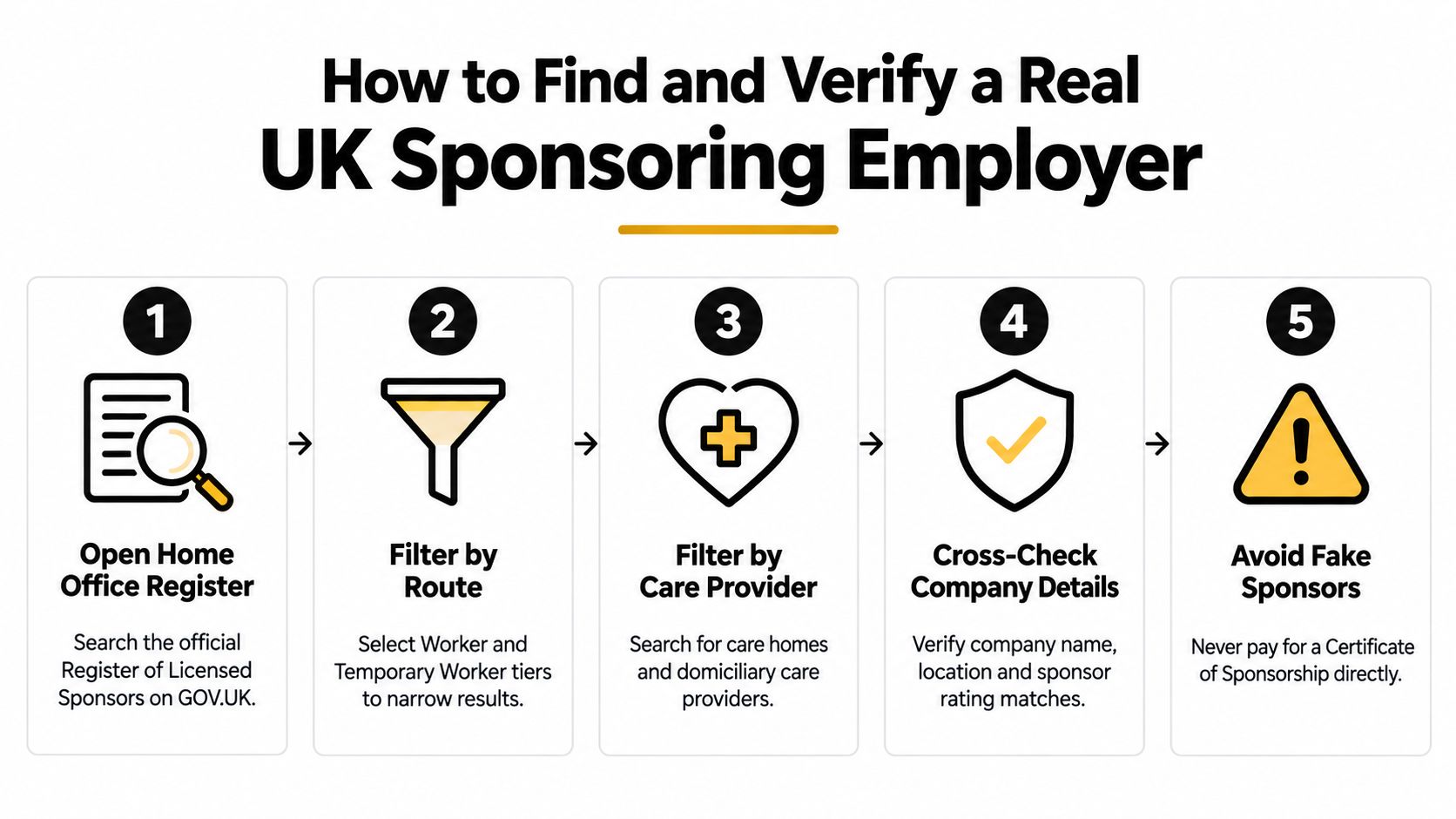
Run these checks before sending documents
- Search the official register. Find the employer on the Home Office Register of Licensed Sponsors and check that it holds the relevant Worker permission.
- Match the legal entity. Compare the sponsor's name and address with its Companies House record. A recruiter's trading name may not be the company authorised to sponsor you.
- Check the regulator. For providers in England, look for a matching Care Quality Commission record and confirm that the provider is registered for the relevant regulated activity. In Scotland, check the Care Inspectorate record.
- Ask precise questions. Request the legal employer name, job title, occupation code, work location, salary, hours, and whether the role is available for your actual immigration route.
- Reject payment demands. An agent asking you to pay directly for a Certificate of Sponsorship, or demanding unexplained recruitment charges before an interview, is a serious warning sign. Don't hand over your passport or money until the employer and route have been independently checked.
This verification process is slower than trusting a forwarded advert. It's also the difference between a genuine application and an expensive dead end.
The following video provides another practical overview of the sponsorship search process:
Training, Qualifications, and DBS Readiness Employers Look For
Care providers don't hire immigration paperwork. They hire people who can deliver safe care and pass onboarding checks without creating avoidable delays. Training won't bypass visa restrictions, but it can make your application more credible when an employer is comparing candidates who are otherwise eligible.
The Care Certificate is a useful starting point for new care workers. It covers 15 standards associated with the knowledge and behaviours expected in health and social care settings. Employers also commonly look for evidence of practical topics such as moving and handling, safeguarding adults, infection prevention and control, first aid, medication awareness, and food hygiene.
A Level 2 Diploma in Care, an NVQ equivalent, or a relevant overseas nursing or healthcare qualification may strengthen your profile. Your overseas qualification isn't automatically equivalent to a UK qualification, so present the original certificate, transcript, training hours where available, and any professional registration evidence. Never claim that a course gives you a regulated UK qualification unless it does.
Build a document pack employers can assess quickly
Keep one organised folder containing:
- Training records: Care Certificate progress and completed mandatory modules.
- Qualification evidence: Certificates, transcripts, translations, and professional registration documents.
- Identity documents: Passport, current visa evidence if you're in the UK, and proof of address where requested.
- Employment references: Contact details for previous supervisors, with dates and duties that match your CV.
- DBS information: Existing certificates, application status, and Update Service details where applicable.
A DBS check is usually arranged through the employer or an approved organisation. Basic, standard, and enhanced checks have different purposes, and an enhanced check can include an adult barred-list check where the role requires it. The DBS Update Service can help keep a certificate portable between eligible roles, but it doesn't replace an employer's decision about whether a new check is needed.
| Credential or requirement | What it covers | Where it applies |
|---|---|---|
| Care Certificate | Core knowledge and behaviours for care work | New care workers and onboarding |
| Moving and handling | Safer movement of people and equipment | Residential, domiciliary, and agency care |
| Safeguarding adults | Recognising and reporting abuse or neglect | All frontline adult care settings |
| Infection prevention | Hygiene and infection-control practices | Care homes, home care, and clinical environments |
| Basic Life Support and first aid | Immediate response to emergencies | Settings where the employer requires it |
| Enhanced DBS and barred-list check | Criminal-record and relevant barring information | Eligible regulated roles involving adults |
| DBS Update Service | Ongoing status checking for an eligible certificate | Where the certificate and role meet the service conditions |
For the practical application process, read how to get a DBS check. Cura Academy is one option for completing Care Certificate standards and mandatory care courses, while helping learners organise training and DBS Update Service readiness in one place.
How to Search for Care Sponsorship in Practice
A realistic search starts with the Home Office sponsor register, not a random overseas recruiter. Filter for Worker sponsors, identify care providers, and then check whether the employer's actual vacancy matches SOC 6135 or 6136, the location, the salary rules, and your immigration position.
Use job boards as discovery tools, not proof of sponsorship. Search Indeed, CV-Library, Totaljobs, Care.co.uk, and Nursing Times for senior roles, then move to the employer's own website. Providers and agencies such as Helping Hands, Bluebird Care, Home Instead, Barchester, HC-One, Four Seasons Health Care, and Priory may advertise care opportunities, but you must verify each vacancy and each legal employer separately.
A disciplined search week
A productive week might look like this:
- Shortlist carefully: Select a manageable group of licensed employers whose roles match your route.
- Tailor the CV: Highlight dementia care, safeguarding, medication support, personal care, moving and handling, and documentation experience where you have it.
- Apply directly: Send applications through the provider's official website rather than relying only on an intermediary.
- Contact managers professionally: A short speculative email can work when it names the service, your experience, your current location, and your lawful sponsorship position.
- Follow up once: Use LinkedIn or email to confirm receipt, then move on if the employer doesn't respond.
For an overseas candidate, this process should begin with route eligibility. For an in-country candidate, it can include direct conversations with care-home managers about switching and timing. In both cases, a licence number in an advert is not enough. Watch for upfront fees, vague job titles, implausible salaries, pressure to send original documents, or claims that a sponsor can guarantee a visa.
Most genuine offers come from employers that understand their own compliance duties. Your application should make it easy for them to see that you understand yours too.
The In-Country Switching Path and Who Can Still Apply From Overseas
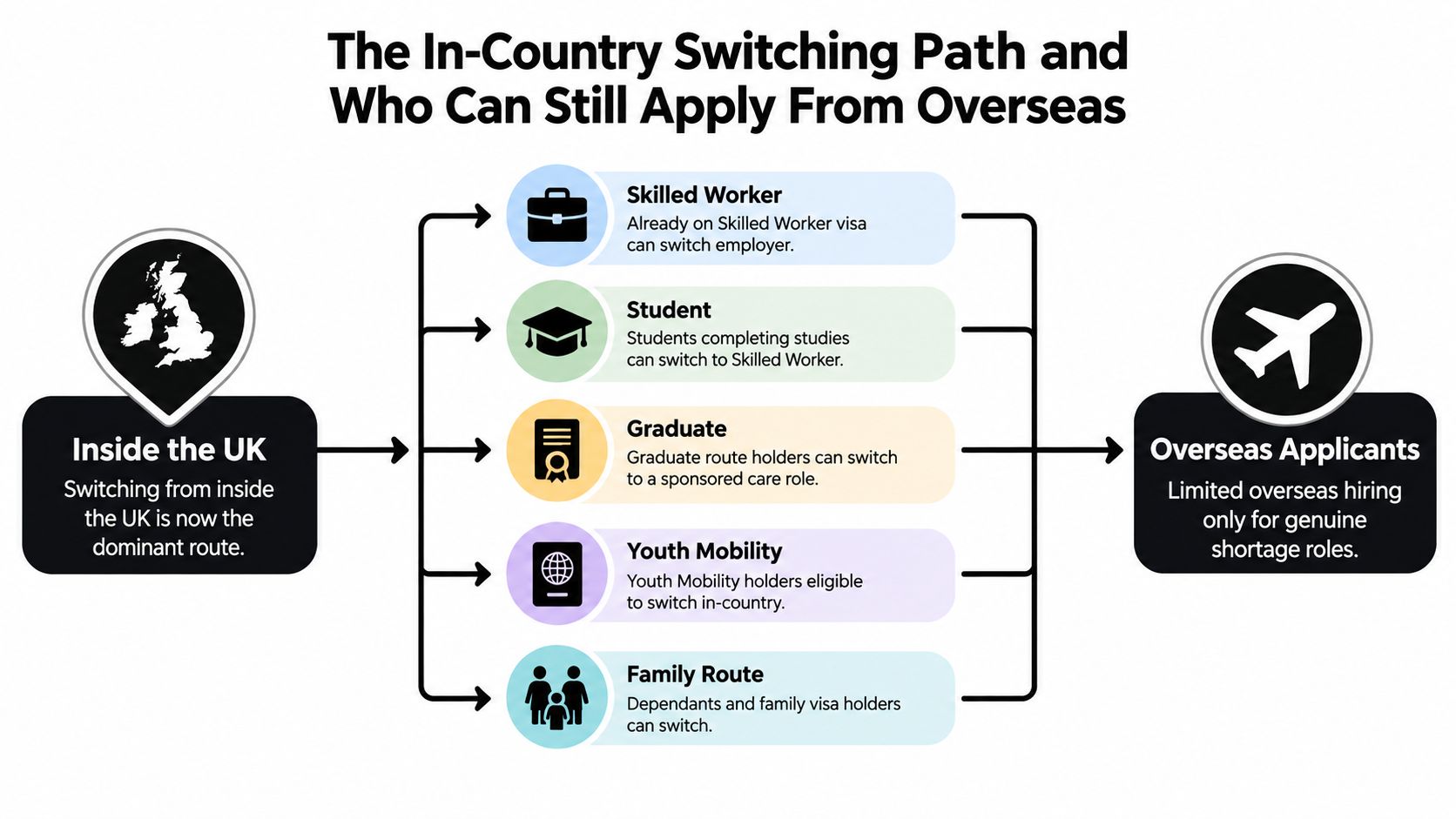
For 2026, in-country switching is the route worth prioritising if you already live in the UK lawfully. The July 2025 closure ended the normal new overseas route for care worker and senior care worker applications. Transitional arrangements still preserve limited options for people who were already sponsored or held another valid status.
A current Skilled Worker, Student, Graduate, Youth Mobility, or qualifying family-route holder may be able to switch into an eligible sponsored care role. Your visa category may restrict switching, or require you to complete a particular stage before changing route. Check your visa conditions and the current Immigration Rules before accepting work or submitting an application.
The transition window matters
People sponsored in care roles before the July 2025 changes may retain rights to extend, change employer, or progress towards settlement under the transitional arrangements, subject to the rules and their circumstances. Those arrangements are currently set to run to 22 July 2028, but they would not give every new applicant permission to enter the route.
That distinction determines whether your plan is realistic. Someone already working in the UK with valid permission may have a workable switching option, while an overseas applicant with the same job title may not. The employer, role code, salary, current visa, and application location all affect the outcome.
Overseas options are narrow
Some applicants can still use an overseas route. This includes people extending an existing Health and Care Worker position from abroad, or applicants applying for a different eligible sponsored role where the rules allow it. Dependants may be able to join an existing sponsored worker, but that does not create a new overseas care-worker sponsorship route.
The Home Office's sponsor licensing statistics show the level of scrutiny employers face. In the year ending June 2025, 34,186 sponsor licences were decided, with 19,177 granted and 15,009 not granted. Expect a genuine employer to check your documents carefully and ask you to explain your immigration route clearly.
My advice is direct. If you are already in the UK, protect your lawful status, prepare for switching, and build evidence of care competence. If you are overseas, reject any paid promise that ignores the July 2025 closure. Target routes that remain open, or enter through a lawful eligible route before pursuing care sponsorship.
Your 90-Day Plan to Become a Sponsor-Ready Care Worker
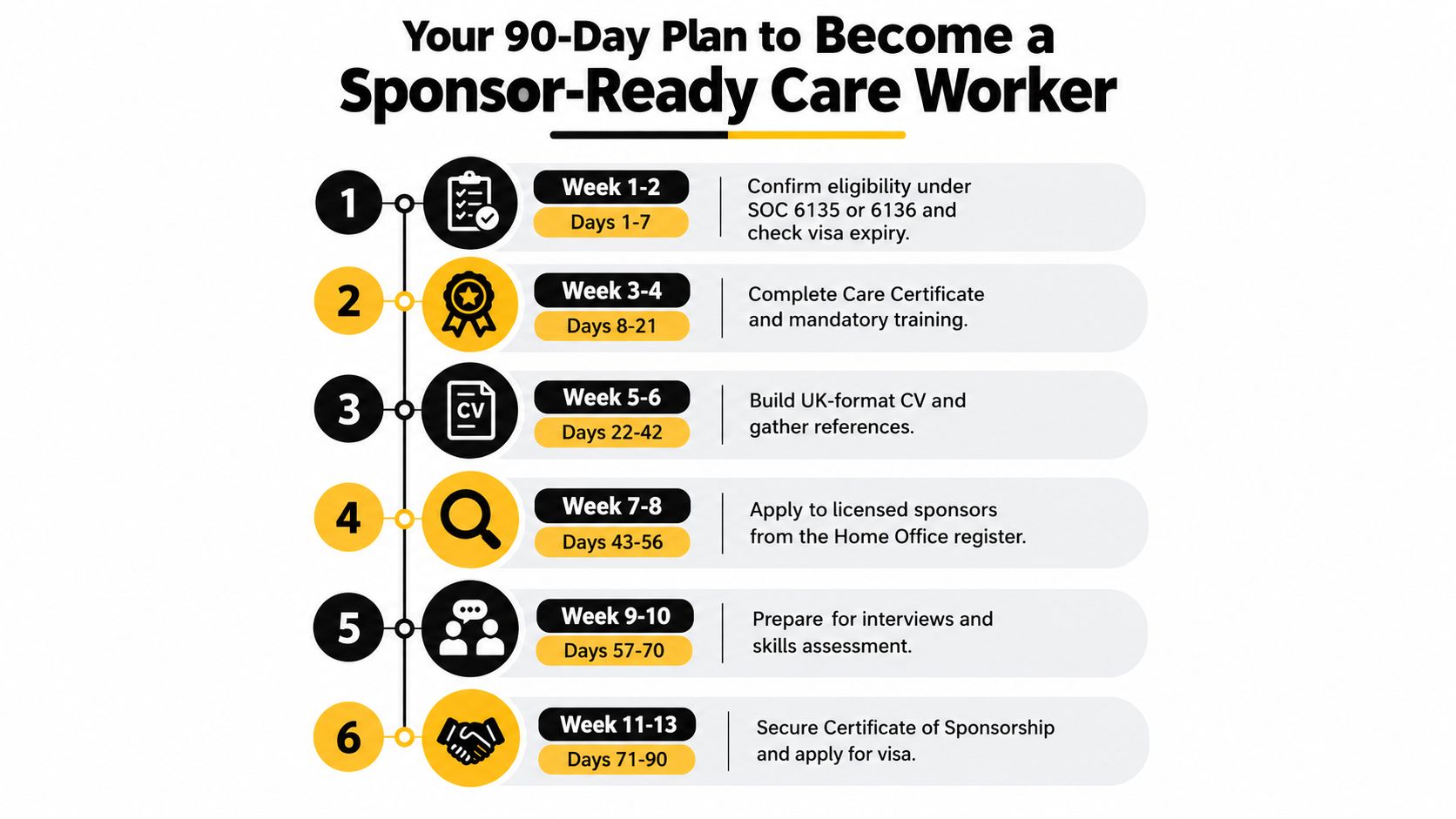
A 90-day plan can't guarantee a job or visa. It can remove avoidable weaknesses and give you a structured application routine.
Days 1 to 7: Confirm whether your target role fits SOC 6135 or 6136, check your current visa expiry if you're in the UK, and list every restriction attached to your permission. Start your DBS process through the correct employer or authorised route, and understand whether Update Service registration will apply to your certificate.
Days 8 to 21: Begin the Care Certificate and mandatory training relevant to the jobs you're targeting. Gather your passport, visa evidence, qualifications, translations, references, and employment history. Keep digital copies with clear file names so you can respond quickly without sending incomplete documents.
Days 22 to 45: Write a focused UK-format CV. Put care duties, safeguarding, dementia support, medication assistance, record keeping, and availability near the top, but only include tasks you've performed. Build a list of licensed employers and check their regulator records before applying.
Days 46 to 75: Apply consistently to suitable providers, follow up professionally, prepare for competency questions, and ask early whether the employer can sponsor your specific route. If you receive an offer, check the occupation code, salary, hours, work location, and Certificate of Sponsorship details before making a visa application.
Days 76 to 90: Prepare for the visa process, biometrics, onboarding, induction, and employer compliance checks. Keep your status lawful throughout and get regulated immigration advice if your circumstances are complicated.
Training signals, DBS readiness, accurate documents, and patient weekly applications will beat mass-applying to every advert. The strongest plan is not “find anyone who says sponsorship”. It's “become easy for a compliant employer to assess, then apply only where the route works”.
Cura Academy provides Care Certificate standards, mandatory care training, and practical pathways for organising a job-ready compliance profile, including DBS and Update Service readiness. Visit Cura Academy to prepare your evidence before you approach licensed UK care employers.