
A new agency carer arrives at a residential home halfway through a busy shift. They know the basic care procedures, but they've never met the resident, the nurse on duty or the colleague supporting them. The handover is rushed. A change in mobility is mentioned casually, while a medication concern remains buried in a note that nobody checks until later. What looked like a small communication gap becomes a near-miss.
This is why how to collaborate effectively in health and social care isn't just a question of being friendly or helpful. Collaboration is part of safe practice. It determines whether information reaches the right person, whether concerns are escalated, and whether the person receiving care experiences one coordinated service rather than a series of disconnected visits.
Table of Contents
- Why Collaboration Determines Patient Safety
- Mastering Structured Handovers Across Shifts
- Navigating Multidisciplinary Teams and Roles
- Resolving Conflict and Building Trust Quickly
- Leveraging Digital Tools for Inclusive Collaboration
- Building a Culture of Continuous Collaboration
Why Collaboration Determines Patient Safety
A care worker can follow every individual instruction correctly and still create risk if they don't coordinate with the people around them. A resident's transfer method may have changed, a person receiving domiciliary care may have refused medication, or a family member may have reported a new symptom. If that information stays with one worker, the next decision is made without the full picture.
The NHS engagement evidence on integrated care describes teamwork, mutual support and multidisciplinary working as foundations of effective collaboration. Staff reported benefits from working within teams and across primary care, secondary care, voluntary organisations and social care. Frontline care depends on exactly those connections.

Treat information as part of the care intervention
A safe team doesn't assume that someone else has noticed, recorded or escalated a concern. It makes information visible and gives each person a clear opportunity to act.
A practical safety model has three parts:
- Share the relevant change: State what has happened, when it happened and what you observed.
- Name the required action: Explain whether someone needs to review, monitor, document or escalate the issue.
- Confirm ownership: Identify who will complete the action and where the outcome will be recorded.
The UK Futures Programme employer research found that only 17% of surveyed employers had collaborated with another employer on skills-related activity during the previous 12 months. In public-sector organisations, including administration, education and health, the figure was 35%. The most frequently cited reason was access to, development of or sharing of expertise, while previous positive experience was mentioned by 50% of participating employers.
Those findings offer a useful operational lesson. People collaborate more readily when the shared purpose is clear and when earlier cooperation has built confidence. In care, that purpose is person-centred safety, not attendance at another meeting. Teams looking for broader principles can also use this unlock team potential guide, then translate general collaboration advice into handovers, escalation and documented decisions.
Mastering Structured Handovers Across Shifts
A handover should allow the incoming worker to make a safe decision without guessing. “Everything is fine” isn't a handover. Neither is a long, unfocused account that hides the urgent detail among routine observations.
Use SBAR, or ISBAR where identification is added, as a repeatable structure. It works best when the person giving and receiving the handover treat it as a safety check rather than a quick exchange of messages.
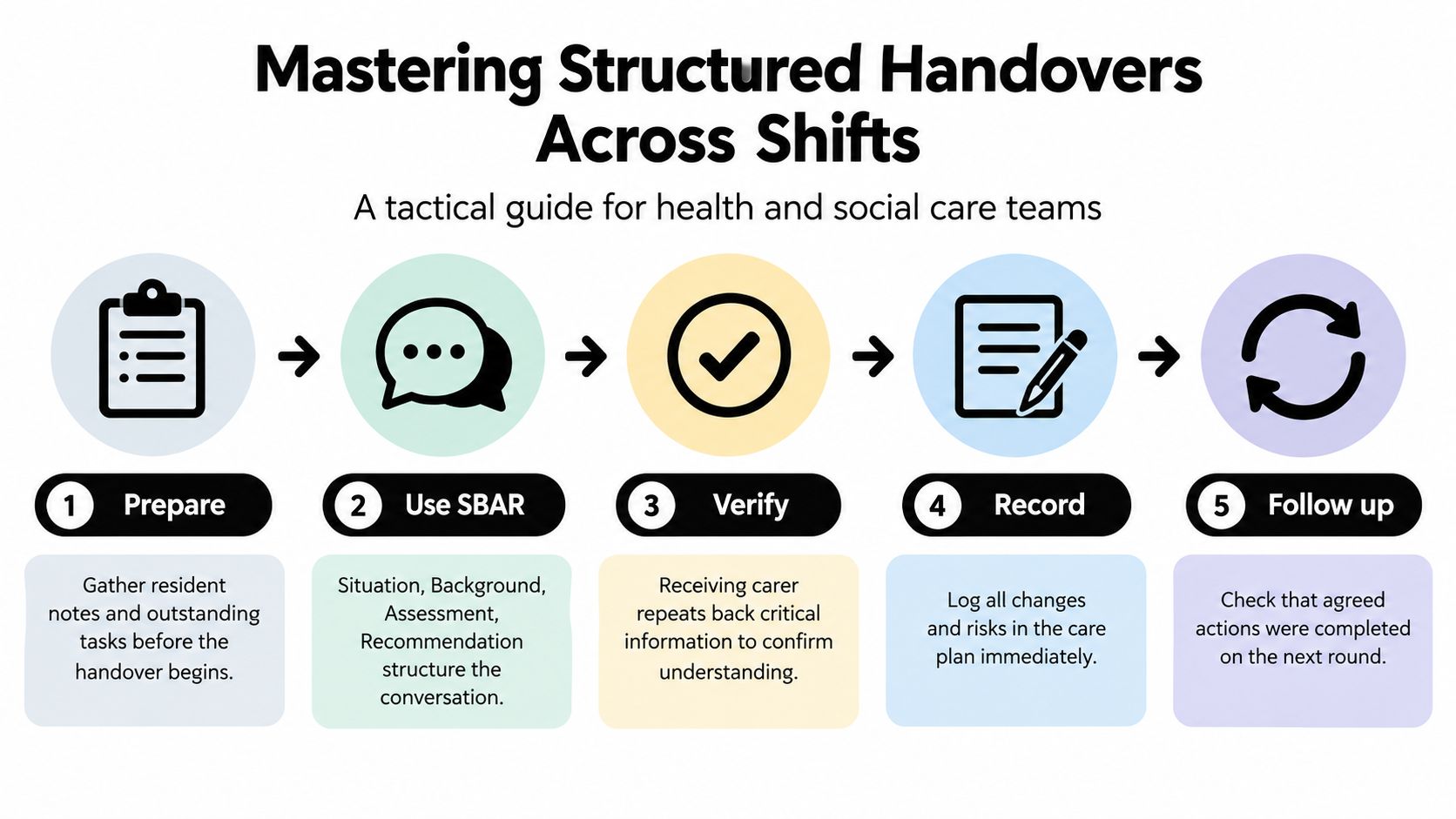
Prepare before speaking
Before the handover begins, check the care plan, recent notes, incident records and outstanding tasks. Separate routine information from changes that could affect immediate care.
A useful preparation list includes:
- Situation: What has changed now? For example, the person is unusually drowsy, has declined food, or needs more support to transfer.
- Background: What relevant history, instruction or previous decision explains the situation?
- Assessment: What have you observed, and what remains uncertain? Don't turn an assumption into a fact.
- Recommendation: What should the next worker do, monitor or escalate, and by when?
Include the person's own preferences and communication needs. A domiciliary carer may arrive after another worker has left, with no informal conversation to fill the gaps. The written record must therefore carry the essential context, including what was offered, what was declined and what follow-up remains.
Verify rather than assume
The receiving carer should listen actively and ask targeted questions. “Which medication was refused?” is safer than “Was medication okay?” “Who has been told?” identifies an accountability gap that a general question may miss.
Use closed-loop communication for critical details. The receiving worker repeats the key instruction in their own words, and the person giving the handover corrects any misunderstanding immediately. This isn't about testing a colleague. It prevents two workers from leaving the conversation with different interpretations.
Practical rule: If a concern could change what the next worker does, it deserves a named action, an owner and a place in the record.
Record changes promptly in the approved care documentation, following local policy and confidentiality requirements. Don't rely on a personal phone, memory or a message that only one colleague can access. Guidance on communication practice in nursing is available through Cura Academy's communication resource, but the same discipline applies across residential, domiciliary, agency and bank work.
Follow through on the next round
The next handover should check whether agreed actions happened. Was the nurse contacted? Did the person receive a review? Did the mobility instruction change? A task that disappears after the initial conversation is not collaborative care.
For a practical handover, aim to leave the next worker with four clear answers:
- What has changed?
- What does it mean for today's care?
- What action is required?
- Who will confirm completion?
Navigating Multidisciplinary Teams and Roles
Health and social care rarely operates as one tidy team. A care assistant may work alongside a registered nurse, GP, social worker, occupational therapist, pharmacist, family member, agency coordinator and voluntary-sector worker. Each person may hold a different piece of information and a different level of authority.
The difficulty isn't only the number of people involved. It's the uncertainty around who decides, who contributes and who must be informed.
Start with a shared outcome
A shared purpose should describe the outcome for the person, not the preference of one organisation. “Keep the person safe and as independent as possible during transfers” is more useful than “complete the mobility referral”. The referral may be one task, but the outcome gives every professional a reason to coordinate.
Write down the outcome in plain language, then identify the dependencies around it. If safe mobility depends on equipment, staff technique, pain management and the person's confidence, the care team can see why one isolated decision won't be enough.
Make responsibility visible
A simple responsibility matrix can prevent repeated assumptions. It doesn't need to be complicated.
| Question | What the team should clarify |
|---|---|
| Who leads? | Who has authority for the decision or care plan change? |
| Who contributes? | Which worker provides observations, specialist advice or practical support? |
| Who acts? | Who completes the task and records the result? |
| Who needs updating? | Which professionals, family members or services require relevant information? |
| What triggers escalation? | What change means the matter must move to a nurse, manager or emergency service? |
Role clarity matters especially when staff work across employers. A temporary worker shouldn't be expected to infer local arrangements from workplace custom. At the start of a shift, ask who is coordinating the care, what decisions sit within your role and how concerns should be escalated.
The Social Care Institute for Excellence material on integrated working identifies unclear responsibilities, insufficient capacity, blame-oriented cultures and siloed incentives as barriers to coordinated practice. It also highlights inter-professional education as a way to develop collaboration skills. In practice, that means training should include shared decisions and role boundaries, not just individual procedures.
A community health and social-care network study found collaboration density of only 2.2% across 321 organisations, while the 44 responding organisations reported 15% density within their surveyed subset. The contrast shows why a team can feel well connected locally while remaining poorly linked to the wider care ecosystem. Keep a current partner map, name a contact and deputy for key agencies, and review relationships that have become one-way or inactive.
Resolving Conflict and Building Trust Quickly
Conflict in care often begins with a genuine safety concern, but poor timing or tone can make the conversation personal. A worker challenges a transfer technique, questions an incomplete record or raises a missed task. The colleague hears criticism, becomes defensive and stops listening.
Respectful challenge protects both the person receiving care and the working relationship. It doesn't require softening a serious concern until nobody understands it.

Challenge the action, not the person
Use an observation, a risk and a request:
- Observation: “I noticed the transfer was completed without the equipment listed in the care plan.”
- Risk: “I'm concerned that this could increase the person's risk of falling or injury.”
- Request: “Can we pause and check the current instruction with the nurse?”
This language avoids accusations while making the safety issue explicit. If the risk is immediate, be direct. A calm relationship matters, but preventing harm takes priority.
A study of 75 healthcare-worker interviews linked team identity, social support and organisational support with collaboration, communication, preparedness and mental health. It also found that reduced social support particularly harmed redeployed staff's ability to work together and cope with stress. That matters for agency, bank and redeployed workers, who may enter a team without its shared routines or established trust.
Build trust on the first shift
Trust doesn't mean assuming a new colleague knows the local process. It means creating enough psychological safety for people to ask questions and report uncertainty.
At the start of a shift, make three things explicit:
- The decision-maker: Who should be contacted for clinical or safeguarding concerns?
- The escalation route: What should happen if that person is unavailable?
- The invitation to question: Tell unfamiliar workers that raising a concern is expected, not disruptive.
When disagreement continues, move from argument to evidence. Check the care plan, local policy, observation record or professional instruction. If the issue remains unresolved, escalate it through the agreed route and document the concern accurately.
For teams working across locations or employers, practical trust-building ideas can be supplemented by this resource on how to strengthen trust in distributed teams. In care, the equivalent isn't a virtual icebreaker. It's reliable follow-through, accessible information and a colleague who responds constructively when someone says, “I'm not sure this is safe.”
A short visual discussion can reinforce those behaviours:
Leveraging Digital Tools for Inclusive Collaboration
Digital systems can make care information easier to find, but they can also create a new divide. A nurse working from a computer, a residential carer on a floor and a domiciliary worker travelling between clients don't have the same access, time or device.
The Office for National Statistics evidence on hybrid working in Great Britain found that 28% of working adults hybrid-worked between January and March 2025. Workers with a degree were ten times more likely to hybrid-work than workers with no qualifications, while disabled workers were less likely to do so than non-disabled workers. These figures aren't a direct measure of care communication, but they show why a digital-first model can exclude people whose jobs require physical presence.
Design equivalent access
Every critical update should have a channel that frontline workers can use. That may mean an electronic care record, a concise mobile-accessible message, a printed shift summary where policy permits, or a verbal handover followed by an approved written entry.
Use technology to support these practices:
- One source of truth: Record the final instruction in the authorised care system rather than scattering decisions across private messages.
- Accessible updates: Make essential information available to workers who aren't sitting at a desk.
- Closed-loop confirmation: Ask the receiving worker to confirm that a critical message was understood and acted on.
- Clear urgency levels: Distinguish routine updates from matters requiring immediate contact with a senior colleague.
- Privacy by design: Share only the information required for the care task, through approved systems.
Don't assume that a messaging app creates collaboration. If staff receive updates during unpaid travel, lack a reliable device or can't find earlier decisions, the tool has increased contact without improving coordination. The Caldicott principles resource from Cura Academy provides useful context for sharing information responsibly, especially where multiple organisations are involved.
The strongest digital process has a non-digital fallback. A worker should know what to do if the system is unavailable, a message is missed or a colleague lacks access. Inclusive collaboration means the care plan remains understandable and actionable for the whole team, not only for the people with the best devices or the most office time.
Building a Culture of Continuous Collaboration
A collaborative culture isn't created by telling staff to communicate better. Leaders create it by giving people a shared purpose, protected opportunities to review care and a reliable response when someone raises a concern.
The NHS evaluation of structured, reciprocal, multidisciplinary peer review examined 24 intervention sites and 11 control sites. After one year, measurable changes were modest and not statistically significant, which is a useful warning against treating collaboration as a quick fix. Better interaction doesn't automatically produce rapid service-level improvement, especially when teams don't track decisions over time.
Turn meetings into operating routines
A useful review asks what changed, what the team learned and what action follows. It should produce named owners and deadlines, not only discussion.
Use a simple cycle:
- Review the person-centred outcome.
- Identify an unresolved handover, referral or responsibility gap.
- Agree one practical action and assign an owner.
- Record the decision where the relevant workers can find it.
- Check completion at the next review.
Measure more than attendance or satisfaction. A balanced view can include role clarity, unresolved handovers, escalation time, completion of agreed actions, staff experience and the person's care outcome. This reveals whether the team is collaborating effectively or merely meeting regularly.
Knowledge also needs maintenance. A current partner map, concise care records and accessible decisions help prevent the same question being solved repeatedly. Teams can draw on knowledge management best practices while adapting them to confidentiality, shift patterns and care documentation. For organisational leadership, the CQC well-led guidance from Cura Academy offers a relevant lens for connecting communication, accountability and improvement.
Use this shift-level check
Before leaving a shift, ask yourself:
- Does the next worker know what changed?
- Have I recorded the information in the correct place?
- Is every outstanding action assigned to someone?
- Do I know who to contact if the situation deteriorates?
- Did I invite questions from temporary or unfamiliar colleagues?
- Have I challenged any unsafe practice clearly and respectfully?
These habits distinguish reliable care workers from workers who merely complete assigned tasks. They also make you more useful across residential, domiciliary, agency and bank settings because you can join an unfamiliar team without becoming another source of uncertainty.
Cura Academy helps aspiring and experienced care workers build job-ready compliance through Care Certificate training, mandatory refreshers and role-specific courses, with learning pathways designed for residential, domiciliary and agency settings. Visit Cura Academy to strengthen the training and documentation habits that help you collaborate safely from your first shift.