
You've just started in care, you've found a free COSHH course online, and your manager wants a certificate on file before your next shift. That certificate might help, but it doesn't protect you on its own. What counts is whether the training matches the actual substances, tasks and controls in your workplace, and whether anyone has checked you can use them safely.
Table of Contents
- What COSHH Training Must Cover in the UK
- Where to Find Free COSHH Training Right Now
- How to Work Through a Free Course Step by Step
- How to Check a Free Certificate Actually Counts
- Special Cases and Your Next Shift
What COSHH Training Must Cover in the UK
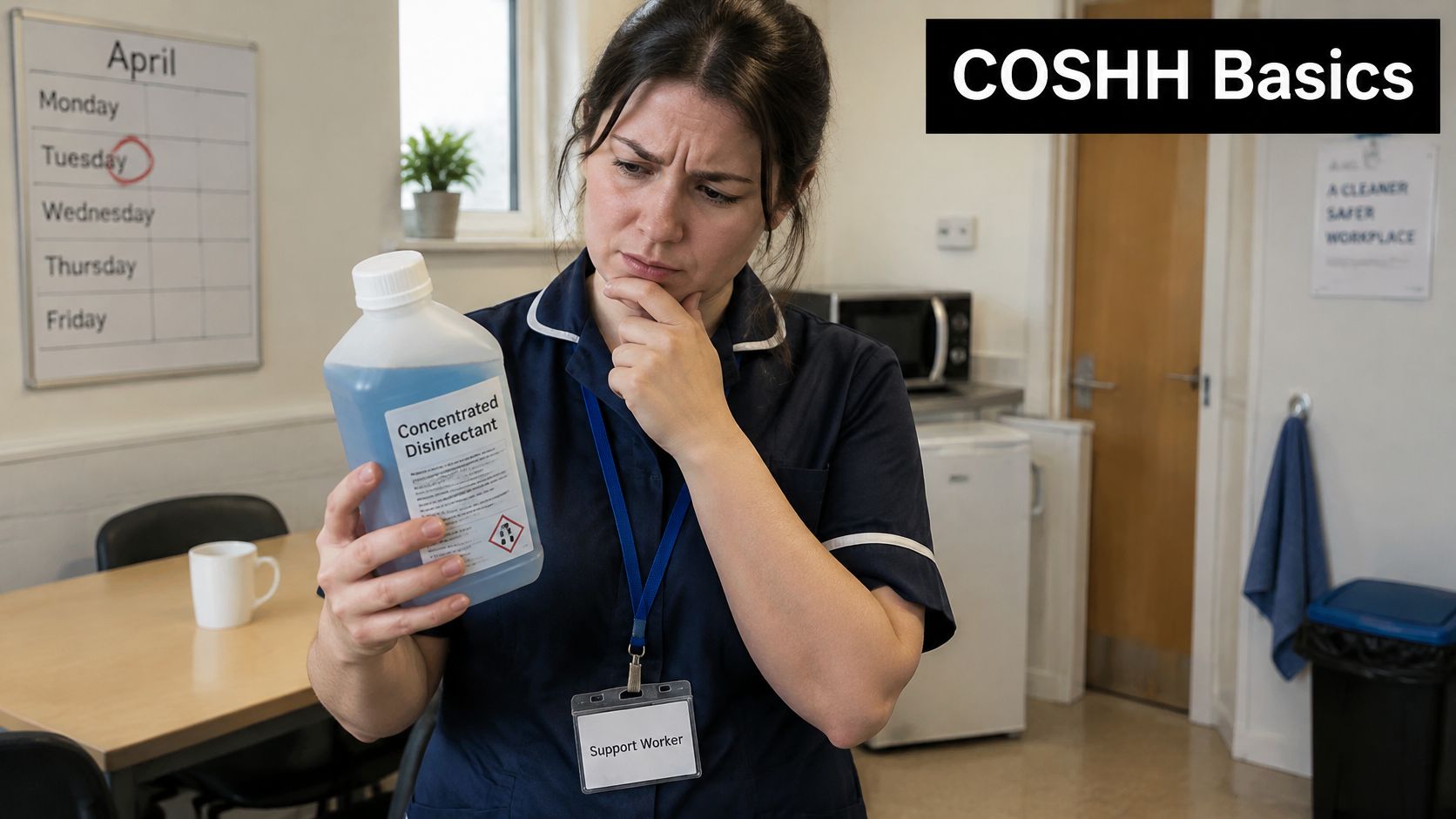
Say a new support worker passes a free online quiz on Monday. On Tuesday she's handed a concentrated disinfectant to dilute for a bathroom clean, but nobody shows her where the safety data sheet is kept, which gloves to wear, or what to do if it splashes her eyes. She's completed training. She isn't yet safe to do that task unsupervised.
That's the gap the law is meant to close. The Control of Substances Hazardous to Health Regulations 2002, as amended, require employers to assess risks from hazardous substances, prevent exposure where reasonably practicable or control it effectively, and provide employees with information, instruction and training, as set out in the HSE COSHH guidance for cleaning work. Free COSHH training is therefore part of an employer's legal duty, not an optional extra you sort out alone.
The minimum content to look for
Training should explain all of the following for your own workplace:
- Risk assessment results: What the workplace assessment found for the tasks you do.
- Substances and harm routes: How each product can cause harm through inhalation, ingestion, skin contact or absorption.
- Precautions and controls: Dilution rates, ventilation, storage rules and safe handling steps.
- Personal protective equipment: Which gloves, aprons or eye protection to use, and how to put them on and remove them.
- Emergency arrangements: What to do after a spillage, splash or accidental exposure.
- Monitoring results: Any relevant exposure monitoring results for your area.
This isn't only for nurses or senior care staff. It covers cleaners, laundry staff and maintenance workers who handle chemicals even when COSHH isn't their main job. In care settings that includes cleaning chemicals, disinfectants, laundry products, aerosols and bodily fluid decontamination products.
A free course gives you foundational awareness. Your employer still has to give you site specific instruction for the products on your trolley, in your sluice room and in your laundry.
If you're working out how this sits alongside other requirements, it helps to understand what mandatory training covers in care roles so you don't double up or miss a gap. Facility teams who want a broader view of day to day practice may also find chemical safety training for facility staff useful as background reading alongside your site procedures.
Where to Find Free COSHH Training Right Now
Ask the person who writes your COSHH assessments before you open a search engine. Employer or site induction is the cheapest reliable route. It costs you nothing, it happens on your own shift, and it is the only training tied to your actual substances, your safety data sheets and your spill procedures. A generic course can teach you what a corrosive pictogram means. Only your site can show you which cupboard the descaler lives in and why it must never sit beside the bleach.
Other free routes still earn their place, because they build the foundation that makes site induction stick. The trade off is straightforward. Free and low cost options away from your workplace teach principles well, but they cannot confirm you can dilute, decant, store and clean up safely in the building where you work. A certificate from an awareness pack proves you worked through the content. It does not prove competence with the five litres of disinfectant sitting in your sluice room.
Free and low cost COSHH training sources
| Source | Typical cost | What it covers | Best use |
|---|---|---|---|
| Employer or site induction | Free to staff | Your site's substances, safety data sheets, spill and emergency procedures | Required for every task involving hazardous substances |
| NHS organisation e-learning | Provided through your employer portal | Trust set modules linked to local policies and product lists | Check with your trust or ICB which modules count |
| HSE free COSHH guidance | Free | Legal duties, risk assessment, control hierarchy | Foundation reading before any course |
| Union or professional body resources | Often free to members | Awareness briefings, workplace rights and safety updates | Check membership benefits first |
| Free online COSHH packs for staff and managers | Free | Awareness topics and printable materials | Awareness only, not proof of competence |
| Paid online COSHH course | Paid per learner | Course content and completion certificate | Last resort when the employer provides nothing |
A quick decision rule
Work down this order. Ask what your employer provides and get booked onto it first. Read the HSE guidance next, so the language in your risk assessments makes sense. Fill any remaining gap with a free pack, a union resource or, if nothing else exists, a low cost paid course that your manager has agreed to fund.
Put the request in writing before you spend anything. Name the tasks you do that involve hazardous substances, and ask what training your manager will fund or provide. A short email creates a record, and it often prompts an induction slot that a corridor conversation does not.
Practical rule: If a route doesn't mention your workplace's own products by name, treat it as background learning, not as your COSHH training record.
How to Work Through a Free Course Step by Step
The route below turns a free course from a quiz score into something your manager can sign off. It follows the same logic as the HSE COSHH assessment guidance, which works through identifying hazardous substances and exposure routes, assessing who may be exposed under what task conditions, checking whether workplace exposure limits apply, then selecting controls using the hierarchy of control, prioritising elimination, substitution and process change before LEV, RPE or PPE.
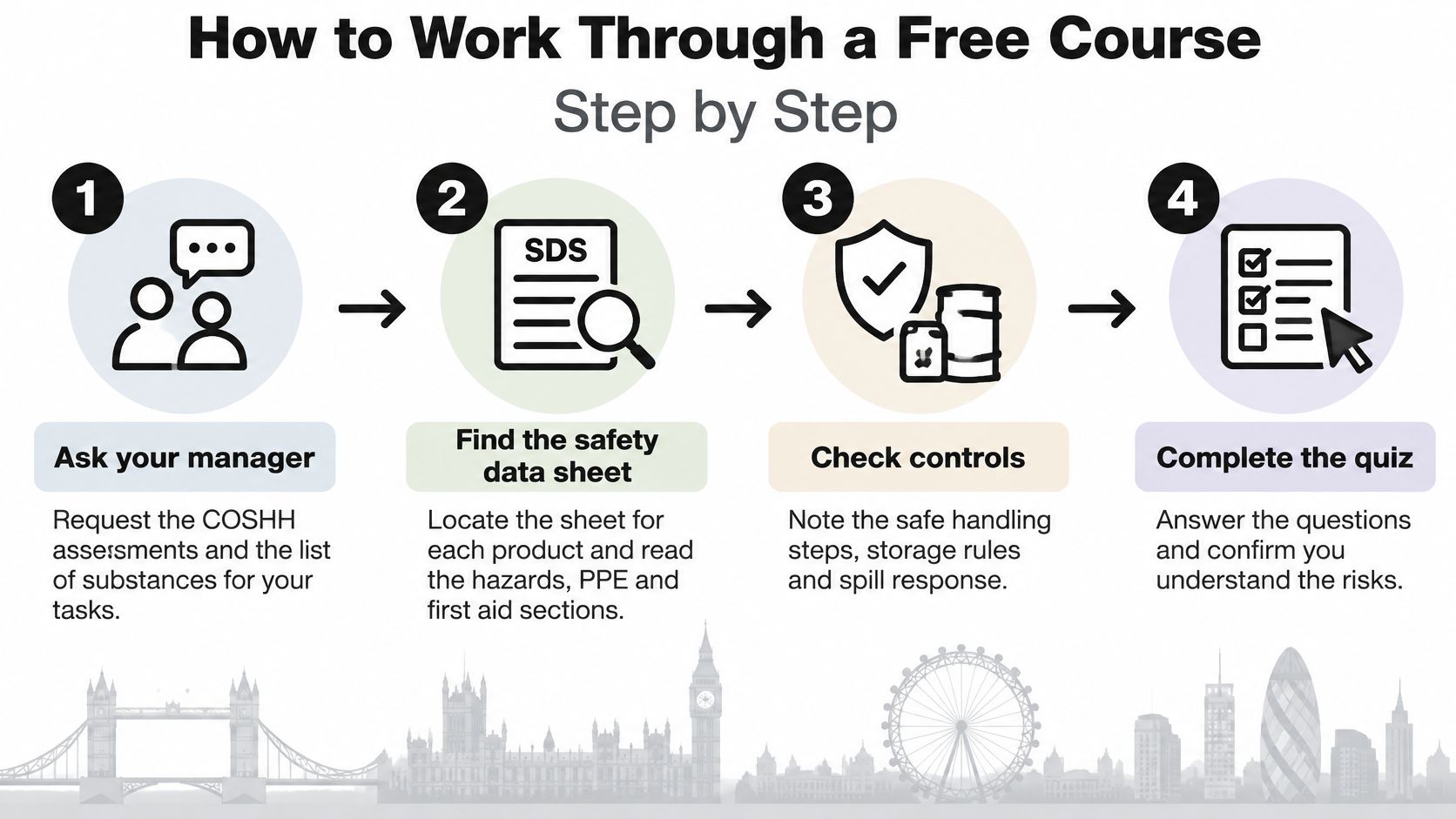
The diagram shows the first part of that route at a glance.
The seven steps
- Ask your manager for the paperwork. Request the COSHH assessments and the list of substances for your tasks before you start any course. This gives you a checklist to test the course against, instead of hoping it covers the right things.
- Find each safety data sheet. Locate the sheet for every product you use and read the hazards, PPE and first aid sections. If you can't find one, that is a finding, not a minor admin issue. Raise it the same day.
- Choose a course that matches your substances. Pick free COSHH training that deals with the product types you handle, such as disinfectants, laundry chemicals, aerosols or bodily fluid decontamination products. A course built around construction dust won't prepare you for a sluice room.
- Complete it and note the gaps. As you go, write down anything the course doesn't cover for your site, such as your dilution dispenser, your colour coded cloths or where your spill kit is stored. That list becomes your questions for your manager.
The short video below is a useful pause point before the practical steps, because the next stage is about demonstrating skills, not collecting more information.
- Practise the controls under supervision. Dilute a product to the correct strength, put on and remove PPE without contaminating your hands, and open the spill kit so you know what's inside. Watching a slide about gloves is not the same as choosing the right pair for oven cleaner.
- Do a spillage scenario. Talk or walk through a realistic spill, for example a knocked over bottle of disinfectant in a resident's bathroom. Cover who you move away, what you put on, how you contain it, how you dispose of contaminated materials and who you report it to.
- Record it against your name and tasks. Get manager sign off that links the training to the substances and duties on your rota, with the date. File the certificate with that sign off, not separately.
Why the practice steps are not optional
Training isn't complete when you pass an awareness quiz. Workers must be able to use controls and PPE correctly and know what to do during accidents such as spillages. The HSE's own practical course uses case studies, assessment and action plan exercises and control selection work, which tells you what a credible course should look like. I'd judge any free option by whether it makes you produce a task specific action plan and show how you'd choose controls, rather than only asking you to recall hazard symbols.
Competence means having the knowledge, skills and experience to do the job properly. A certificate that never tested your skills can't evidence two thirds of that.
A finished record at the end of this route names you, lists your tasks and substances, shows the course date, records the supervised practice and scenario, and carries your manager's signature. That's the document that holds up when an inspector, auditor or new employer asks what your training covered.
How to Check a Free Certificate Actually Counts
A certificate can look official and still prove very little. In an Occupational Medicine study of 100 UK patients with occupational asthma, 91% had never been informed about the risk of developing work-related asthma and 73% had never seen the relevant safety data sheets. Gaps like these show that a policy or document existing on paper is not the same as the information reaching the worker in a usable form.
Use that as your warning benchmark. A free course counts when it helps you find the safety data sheet for a product you use, recognise breathing symptoms that might be work related, and explain the controls attached to your tasks. If it only teaches hazard symbols in general, it is awareness, not site training.
Free COSHH certificate checklist
| Check | Good sign | Red flag |
|---|---|---|
| Content | Covers your workplace substances and tasks | Generic awareness only with no link to your site |
| Assessment | Scenario or practical task such as spill response | Multiple-choice quiz only |
| Date | Within your employer's refresher schedule | Older than the last change to your COSHH assessment |
| Provider | Named, with a contact address | No identifiable provider |
| Records | Linked to your name and tasks, with manager sign-off | Standalone PDF with nothing on file |
| Competence | You can show controls and PPE use | You cannot find the safety data sheet when asked |
Work down the table with your certificate and your COSHH assessment side by side. I'd weight content and competence most heavily. A recognised provider and a recent date do not rescue a course that never mentioned the degreaser in your kitchen or the chlorine based tablets in your cleaning cupboard. That gap matters because a generic certificate is only useful when it is tied to the substances and tasks in your own workplace.
The practical test is simple. Can you walk to the safety data sheet for the product you used this morning, turn to the PPE section, and show the gloves and eye protection it specifies? If you can, the training has transferred to the workplace. If you cannot, the certificate is detached from your practice. Completion records fail in the same way when they sit as standalone files instead of being linked to your tasks and current COSHH assessments. A training matrix template for care settings shows one way to keep names, dates and sign off together so that link stays visible.
Treat a standalone PDF with no record on file as a red flag. It's evidence you clicked through something, not evidence you can work safely.
If one check fails, don't start again from zero. Ask your manager to close the specific gap: a supervised practice session, a scenario assessment, or recording your existing certificate against your tasks with sign off. Ask for a refresher check whenever a product, process or control changes, because that is when yesterday's training stops matching today's risk. A free certificate can be a useful starting point. It cannot replace the site-specific instruction and supervision your employer must provide.
Special Cases and Your Next Shift
One certificate does not travel with you from building to building. That's the assumption that catches out agency and bank staff most often, and it's worth challenging before your next placement rather than during an incident.
Three situations that need fresh checks
The agency worker across two care homes. Say you work Monday in a home that uses a quaternary ammonium disinfectant and Wednesday in one that uses chlorine based products. The PPE, dilution, contact time and storage rules differ, and mixing products carries its own risks. Training from the first home doesn't transfer. Each site needs its own safety data sheet review with you, even if it's brief, before you clean unsupervised.
The bank worker covering laundry. You've supported residents for months, then you're asked to cover a laundry shift with industrial detergents and descaling products you've never handled. Your general care experience doesn't cover dosing systems or what to do when a chemical pump leaks. Ask for the laundry COSHH assessment and a supervised run through before the shift starts, not halfway through it.
The cleaner or maintenance worker in a care setting. Your job title isn't clinical, but you handle aerosols, cleaning concentrates, adhesives or paints. That work falls under COSHH in exactly the same way. If you've been missed off training lists because you're not care staff, raise it directly. Exposure doesn't check your job title first.
New to care and still waiting on induction
If you're new to care, free COSHH training is a sensible first step while your employer completes your site induction. Do the course, keep your gap list, and take it to your first supervised shift. Just don't let an early certificate become a reason for anyone to skip showing you the products, cupboards and spill kit in the building where you'll work. The same principle applies across safety topics, which is why it's worth seeing how fire safety training in care settings also ties general learning to your own building's evacuation routes.
Three actions for this week
- Ask for your substance list in writing. Request the substances used in your role and where the safety data sheets are kept. If the answer is vague, follow up by email so there's a trail.
- Book any missing site induction. Get a date in the diary and record it, even if you've already completed an online course.
- Save certificates properly. Keep every certificate with its date and your manager's sign off, in one folder you control, so agency or bank work doesn't leave your evidence scattered.
If your employer provides nothing
Be honest about the fallback. If there's no employer provision and you need a paid route to build related skills, look for courses that strengthen the practice around COSHH rather than claiming to replace it. Cura Academy's Infection Control course covers infection prevention and control principles, how infections spread, hand hygiene, PPE use, cleaning and decontamination, waste disposal and sharps safety, and managing cross contamination risks. Its Duty of Care course supports compliance with UK legislation, CQC expectations and organisational policies. Neither is a free COSHH course, and neither replaces site specific instruction on your own substances and assessments. I'd use either to round out your knowledge, never as a substitute for the induction your employer owes you.
A free course is a starting point. The record that counts is the one linked to your workplace, your substances and a manager who has watched you work safely and signed to say so.
Build the knowledge around your site specific COSHH induction with structured care training from Cura Academy, including courses on infection control and duty of care that strengthen the PPE, decontamination and compliance skills your role depends on. Visit us today, choose the courses that fill your gaps, and keep every certificate filed with your manager's sign off so you're ready for your next shift.