
You've been offered a care job, and your employer says a DBS check is needed before you can start. The check's level depends on the role, not on a certificate you choose to buy.
An Enhanced DBS check is a higher-level criminal record check for eligible roles involving vulnerable groups or a high degree of trust. Many health and social care positions may qualify. The certificate can include relevant local police information beyond a Standard check.
The Disclosure and Barring Service processed almost 7.4 million checks in 2023–24, including 4,067,255 Enhanced checks with a Barred List check. (DBS annual quality account)
Your employer must establish that the role is legally eligible and choose the appropriate level. Duties matter more than job titles: particular care responsibilities may also make an Adults' Barred List check eligible. The employer makes that decision, while you can prepare by checking your personal details and documents.
Table of Contents
- What an Enhanced DBS Check Actually Is
- What an Enhanced Check Searches For
- Who Qualifies for an Enhanced Check in Care
- How to Apply and How Long the Process Takes
- Keeping Your Certificate Portable With the Update Service
- Choosing How to Get Ready for Employer Checks
- Your Next Step Toward Care Shifts
What an Enhanced DBS Check Actually Is
You've received a conditional offer for a care role, but your employer says you can't start until the DBS process is complete. That can feel like a frustrating pause, especially when you're ready to work. Understanding what the check is for, and who decides which level applies, makes the process easier to approach.
An Enhanced DBS check is a higher-level criminal record check used for eligible roles involving vulnerable groups or a high degree of trust. Many health and social care positions may qualify, but the job title alone doesn't settle the question. The employer must consider the actual duties and confirm it has the legal entitlement to request an Enhanced check.
The key difference from a Standard check is that an Enhanced certificate can include relevant information held by local police. A chief officer considers whether that information is relevant to the role and ought to be disclosed. It's not a general search for every detail about a person, and the additional information is not automatically included just because an application is for an Enhanced check.
The application route is different from buying a personal certificate online. Enhanced checks are normally submitted through a registered body, such as an employer or an organisation that handles applications on the employer's behalf, rather than directly by an individual applicant. In 2022–23, total intake for Standard, Enhanced and Enhanced with Barred List checks exceeded 5 million applications, a 26.5% increase and the highest in-year volume since DBS was formed (DBS business plan).
That scale is a reminder that this is a formal safeguarding process, not a routine certificate purchase. The useful next step is to understand what information a certificate may contain, then check how your intended care duties affect eligibility.
What an Enhanced Check Searches For
Think of the check as a filing cabinet with three drawers. The first holds relevant criminal-record information, the second may contain local police information, and the third is opened only when the role qualifies for a Barred List check.
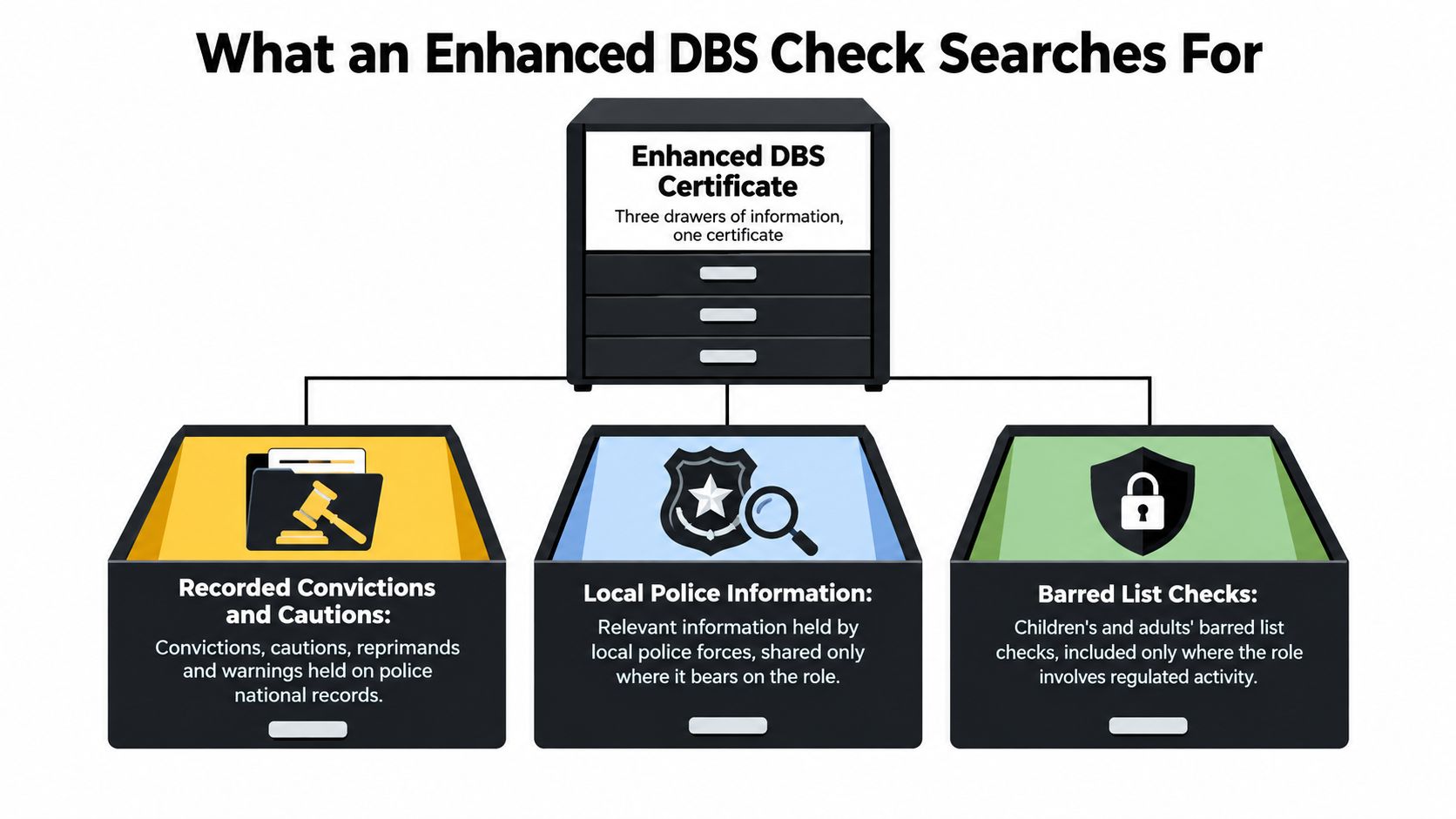
The first drawer contains criminal-record information included under the applicable disclosure rules, such as convictions and cautions. An Enhanced certificate includes the information available at Standard level as well. What appears depends on the disclosure rules that apply, so a certificate isn't a complete account of every event in someone's life.
The second drawer is the additional local police information. Police may hold information that doesn't amount to a conviction or caution. A chief officer decides whether any such information is relevant to the role and ought to be disclosed. This is one reason an Enhanced check is broader than a Standard check, but it doesn't mean all locally held information will appear.
The third drawer is a Barred List check, where the role is eligible. For adult social care, an Adults' Barred List check is a separate safeguarding determination. It indicates whether someone is barred from regulated activity with adults, rather than merely adding another list of convictions to the certificate. An employer may request this check when the role meets the legal threshold (DBS overview of checks).
These layers help explain why training and DBS screening do different jobs. Completing a Care Certificate or mandatory training can show that you've developed relevant skills, but it can't change police or DBS records, and it doesn't guarantee clearance.
Suppose a candidate has an older caution included under the rules for their Standard-level disclosure. The Enhanced check may also include relevant local police information if the chief officer considers it appropriate for the role. Whether the job includes personal care is a separate eligibility question, and shouldn't be confused with what information is disclosed.
Before applying, check that your identity details and personal history are accurate. That preparation won't determine what the certificate contains, but it can help your application reflect the correct person and role.
Who Qualifies for an Enhanced Check in Care
A “care assistant” title doesn't automatically qualify someone for an Enhanced check with an Adults' Barred List check. The deciding factor is what the worker does in practice, not the label on a contract or the building where they work. The same kind of assessment applies across settings such as domiciliary care, hospitals, care homes, day-care centres, prisons and sheltered housing.
For adult social-care roles, eligibility for an Enhanced check with an Adults' Barred List check can apply when the work involves regulated personal care for adults who need assistance because of age, illness or disability. Personal care includes physically helping someone to eat or drink, use the toilet, wash, bathe, dress, receive oral care, or manage skin, hair or nail care. It can also include prompting or supervising those activities when the adult can't decide or act independently.
The employer must map the duties against the eligibility rules before choosing the level. The official guidance makes clear that requesting a Barred List check for an ineligible role isn't permitted (adult-care eligibility guidance). A candidate can help by describing the role clearly, but the employer is responsible for confirming the lawful level.
| Role Example | Typical Duties | Level to Confirm With Employer |
|---|---|---|
| Domiciliary care assistant | Visiting adults at home to provide eligible personal care | Whether duties meet the threshold for Enhanced and Adults' Barred List checks |
| Residential care worker | Helping residents with personal care and daily activities | Whether the specific duties constitute regulated activity |
| Supported-living worker | Providing support that may range from personal care to independent-living assistance | The exact duties and level of contact |
| Bank care worker | Covering shifts with duties that can vary by placement | Whether the particular placement qualifies |
| Companion | Social visits without personal care duties | Whether the role meets eligibility criteria for the requested check |
| Administrative worker | Office duties without regulated personal-care activity | Whether the role is eligible for the requested level |
For a closer look at one common care route, see this guide to working as a domiciliary care assistant. The same principle applies across job settings: don't assume that a familiar title answers the eligibility question.
Practical rule: Asking for the highest level “just to be safe” isn't always lawful. Share the role description and ask the employer to confirm which check the duties support.
Before onboarding, note the intended role, setting, service-user group and personal-care activities. This gives the employer a more useful basis for its eligibility assessment than a generic job title or training certificate.
How to Apply and How Long the Process Takes
A fixed start date can make a DBS application feel like a countdown. The timing depends on the role details and checks required, so begin by asking the employer what level is lawful for the duties and how it will manage onboarding while the application is pending. The employer, not the candidate, makes the final level decision.
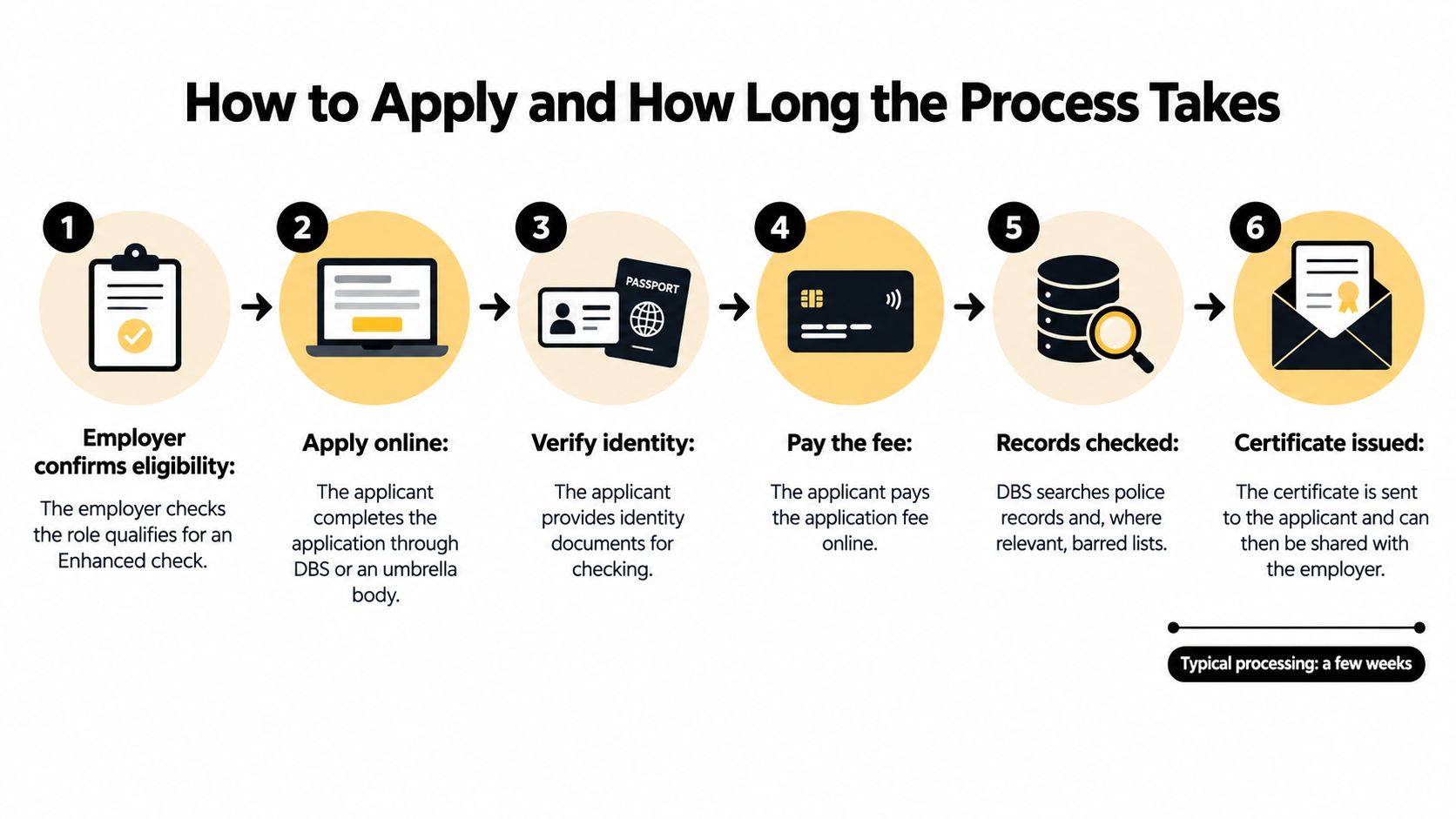
Follow the application from role to certificate
- The employer confirms eligibility. It selects the appropriate level and checks whether the role permits an Adults' Barred List check.
- You complete the application. An Enhanced check is usually arranged through the employer or a registered body. Follow its instructions for the workforce and role details.
- Your identity is verified. Provide the requested documents and check that your personal details match across the application and ID.
- DBS processes the application. The required checks depend on the level and workforce selected. Where eligible, this can include a Barred List check.
- The certificate is issued. It is sent to you. Your employer can explain how it needs you to present or share it.
There is no single completion time that applies to every application. The route depends on the workforce selected, how quickly identity checks are completed, and whether the application includes a Barred List check. If information is incomplete or does not match, it may need attention before the application can proceed. For current guidance, check the DBS application process and timescales before relying on an estimate for a start date.
Keep your application reference. It can help you follow up with the employer or registered body and may be used to register for the Update Service while the check is processing. If a form field is unclear, ask before submitting rather than guessing. A small detail, such as an address history entry, can be harder to correct once the application is under way.
For a step-by-step overview of how to apply for a DBS check, see the application guide. Tell the employer early if you have a fixed start date and ask what arrangements apply while you wait.
Keeping Your Certificate Portable With the Update Service
If you take shifts through an agency or work across different employers, the DBS Update Service may help avoid repeat applications. It lets an employer check a certificate's status online, but it doesn't make the certificate universally portable or automatically suitable for every new role.
The service applies to Standard and Enhanced checks, not Basic checks. It costs £15 per year, and an employer may carry out a status check only when it's legally entitled to do so and you've given permission (DBS Update Service guidance). The employer still needs to confirm that the certificate's level and workforce match the role it's considering.
There's a deadline to keep in mind. You can register using your application reference while the check is being processed, or use your certificate number to register within 30 days of the certificate issue date. If you miss that window, check the current DBS guidance or ask your employer what route is available.
Check whether it fits your next move
- First care job: Ask whether the employer expects you to register and whether your role's check level is eligible.
- Second agency or bank work: Ask the new employer whether it can lawfully rely on a status check for that role.
- Changing employer: Confirm that the workforce and check level on your certificate fit the new duties.
- Lost certificate: Ask the employer or DBS what evidence it needs; an online status check isn't the same as having the certificate in hand.
- Barred List requirement: Check that the existing certificate and the new role's eligibility context align.
The Update Service is a verification tool, not a promise of employability or compliance. It may be useful if you move between similar care roles, but the employer remains responsible for checking that it's appropriate.
For a more detailed explanation of the Enhanced DBS Update Service, consider how often you expect to change employers and whether your future roles are likely to require the same level and workforce.
Choosing How to Get Ready for Employer Checks
A care-home role may ask for evidence of moving-and-handling training, while a home-care position may require different preparation. Start with the duties in the job description, then match your learning and records to the work. A course certificate is one part of readiness, not a substitute for completing the employer's checks.
| Preparation task | If you organise it yourself | If you use a structured pathway |
|---|---|---|
| Match learning to duties | Compare the job description with the training requested, such as dementia awareness or basic life support. | Follow learning arranged by topic or role, then check it against the employer's list. |
| Keep evidence together | Save each certificate and course record in one folder, with clear filenames. | Store records from the pathway together so you can find the relevant evidence when requested. |
| Prepare for onboarding | Note which forms and records each employer asks you to provide, and respond to those requests. | Work through preparation steps in sequence and keep the requested documents ready to hand. |
| Choose training | Select individual courses to address specific gaps in your experience or knowledge. | Use a set learning route to cover related topics, then identify any role-specific gaps separately. |
For example, if a care role involves supporting people with dementia, check whether the employer requests dementia-awareness training and whether your record shows when you completed it. If the job includes physical support, ask which moving-and-handling training it expects. This makes your preparation specific to the work, rather than collecting certificates that may not be relevant.
Cura Academy provides care-training courses and structured learning pathways. If you use a training provider, compare its course topics with the duties and evidence listed by the employer, and confirm whether the employer accepts those records.
Take a practical step now: open the job description and mark each training requirement, then check your existing certificates against that list. For anything missing or unclear, ask the employer which course or record it expects before booking training.
Your Next Step Toward Care Shifts
A well-prepared application begins with three clear decisions: whether the role is eligible for an Enhanced check, which level the employer is entitled to request, and whether the Update Service fits the way you expect to work. You don't have to resolve every question alone. Share the job description with the employer and ask it to confirm the correct check level before you apply.
Use this checklist to get organised:
- Role duties: Write down the setting, service-user group and personal-care activities involved.
- Identity details: Check that your name and identifying information are consistent across your documents.
- History information: Prepare accurate address and employment history details for the application.
- Training evidence: Gather certificates or records relevant to the role.
- Update Service timing: Decide whether you want to register while the application is processing or within the certificate's registration window.
Then take one practical step today: visit curaacademy.co.uk and explore the training and pathways that match the care role you're aiming for. A complete, accurate application and organised training record can help you approach employer checks with confidence, while the employer makes the final decision on the DBS level.
If you're preparing for a care role, Cura Academy offers Care Certificate standards, mandatory refreshers, role-specific courses and structured pathways to help organise your training and onboarding preparation. Explore the route that fits your intended duties, and confirm the appropriate DBS level with your employer before applying.