
It's 2am. The person you support at home is more breathless than at teatime, their daughter is frightened, and the plan agreed on the ward last month is still in a hospital notes trolley. You have a phone, a paper folder, and a decision to make before anyone else arrives.
That is what end of life care support looks like in many settings. The useful skill isn't a single national script, because local pathways differ. It's knowing which document to open, who to call, and what to write so the next worker isn't starting from zero.
Table of Contents
- Assess Needs and Record Preferences Across Settings
- Scripts for Hard Conversations and Culturally Safe Planning
- Advance Care Planning Documents to Check
- Symptom Checks and Out-of-Hours Escalation
- Safeguarding, Last Days and Bereavement Support
- Competency Checkpoints for Care Teams
- Audit One Pathway Before Your Next Shift
Assess Needs and Record Preferences Across Settings
Few deaths occur in a hospice, so the plan has to work where they live. In England in 2023, hospital was still the most common place of death at 42.8% of all deaths, while 57.2% occurred outside hospital: 28.4% at home, 21.0% in care homes, 5.2% in hospices and 2.6% in other locations, according to the UK Government palliative and end of life care profiles. Comfort, personal care and family support happen in ordinary rooms far more often than in a specialist unit.
Run the assessment in one visit, in this order.
- Spot the triggers. Look for clinical deterioration, advanced illness, frailty or repeated unplanned admissions. Check whether the person has had three or more emergency admissions in the final 90 days. The coherence note on UK end of life statistics notes that NHS profiles use this indicator to pick out avoidable coordination failures.
- Talk through what matters. Cover goals, symptom priorities, preferred place of care, and who should be involved, including family who might otherwise decide alone.
- Write it where the person can read it. Use an accessible care plan or electronic palliative care coordination record, in plain language.
- Share it the same day. Send it to the GP, community nurses, ambulance service, care home or hospice, and family where the person agrees.
- Reassess after a fall, an admission or a medicine change. One conversation is a starting point, not a permanent instruction.
Historic ONS VOICES evidence, set out in that coherence note, found that 54% of people died in their preferred place. Alignment is the benchmark, not the building.
Where the plan usually breaks
Preferences get written down and never shared. A single conversation is treated as fixed. Communication needs are left blank. A transfer is treated as clinically necessary when the escalation plan is missing.
Say a domiciliary carer finds the hospital never received the wish to stay at home. They raise it on the handover, the crew gets the updated record, and the next decision uses the person's words rather than an empty form.
Practical rule: If the night team can't see the preference, it hasn't been recorded.
Before you call the pathway safe, check three things. Are preferences documented and dated? Is out-of-hours access written so a tired carer can follow it? Are emergency admissions reviewed, not just counted?
| Place of death | Share of deaths | Typical frontline support role |
|---|---|---|
| Hospital | 42.8% | Escalation plans, transfer decisions and ward-based communication |
| Own home | 28.4% | Equipment, medicines access, family support and carer visits |
| Care home | 21.0% | Daily personal care, GP and nurse liaison, anticipatory prescribing |
| Hospice | 5.2% | Specialist symptom control and bereavement support |
| Other locations | 2.6% | Community and unplanned settings where handover is hardest |
Scripts for Hard Conversations and Culturally Safe Planning
A care plan can look finished and still fail the first time a family disagrees about treatment, because nobody recorded who speaks for the person, in what language, or which faith practices shape the answer. An empty cultural field usually means nobody asked. The National Audit of Care at the End of Life recorded spiritual, religious and cultural needs, or a documented reason why assessment was not possible, in only 49% of cases, and fewer than half of patients had evidence of taking part in personalised care and support planning conversations. Gaps like that turn every handover into guesswork.
Use these openers as written, then stop and listen.
What matters most: "What matters most to you as we plan your care?"
Daily priorities: "What does a good day look like for you this week?"
Who decides with them: "Who would you like to be part of decisions about your care, and who should we speak to?"
If the person is quiet, offer a choice: "Would you prefer we talk now or later?" If they are distressed, pause, name the feeling and ask one question. If they disagree with family, ask each person what outcome they most want, then record both views with the person's consent. Relatives often freeze when the subject comes up, and pointing them to Cremation.Green's tips for compassionate conversations gives them somewhere to start before the next conversation.
Prompts that avoid stereotypes
Ask, don't assume, about faith practices, dietary requirements, family roles, language, disability, housing, money worries and preferred place of care. The same audit found unmet need ran higher for people with multiple conditions and for people struggling financially. A housing problem or an unpaid bill can block a home death more firmly than a missing syringe driver, so ask about money even when it feels intrusive.
Use a professional interpreter for clinical decisions whenever the person does not share a language with the clinician. Family members should not interpret those conversations. They may soften bad news, miss a refusal, or carry a conflict of interest, and consent taken through an emotionally involved interpreter is unreliable consent.
Record what was asked, what was answered, who was present and the date. Note when you will revisit the conversation if capacity, symptoms or family circumstances change. Clear records sit inside wider communication in health and social care, not as a separate courtesy.
Advance Care Planning Documents to Check
A paramedic at the door asks for one thing first: the paperwork. In England in 2024, 83% of deaths were assessed as expected by clinical staff during the final hospital admission, and 84% of those cases had an individualised end of life care plan, according to NACEL, published by HQIP. Expected death still leaves a sizeable group without a usable plan, and a plan locked in a hospital portal helps nobody at home. The failure point is rarely a missing document. It is the copy that never left the ward, or the relative who knows a decision exists but can't say where the original lives.
Keep copies at the front of the care plan folder, tell the family where they are, and send a copy every time the person transfers between settings.
| Document | Who completes it | Purpose | When to review |
|---|---|---|---|
| Advance care plan | Person with their clinician or care team | Records wishes, values and preferences for future care | After a major change in health or home |
| ReSPECT form | Clinician with the person and family | Summarises emergency treatment preferences for any setting | When the condition or wishes change |
| DNACPR decision | Responsible clinician | Records a decision not to attempt CPR | On any change in condition |
| Advance decision to refuse treatment | The person, while they have capacity | Refuses specified treatments in future | If circumstances change |
| Lasting power of attorney for health and welfare | The person applies; the LPA must be registered with the Office of the Public Guardian before it can be used | Names decision makers if capacity is lost | Check it is registered and easy to find |
You'll usually meet the advance care plan first, then the ReSPECT form once an emergency becomes likely. A DNACPR decision is a clinical one. Confirm the responsible clinician has recorded it and that the form itself sits in the folder, because a decision mentioned on the phone proves nothing to a crew at the door.
An advance decision to refuse treatment only stands if the person made it with capacity, and it must be revisited if circumstances change. Capacity questions belong with a proper mental capacity assessment rather than a hurried guess at the bedside. For the health and welfare LPA, check the registration stamp and make sure staff know which attorney holds authority. The attorney's powers end at death, when responsibility for affairs passes to whoever administers the estate; families who want to understand what a power of attorney can and can't do after that point can read probate guidance from Clear It Services.
Symptom Checks and Out-of-Hours Escalation
Breathlessness is the symptom that most often wakes a household. Position the person upright, check how distressed they are, and use oxygen only if it's already prescribed. Then call. Success isn't the postcode of the death. It is whether pain, fear and the carer's limits were handled with dignity.
The ONS national survey of bereaved people (VOICES) found that 86% of bereaved respondents said the person was involved in care decisions as much as desired. Only 3% reported that hospital was the patient's preferred place of death, yet 73% believed hospital had been the right place. Families can accept a transfer afterwards even when it cut across an earlier wish. Home care isn't automatic. It needs equipment, trained carers, medicine access, a clinician and a backup plan.
The Marie Curie unmet need report estimates that around 200,000 people each year are unlikely to have their palliative care needs met, with weak GP support and unaddressed symptoms among the main problems. In 2025, only 64% of providers offered face-to-face specialist nursing or medical support seven days a week. Round-the-clock cover is a coordination problem, not a referral you can tick and forget.
Who you call, and when it becomes urgent
The first call is usually the out-of-hours GP or the on-call palliative team. Use NHS 111 or 999 when breathing is severely affected or the person is in immediate danger. Confirm your own on-call numbers and anticipatory medicines protocol, because local routes aren't the same everywhere.
| Symptom | First check | Who to contact | Act urgently if |
|---|---|---|---|
| Sudden breathlessness | Position the person, check distress, use oxygen only if prescribed | Out-of-hours GP or on-call palliative team | Breathing worsens quickly or distress is severe |
| Pain not controlled | Check prescribed dose and timing, note what has helped | Prescriber or on-call palliative team | Pain breaks through the agreed plan |
| Agitation or confusion | Check pain, constipation, urine retention and signs of infection | GP or on-call team | Sudden change in behaviour |
| Nausea or vomiting | Check which medicines were given and when, check fluids | On-call prescriber | Medicines cannot be kept down |
| Medicines not available | Check the anticipatory medicines supply and expiry dates | Community pharmacy or on-call prescriber | A dose is due and no supply is in the home |
| Restlessness at night | Check comfort, toilet needs and safety in the room | Out-of-hours line | Carer cannot keep the person safe |
On a Saturday night with a delayed discharge, the anticipatory box may still be at the pharmacy. Call the on-call prescriber before the dose is due, and don't wait for Monday's GP. If two services disagree about who holds the person, write both names, the time and the advice, then escalate to the senior on call.
A short film on recognising deterioration is worth watching with new staff before their first night visit.
Keep a one-page escalation card in every home. List the contacts, the stated preferences and the medicines already prescribed.
Safeguarding, Last Days and Bereavement Support
What the last days often look like
Reduced eating and drinking, increasing drowsiness, a change in breathing and mottling of the skin mean you should contact the prescriber and tell the family what to expect. Say what is common, what you will do, and who is on the phone tonight. Guessing a time of death helps nobody.
Safeguarding without playing detective
Watch for neglect, unexplained gaps in medicines, financial pressure on the person or carer, visitors who control every decision, and a carer who can no longer cope. Write what you saw in factual terms, tell your manager the same day, and follow local procedure. Don't investigate alone. The steps sit inside safeguarding adults procedures.
Record the fact, the time and who you told. Leave the judgement to the safeguarding lead.
At the death, and after it
Confirm who will verify the death. Tell the family what happens next, in short sentences. Check that any DNACPR decision and ReSPECT form are on file so the attending clinician isn't hunting through drawers.
Give the family named contacts, a written note of who to call first, and a copy of the local bereavement directory. Later, hold a short debrief. Ask what helped and what didn't, and pass that to the team lead before the next competency review.
Competency Checkpoints for Care Teams
Managers can run this every quarter without a new policy pack. The checkpoint list I would use is a symptom and carer assessment, an anticipatory plan, rapid access to symptom medicines through an authorised prescriber, a tested 24-hour contact route, a review of whether medicines helped or caused harm, and bereavement follow-up. Read family feedback after each death. Look for cases where people were "involved" on paper but the place of care still drifted because nobody owned the night plan.
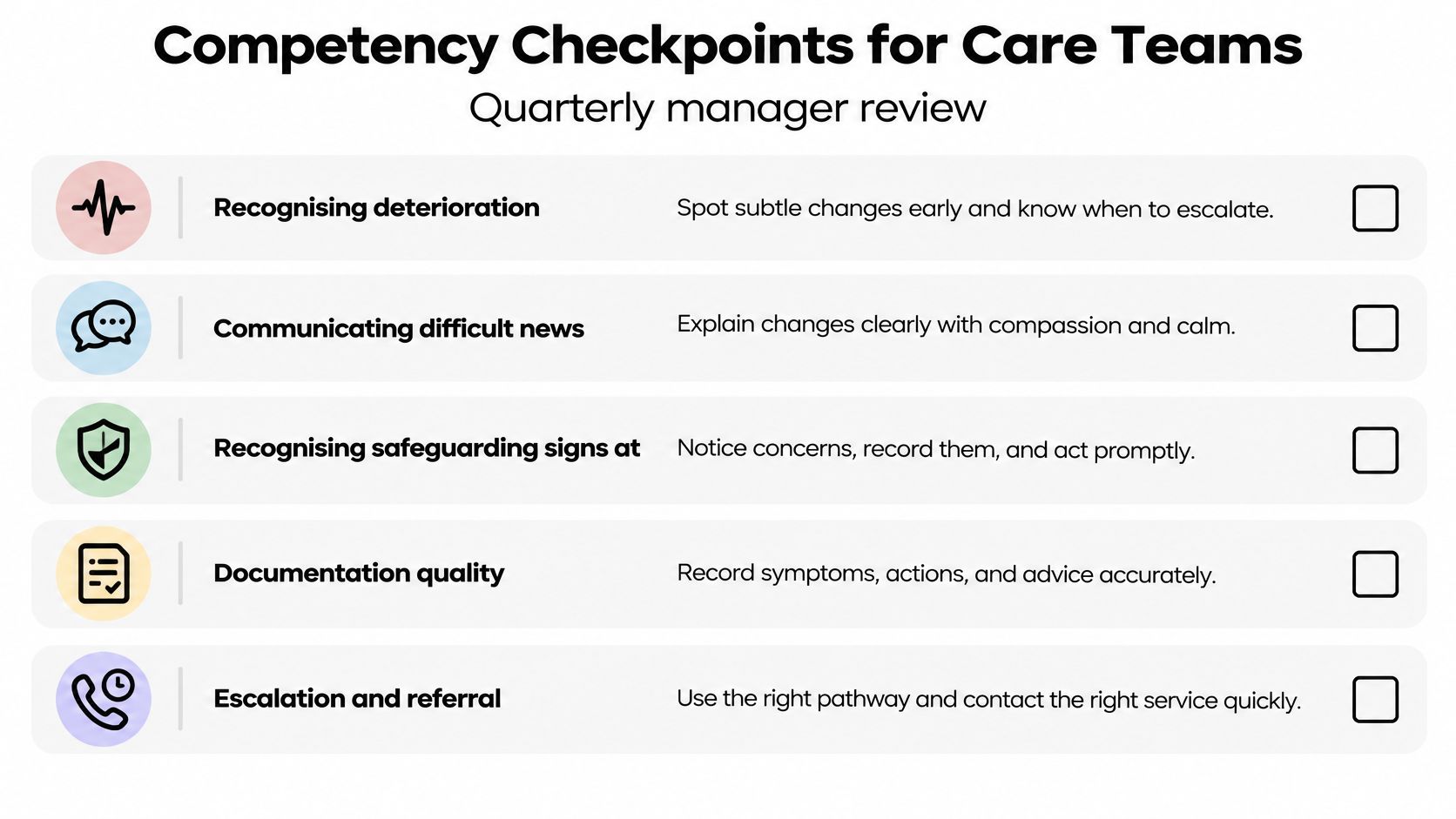
| Competency | Evidence to keep | Review interval |
|---|---|---|
| Recognising deterioration | Observation records and handover notes | Every six months |
| Communicating difficult news | Supervised role-play or reflective practice log | Annually |
| Recognising safeguarding signs at end of life | Completed training and referral examples | As set by organisational policy |
| Medicines awareness and anticipatory prescribing | Competency sign-off for medicines tasks | Annually |
| Bereavement signposting | Signposting record and checked local directory | Every six months |
Recognising deterioration is proved by notes that show a change, a time and an escalation, not by a certificate on the wall. Difficult conversations need a supervised practice log, because confidence fades if it is only talked about in induction. Safeguarding evidence should include a real referral example with names removed. Medicines sign-off covers what the worker may check and what they must not change. Bereavement signposting fails when the directory in the folder lists a service that closed last year, so check the numbers twice a year.
Sign-off: I have reviewed these five competencies, the evidence is current, and gaps are booked before the next quarter.
Audit One Pathway Before Your Next Shift
Pick one person on your caseload who is likely to be in the last year of life. Copy this into your shift notes and tick it before you leave.
- Preferences: Recorded, dated and shared with the GP, nurses and ambulance service.
- Escalation card: In the home, with night numbers and stated wishes.
- Documents: Advance plan, ReSPECT, DNACPR if made, and any attorney details, current and easy to find.
- Out-of-hours numbers: Checked against this week's on-call rota, not last month's.
- Bereavement signposting: A named contact and a current local directory ready for the family.
Where the ticks fail, training closes the gap faster than another unread policy. Our Duty of Care course covers health and social care professionals' legal and ethical responsibilities when supporting individuals, and it supports compliance with UK legislation, CQC expectations and organisational policies. The Care Certificate Bundle includes the full set of mandatory courses for people new to care, and the Basic Life Support course covers a common requirement for frontline roles. Learners have access to the support team throughout their learning journey, so you can raise a question before the next shift.
The first action today is simple. Open one folder and see whether a stranger at 2am could find the plan.
Cura Academy trains health and social care staff in the practical skills this work depends on, from duty of care and safeguarding through to communication at the end of life. If your team needs current, job-ready training that fits around shifts, start with the courses that match the gaps in your own audit. Visit Cura Academy and pick the pathway that gets your next night shift better prepared.