

You've completed a DoLS course, uploaded the certificate, and expect the next agency shift to be straightforward. Instead, the compliance officer asks for evidence of recent refresher training, supervision, and current role readiness. Your general safeguarding certificate is valid, but it doesn't answer the question the employer is asking: can you carry out a defensible DoLS assessment now?
That distinction matters. DoLS assessor training isn't only a route to qualification. It's part of an ongoing evidence trail involving legal knowledge, role-specific competence, supervision, continuing professional development, and current documentation. For agency, bank, and frontline staff, those details can decide whether an employer can safely place you on a rota.
Table of Contents
- Introduction to DoLS Assessor Training and Why It Matters Now
- Understanding the Legal Framework Behind DoLS Assessments
- Who Can Become a DoLS Assessor and What Competencies You Need
- How DoLS Assessor Training and Assessment Work
- Staying Competent With CPD Supervision and Annual Refreshers
- Proving Your Compliance and Securing More Opportunities
Introduction to DoLS Assessor Training and Why It Matters Now
An agency offers a care-home shift, then asks for more than a course title on your CV. The compliance officer may request your certificate, completion date, recent learning, supervision records, and confirmation that you understand the boundaries of your role. A general safeguarding qualification can support your application, but it may not show that you are ready to undertake DoLS-related work now.
That distinction affects both frontline and agency staff. Anyone supporting a person who may be deprived of liberty must recognise restrictions that need closer scrutiny, apply the Mental Capacity Act appropriately, document concerns clearly, and escalate them through the correct route. Formal assessor duties require role-specific competence, sound judgement, and records that can withstand review.
Demand remains high, and applications can take time to progress. The Warwickshire Council summary of the DoLS assessor training programme and government data describes the scale of completed applications and the delays affecting the system. That makes assessor availability, appropriate allocation, sequencing, and administrative readiness practical concerns for employers and services, not abstract policy issues.
Before starting the pathway, separate three questions:
- Can I enter the route? Your professional background and experience influence which assessor role you may be able to undertake.
- Can I complete the training? A structured programme may test your Mental Capacity Act knowledge and require evidence before you progress.
- Can I remain defensible in practice? Refresher training, supervision, reflective learning, and accurate records must stay current after the certificate is issued.
DoLS assessor training sits within a wider professional framework. It covers capacity, mental disorder, best interests, necessity, proportionality, human rights, and assessment practice. It should also make clear what you are authorised and competent to do. Courses carrying a DoLS label are not interchangeable, and employers may apply their own compliance filters before confirming shift readiness.
Qualification is the starting point of that evidence trail. A certificate without current refresher evidence may not satisfy an employer, while a broad safeguarding course will not replace assessor-specific preparation. Treat statutory refresher cycles, supervision gaps, and documentation as part of staying competent, rather than paperwork added after the work.
Understanding the Legal Framework Behind DoLS Assessments
A person may be unable to consent to a care arrangement, while the arrangement still restricts their liberty. DoLS sits within the Mental Capacity Act framework to ensure that situation receives formal scrutiny. The safeguards protect rights, require independent assessment, and prevent restrictive arrangements from continuing without proper authorisation and review.
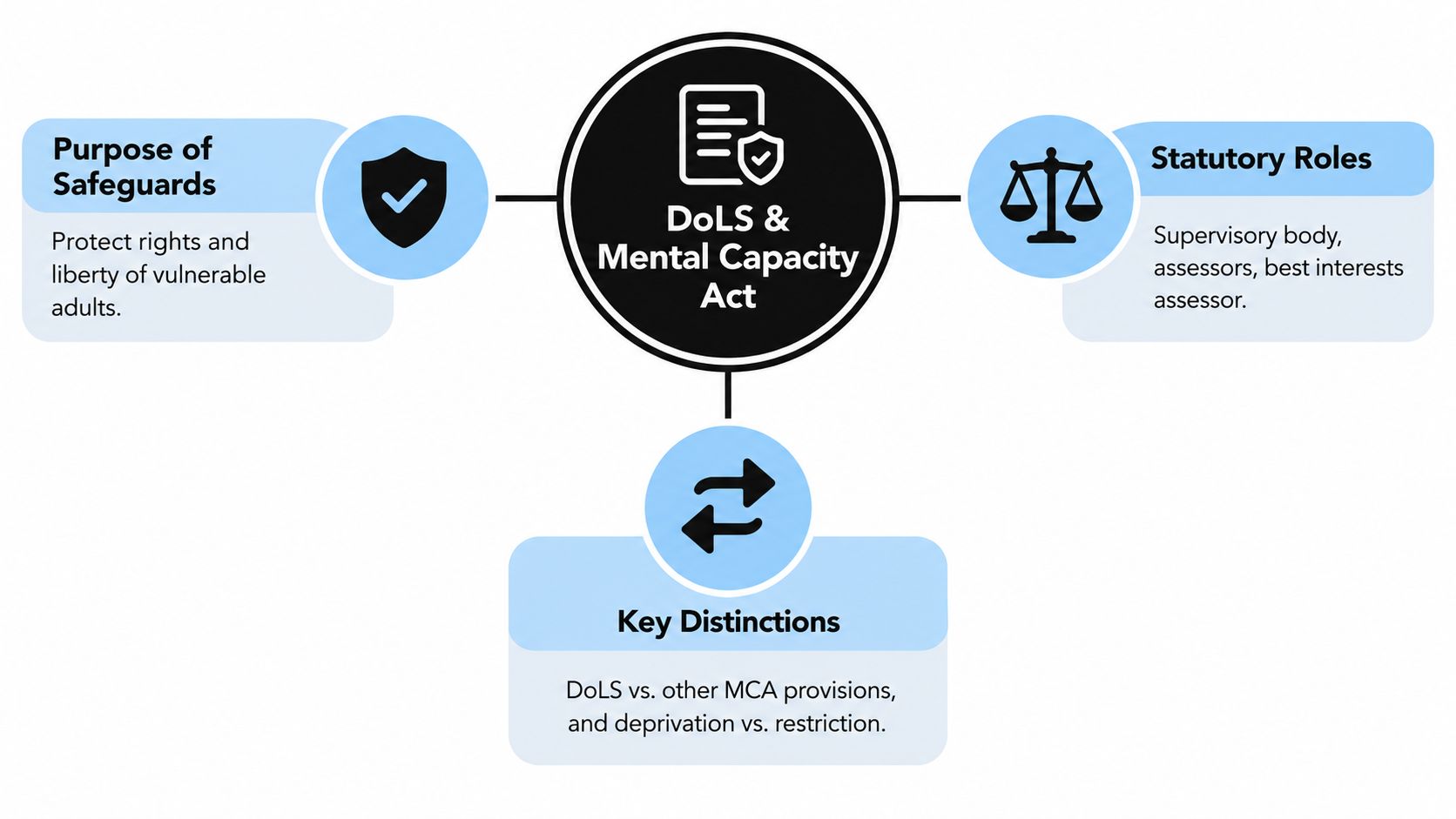
The legal process assigns different questions to different participants. A supervisory body manages the authorisation process. Assessors examine the person's circumstances and the statutory criteria. A Best Interests Assessor considers best interests, human rights, necessity, proportionality, and whether a less restrictive option could work. A mental health assessor addresses the mental health and mental disorder elements required by the process.
These functions may involve related evidence, but they are not interchangeable. Understanding capacity principles does not, by itself, demonstrate that a practitioner can complete a formal DoLS assessment, record the reasoning, and withstand later scrutiny. Generic Mental Capacity Act awareness is not the same as DoLS assessor readiness.
Why assessor-specific preparation matters
The statutory framework sets specific expectations for preparation. Under England's DoLS regulations and Code framework, mental health assessors must complete a dedicated training programme made available by the Royal College of Psychiatrists. They must also complete further relevant training within the prior 12 months before selection. The Code states that all assessors under the safeguards must undertake mandatory annual refresher training.
For employers and supervisory bodies, that creates a practical compliance check. They may ask for:
- Role-specific training, rather than general safeguarding learning.
- Recent relevant CPD, completed within the required timeframe where applicable.
- Annual refresher evidence, stored and ready for review.
- Assessment readiness, supported by supervision and practice discussion.
A current safeguarding certificate does not prove that an assessor can apply the statutory route, distinguish assessment functions, or produce defensible reasoning. Supervision gaps can also matter. A certificate may show attendance, while case discussion, reflective records, and sampled assessments show whether competence remains usable on shift.
Use the Mental Capacity Act training guidance to revisit the legal foundation, then check that DoLS learning covers the additional assessor requirements. The practical test is the evidence trail. Can you show current training, refresher completion, supervision, and records that explain how the law was applied?
Key takeaway: Generic MCA awareness supports good practice. Assessor-specific competence, annual refresher evidence, and current supervision support lawful appointment and defensible assessment.
Who Can Become a DoLS Assessor and What Competencies You Need
Eligibility depends on the statutory function and your professional background. DoLS assessors come from different workforces, and experience that supports one role may not satisfy the requirements for another.
Doctors face a defined eligibility boundary. The programme information discussed earlier states that eligible doctors need at least three years of post-registration experience in diagnosing or treating mental disorder. That limits the available pool and can leave employers balancing urgent demand against the need to appoint people who meet the formal criteria.
Best Interests Assessor candidates need preparation that supports work with capacity, care, safeguarding, risk, rights, communication, and person-centred decision-making. A job title alone does not demonstrate readiness. Candidates must show that they can examine a person's circumstances independently, weigh conflicting evidence, identify less restrictive options, and explain how the evidence supports their conclusion.
Compare your background with the route
| Assessor Route | Typical Background | Key Competency Check |
|---|---|---|
| Mental health assessor | Eligible medical professional with relevant mental disorder experience | Can you assess the mental health and mental disorder requirements within the statutory framework? |
| Best Interests Assessor | Suitable social care or allied professional background, subject to the applicable appointment requirements | Can you assess best interests, necessity, proportionality, objection, and the person's rights? |
| Frontline care worker | Care assistant, support worker, nurse, or agency worker involved in day-to-day support | Can you recognise possible deprivation, apply MCA principles, record concerns, and escalate to the appropriate professional? |
| DoLS coordinator or administrator | Experience in social care administration, legal processes, or safeguarding systems | Can you manage records, track authorisations, identify missing evidence, and support assessors without making decisions outside your role? |
The table separates learning from appointment. Not everyone who completes DoLS learning becomes a statutory assessor. Training can improve frontline decisions and make you more useful to a service, while formal appointment still depends on eligibility, competence, and the requirements set by the relevant supervisory body.
The competencies employers notice
Employers and commissioning teams look for practical judgement. They want evidence that you can support a capacity assessment, identify the decision being considered, distinguish restriction from deprivation, and avoid assumptions based on diagnosis, age, communication style, or apparent compliance.
Record-keeping carries equal weight. A defensible record should identify the information considered, show how the person's wishes and feelings were explored, record the less restrictive options examined, and connect the conclusion to the evidence. “The person is safe here” is a conclusion, not an analysis.
Shift readiness also depends on what happens after training. Supervisors may check whether you can discuss a difficult case, explain the statutory reasoning, and recognise when a matter needs escalation. If supervision has lapsed, an otherwise current certificate may not reassure an employer that your judgement is usable in practice. Annual refresher requirements and local compliance checks therefore affect whether you can be appointed for work, not whether you once completed a course.
The workforce shortage affects career planning. Independent coverage describes councils struggling to recruit and retain BIAs, while social workers remain occupied in substantive roles and independent assessors can be difficult to recruit because of pay and responsibility. The Community Care report on DoLS backlogs and workforce pressures places training within that wider capacity problem.
Demand may create opportunities, but it does not remove the need for standards. The strongest candidate can show a clear route from eligibility to supervised, refreshed, and defensible practice.
How DoLS Assessor Training and Assessment Work
A learner can complete several modules and still struggle with a capacity decision on shift. Good dols assessor training makes the progression visible, tests the MCA foundation first, and shows whether the learner can apply the safeguards to evidence rather than repeat terminology.
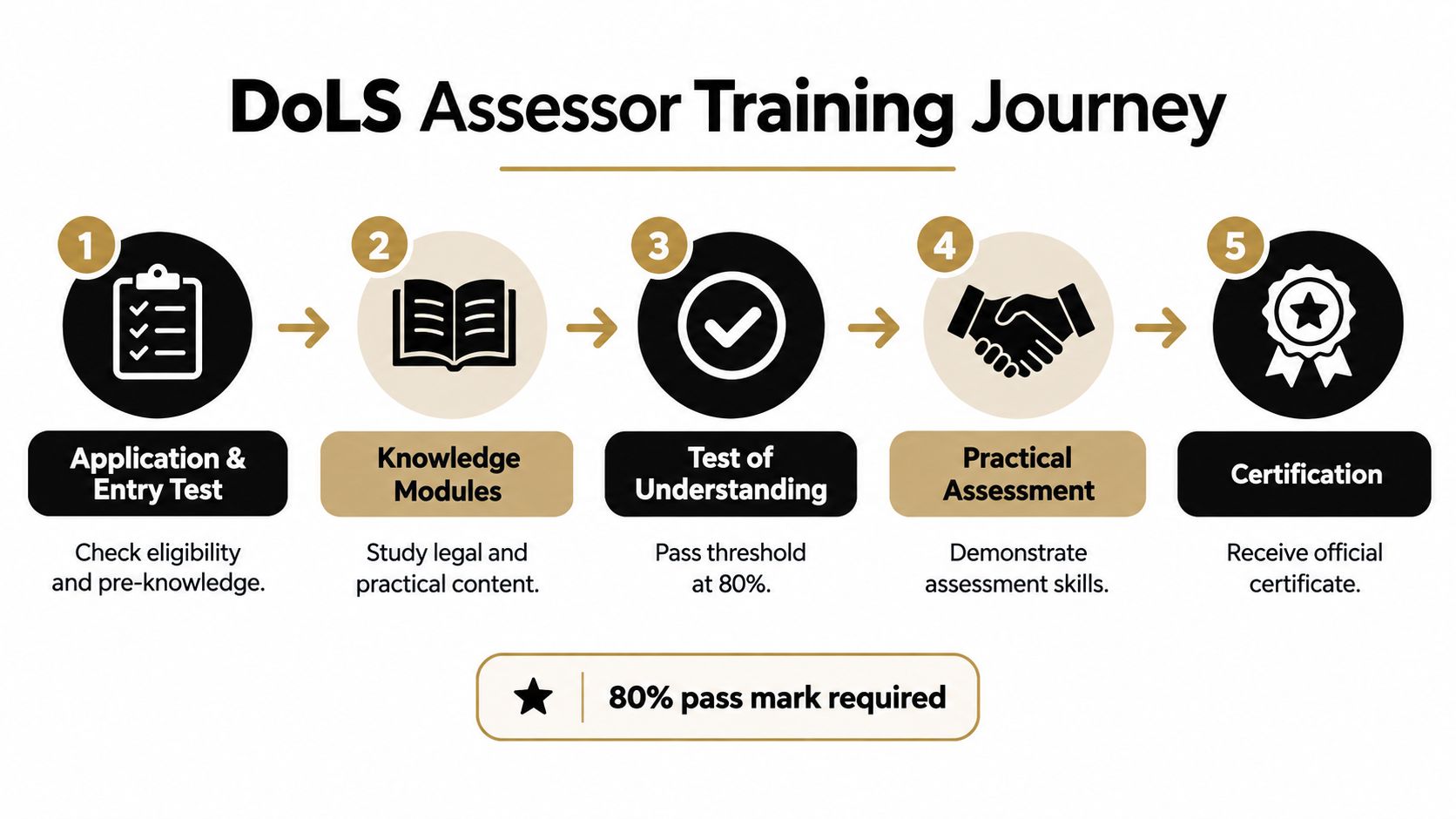
One UK local-authority e-learning programme sets a useful technical benchmark. Learners must pass an MCA Test of Understanding with a satisfactory score of 85% or more, then complete five DoLS knowledge sessions and a final DoLS test. The certificate is issued only after both tests are passed, according to the Warwickshire Council programme information.
That order matters. DoLS decisions depend on the Mental Capacity Act, so a weak MCA foundation can turn later modules into memorisation. An entry test identifies the gap early, while staged learning gives the learner a defined route to correct it.
Follow the sequence, not just the certificate
Start with eligibility. Check that your professional background, registration status where relevant, and experience fit the route you plan to take. Doctors should confirm the post-registration experience requirement before committing time and money to a programme.
Complete the MCA knowledge check. The local-authority programme described above uses 85% or more as its pass benchmark. Revise the functional approach to capacity, the decision-specific nature of assessment, best interests, communication support, and the balance between autonomy and protection.
Work through the DoLS knowledge sessions. Familiarity with the topic is not a reason to rush. Pay attention to statutory roles, the assessment sequence, evidence requirements, rights, objections, authorisation, conditions, and the practical tests of necessity and proportionality.
Take the final DoLS test. Treat each question as an application problem. Identify the legal function being tested, the person responsible for it, and the evidence needed to support the decision.
Retain the certificate and supporting evidence. Employers may check more than the final certificate. Keep the completion record, assessment outcome, relevant learning notes, and later refresher evidence in one professional file. That file can determine whether you are cleared for a shift when the rota is under pressure.
The supplied visual shows a five-stage journey, but its stated 80% pass mark conflicts with the verified programme benchmark of 85%. Follow the requirement set by your actual provider or appointing body. One programme's threshold does not automatically apply elsewhere.
Study for judgement, not recall
Use short case scenarios to test your reasoning. Write down the decision, available evidence, the person's communication, restrictions in place, alternatives considered, and the legal question still unanswered. This exposes weak reasoning sooner than highlighting a module and assuming recognition equals competence.
Keep a question log. When you miss an answer, record the underlying principle instead of copying the correct option. Revisit the log before the final test, and raise difficult points with a supervisor, educator, or experienced DoLS lead.
Use practical guidance on assessing mental capacity to connect legal principles with frontline observations. Your role may not include the formal assessment, but your records and escalation decisions can shape the evidence available to the appointed assessor.
The wider service situation also affects training value. Applications can take a long time to complete, and missing information, poor sequencing, or assessor unavailability add avoidable friction. Training cannot resolve every capacity problem, but clear preparation helps prevent delays that employers and appointing bodies will scrutinise.
A short programme may suit an experienced professional. It does not replace supervised exposure to complex cases. Complete the formal learning, then use supervision and case discussion to test whether your reasoning remains usable in practice.
Staying Competent With CPD Supervision and Annual Refreshers
Completing a course shows that you met a learning requirement at a particular point. It does not show that your reasoning remains current, that you have received useful feedback, or that you can explain a difficult decision months later. Shift readiness depends on evidence that competence has been maintained.
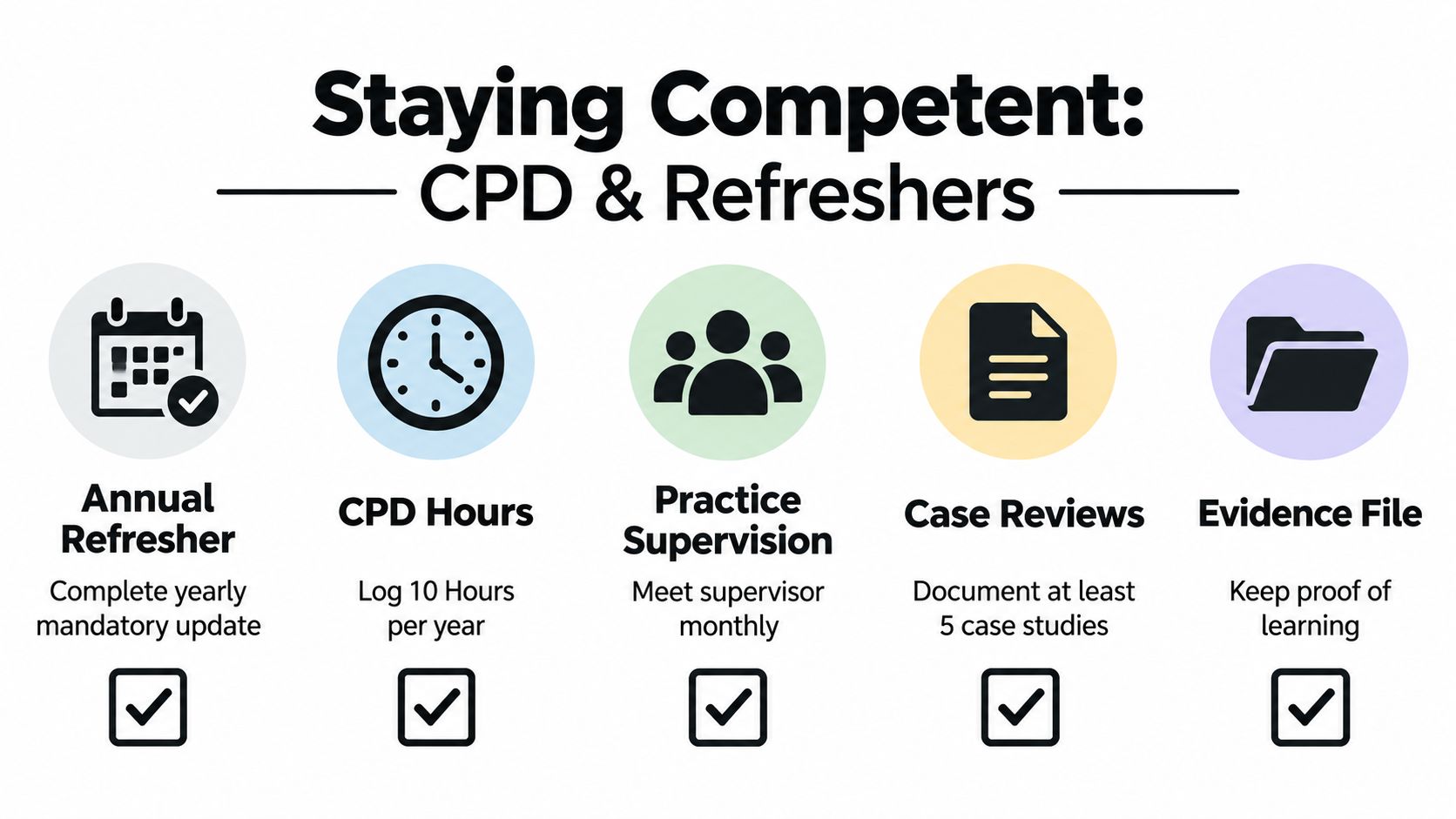
The statutory framework places annual refresher training within the compliance process. The requirement is a fixed control date, not professional development to complete only when the rota allows. Employers may check this before allocating work, so set the next refresher date as soon as the current one is completed.
Build an evidence system that survives scrutiny
A practical system can remain simple:
- Record the qualification date. Store the certificate, provider details, course title, and assessment result.
- Set the annual refresher date. Use a work calendar and a personal reminder, then confirm the requirement with the relevant supervisory body.
- Log relevant CPD as you complete it. Include the topic, date, learning point, and effect on your practice.
- Document supervision. Keep a confidential record of themes discussed, actions agreed, and further learning identified.
- Review the file before accepting work. An expired refresher or missing certificate is easier to resolve before an employer requests it.
Supervision is often the missing link between training and defensible practice. UK commentary reported that 40% of Best Interests Assessors did not receive supervision, while 28% said their training wasn't preparing them adequately. The same Community Care coverage of BIA supervision records concerns that initial five- or six-day courses were too short for such a complex statutory role.
Those findings do not make an initial course worthless. They show why attendance alone cannot demonstrate sustained competence. If supervision is inconsistent, raise the gap early with your manager or professional lead. Where local support is limited, structured courses in supervision can help formalise feedback, responsibilities, and review points.
Make supervision practical
A useful supervision meeting examines an actual decision or an anonymised scenario. Discuss how the person's wishes and feelings were obtained, whether communication was adapted, how objections were interpreted, what alternatives were considered, and whether the record supports the conclusion.
Peer review adds another check. Ask a colleague to challenge the reasoning rather than approve the outcome automatically. If the case involves uncertainty about mental disorder, capacity, risk, or a restriction, record the advice sought and how you acted on it.
Keep the evidence honest. A small record of meaningful discussions is stronger than generic entries such as “reviewed DoLS principles”. Employers check whether learning affected practice, not whether a folder is full.
A current certificate opens the conversation. Supervision, reflection, and clear records make your practice defensible.
The strongest approach combines annual revalidation, recent CPD, supervision, and role-specific evidence. Together, these records support safe decisions, help employers confirm shift readiness, and give the person subject to restrictions a more careful assessment.
Proving Your Compliance and Securing More Opportunities
A council or agency may need to decide quickly whether you can be booked safely and compliantly. Make that decision easier by keeping your evidence current, organised, and clearly linked to the role.
Create a digital onboarding folder containing your DoLS certificate, relevant MCA learning, annual refresher evidence, CPD log, supervision record, professional registration evidence where applicable, and DBS information. Use consistent file names and dates. One organised profile is easier to check than a collection of screenshots or incomplete attachments.
Use an employer-facing checklist
- Certificate: Show the full course title, provider, completion date, and assessment outcome.
- Refresher: Include the latest annual update and next review date.
- CPD record: List relevant learning and explain how it supports DoLS work.
- Supervision: Provide confirmation of current support when requested, without sharing confidential case details.
- Role clarity: State whether you are applying as a statutory assessor, a frontline worker supporting DoLS processes, or a coordinator.
- Availability: Tell the agency when evidence expires so it can act before a compliance hold.
- Interview examples: Prepare an anonymised example showing how you identified a concern, recorded it, and escalated it within your role.
Employers also look for evidence that you remain ready for the shift, not that you once completed a course. A certificate can become less persuasive when annual refreshers are overdue, supervision has lapsed, or your records do not show how learning informs decisions.

Do not claim assessor status if you have completed awareness training only. That can damage trust and place you outside your competence. Use precise wording: “I've completed DoLS learning, understand how to identify possible deprivation, and know when to refer to the appointed assessor.”
Backlog pressure can make current availability useful, but employers still apply approval checks. Councils and providers need people who keep learning current, work within statutory boundaries, and can produce reliable evidence when requested. Training may start the conversation. Maintained competence and clear records help you stay on the booking list.
Before accepting an assignment, check your route, confirm the provider's assessment requirements, complete the relevant learning, organise your evidence folder, and calendar the annual refresher date. This links qualification evidence to actual shift readiness rather than treating compliance as a one-off task.
Cura Academy helps UK health and social care workers build job-ready compliance through structured training pathways, mandatory refreshers, and role-specific learning in one place. Visit Cura Academy to organise your training evidence and stay prepared for employer checks and future shifts.