

At 7:45 on a Monday morning, care home staff training rarely looks like a tidy learning plan. In a 60-bed nursing home, the deputy manager may be preparing for two new healthcare assistants due at 8, checking an HR list showing that manual handling training expired last week, and meeting an agency registered nurse who has never worked in the building.
The phones keep ringing. Printed care plans cover the desk. The training matrix sits in a locked file that nobody has updated since the last CQC inspection. Everyone is busy, but the uncomfortable question remains: what important gap has been missed?
Turnover, agency cover and inspection readiness create the same pressure in almost every care setting. A new starter needs enough knowledge and supervision to work safely, an agency worker needs a role-specific orientation before joining the rota, and the manager needs evidence that training has become competent practice rather than a collection of certificates.
This is why effective care home staff training can't be reduced to a compliance checklist. The system has to keep working when shifts change, people leave, certificates expire and the next inspection arrives without warning. The practical aim is a training process that survives an ordinary Monday.
Table of Contents
- The Monday Morning Reality of Care Home Training
- What the Mandatory Training Baseline Actually Includes
- Inside the Care Certificate and How to Evidence It
- Induction and Refresher Schedules That Survive Real Shifts
- Choosing How Training Is Delivered in a Care Setting
- Tracking Compliance and Producing Evidence on Demand
- Building a 90-Day Training Plan Managers Can Actually Run
The Monday Morning Reality of Care Home Training
The hardest training problems usually appear before the first handover. A deputy manager may know that two new healthcare assistants need induction, but the priority can change as soon as a resident falls, a staff member calls in sick or an agency booking changes from a carer to a nurse. The training plan then competes with immediate operational demands.
A printed matrix often creates false confidence. It may show that someone attended moving and handling training, but not whether their practical technique was observed, whether the certificate has expired, or whether the worker understood the equipment used in that particular home. Attendance answers one question only. It doesn't prove that a worker can apply the skill safely.
Three pressures managers can't ignore
Turnover means the home repeats the same induction work throughout the year. If every starter begins from scratch, managers spend time checking information that could have been captured once and reused. If they assume previous experience is enough, they risk putting someone on the floor without evidence of local competence.
Agency cover introduces a different problem. An agency worker may hold relevant training, but still need an explanation of the home's safeguarding route, emergency procedures, equipment, resident risks and documentation standards. A certificate from another employer can't demonstrate familiarity with this building or its residents.
The next inspection exposes weak systems rather than isolated missing documents. Inspectors may ask how the provider identifies training needs, how competency is assessed, how agency workers are managed and what happens when a gap is discovered. A last-minute folder assembled for the visit won't answer those operational questions convincingly.
Manager's reality: A training system earns its value when the home is short-staffed, not when everyone is available for a planned workshop.
The answer isn't to add more courses indiscriminately. Managers need a live process that distinguishes knowledge from competence, adapts induction to the worker's starting point and produces evidence without a frantic search through paper files. That is the standard used throughout this guide.
What the Mandatory Training Baseline Actually Includes
The starting point in England is the Care Certificate, which became a key UK care workforce milestone in April 2015. Health Education England, Skills for Care and Skills for Health created it in response to the Cavendish Review. The framework contains 15 standards that new health and social care support workers are expected to attain, or be working towards, within their first 12 weeks of employment. The CQC mandatory training overview references the Care Certificate as the induction route for new care staff.
Skills for Care describes the Care Certificate as the minimum training, supervision and assessment new staff should receive before delivering care out of the sight of more experienced workers. That distinction matters. A worker may complete an online module about safeguarding, but the manager still needs to establish whether the worker knows how to report a concern in this home.
Build the baseline around risk
A care home training matrix should cover the Care Certificate standards and the role-specific subjects attached to the worker's duties. Core areas include:
- Safeguarding adults and children, including the home's reporting route and escalation process.
- Health and safety, fire safety and infection prevention and control.
- Basic Life Support, with practical assessment where the role requires it.
- Moving and handling, assessed against the equipment and techniques used in the home.
- Handling information, confidentiality and secure record keeping.
- Person-centred care, equality, diversity and inclusion.
- Mental Capacity Act principles, consent and appropriate decision-making.
- Role-specific clinical topics, such as medicines, pressure ulcer prevention and dementia care where the worker's responsibilities require them.
The Skills for Care Care Certificate FAQ explains that employers must combine learning with workplace assessment. CQC Regulation 18 also requires providers to give staff the support, training, professional development, supervision and appraisal needed to carry out their roles.
A useful working schedule separates immediate safety from the full induction cycle.
| Module | Typical completion window | Delivery method |
|---|---|---|
| Safeguarding | Before independent care, within the home's defined induction window | Interactive session plus local policy discussion |
| Moving and handling | Before carrying out relevant tasks | Face-to-face practical assessment |
| Infection prevention and control | Before routine resident contact | E-learning followed by local practice check |
| Fire safety | Before working in the home | Site-specific briefing and practical drill |
| Basic Life Support | Before duties requiring emergency response | Face-to-face practical assessment |
| Mental Capacity Act and consent | During initial induction | Guided learning plus scenario discussion |
| Handling information | Before accessing care records | E-learning and supervised documentation check |
The mandatory training guidance for care workers can help managers organise the course side of this baseline, but a provider still owns the workplace assessment. A certificate can't replace a signed observation, local briefing or supervision decision.
Inside the Care Certificate and How to Evidence It
The Care Certificate is often treated as a workbook project. That is where many otherwise organised inductions go wrong. The workbook demonstrates knowledge, while competence is established through observed practice, discussion and evidence gathered in the workplace.
The 15 standards cover subjects including duty of care, working in a person-centred way, communication, privacy and dignity, fluids and nutrition, awareness of mental health conditions, safeguarding, basic life support, health and safety, handling information and personal development. Each standard needs an evidence route that matches the risk.
Separate paper completion from safe practice
Some standards appear straightforward until a worker has to use them during a difficult shift. Safeguarding, basic life support, duty of care, fluids and nutrition, and awareness of mental health conditions commonly require more than a completed workbook because staff must make decisions in context.
Other standards may be easier to evidence through written work, but managers should still check whether the employee can apply them with residents and colleagues.
| Standard | Inspection risk | Evidence type |
|---|---|---|
| Safeguarding adults | High if escalation routes aren't understood | E-learning certificate, scenario discussion and observed reporting process |
| Basic Life Support | High if practical response isn't assessed | Course certificate and dated practical competency record |
| Duty of care | High when responsibilities are unclear | Reflective account and senior carer witness statement |
| Fluids and nutrition | High where recording or support is inconsistent | Work-based observation and care record review |
| Mental health awareness | Increased risk of poor communication or unmet needs | Reflective account and assessor discussion |
| Person-centred care | Weak evidence can expose a gap between policy and practice | Observation note and resident-focused discussion |
| Communication | Usually visible through daily interactions | Witness statement and supervised practice |
| Privacy and dignity | Often passes on paper but needs behavioural evidence | Observation note signed by an assessor |
| Handling information | Commonly underestimated because access controls matter | E-learning certificate and record-handling observation |
| Personal development | Missed when managers focus only on mandatory topics | Supervision note and development plan |
| Health and safety | Incomplete where local hazards aren't discussed | Certificate, local briefing and observation |
The Care Certificate standards guide is useful for structuring the learning sequence, but the manager or assessor must connect each standard to a real task. A senior carer might observe a new worker supporting nutrition, handling confidential information or responding to a concern, then record the date, context, outcome and any follow-up action.
The question isn't “Has the employee finished the workbook?” It is “Can the employee carry out the relevant task safely, and can I prove how I reached that decision?”
The practical trap is familiar. A new worker completes most of the e-learning in the first week, but no assessor observations are recorded. That worker may have evidence of knowledge, not a completed Care Certificate. CQC inspectors understand the difference, and a manager should be able to show it without reconstructing the induction from memory.
Induction and Refresher Schedules That Survive Real Shifts
One induction plan for every starter sounds efficient until the first experienced carer joins, a returning employee comes back after a break or an agency nurse arrives for a single shift. Those people don't have the same evidence needs. An effective schedule uses the worker's previous records, role and risk profile to set the minimum safe route.
A brand-new healthcare assistant needs local orientation, supervision and the relevant Care Certificate pathway before working beyond the line of sight of experienced staff. A returning carer may already have evidence for some standards, but the manager should check whether policies, equipment, resident needs or the worker's role have changed. An agency nurse needs a focused pre-shift briefing, local escalation information and confirmation that clinical responsibilities match current competence.
Use a route, not a rigid week
| Starter type | Pre-shift minimum | Full induction window | Key refresher intervals |
|---|---|---|---|
| New healthcare assistant | Identity, role boundaries, safeguarding route, fire procedure, infection control, moving and handling restrictions and supervised duties | Care Certificate standards within the first 12 weeks, with workplace observations | Use the home's documented renewal schedule and risk review |
| Returning carer | Review previous evidence, changes to policy, equipment, resident risks and any expired training | Targeted re-induction, followed by gaps and updated observations | Recheck every certificate against its expiry date |
| Agency nurse | Agency compliance evidence, local emergency procedures, safeguarding policy, medicines arrangements and supervised orientation | Role-specific local induction before further shifts | Confirm agency records and reassess where evidence is absent or outdated |
Some refresher cycles are set by the provider's risk assessment, contract or local policy rather than one universal national timetable. Safeguarding is different. NICE recommends that directly employed staff complete mandatory safeguarding training as soon as possible and no later than six weeks after starting, with annual assessment of safeguarding knowledge and refresher training when needed. The NICE safeguarding recommendations also favour live, interactive delivery where possible.
The rota has to accommodate reality. If a worker is sick on day two, record what was completed, move the missed observation to a named date and keep the person under appropriate supervision. A night-shift employee may need short sessions arranged around sleep and handover rather than being marked as non-compliant because they can't attend a daytime class.
Before full completion, sign off a clearly defined minimum safe status. That should state which duties the worker may perform, which require direct supervision and which remain prohibited until observed competence is documented. This gives the team a practical control instead of relying on an informal promise to finish the paperwork later.
Choosing How Training Is Delivered in a Care Setting
The right delivery method depends on the skill being taught, the staff member's needs and the home's ability to release people from shifts. No platform can turn every subject into an effective online quiz. Managers should choose the method that produces reliable behaviour, not the method that creates the neatest completion report.
Match the method to the task
| Method | Best for | Shift impact | Watch-outs |
|---|---|---|---|
| Classroom face-to-face | Safeguarding discussion, practical skills and complex scenarios | Requires cover and coordinated attendance | A single session may not suit different experience levels |
| E-learning modules | Policy knowledge, terminology and introductory theory | Flexible around shifts | Poor fit for practical competence, limited literacy support or weak internet access |
| Blended programmes | Combining structured theory with observation | Spreads time across different shifts | Managers must connect the online result to a named workplace assessor |
| Microlearning nudges | Short refreshers, reminders and policy prompts | Low disruption when scheduled well | Small modules cannot replace full learning or live assessment |
A sensible default is theory online, practical learning face-to-face and short refreshers through mobile-friendly modules. That arrangement gives staff flexibility without pretending that moving and handling, fire drills or resuscitation can be mastered through a multiple-choice test.
Low-bandwidth homes need an offline or printable fallback. Staff with English as a second language may need extra explanation, visual prompts and a chance to discuss scenarios rather than being judged only by reading speed. Literacy levels also matter. A completion tick can hide misunderstanding if the learner has clicked through content without being able to explain the decision behind it.
Record digital learning properly
When training starts online, the manager should add a separate workplace observation. Record the worker's name, skill observed, equipment or scenario used, assessor, date, result and any action required. If the person needs further supervision, record the restriction and review date rather than marking the module complete.
Face-to-face teaching also needs evidence. A signed attendance sheet proves presence, not competence. The stronger record combines attendance, assessment outcome and a clear decision about what the worker can do independently.
Tracking Compliance and Producing Evidence on Demand
Training is only defensible when the evidence is easy to retrieve. An inspector or agency auditor doesn't buy a list of course titles. They need to see that the provider knows who has completed each requirement, when competence was checked, when renewal is due and what action follows a gap.
The minimum evidence pack should contain:
- Dated certificates: Include issue dates, expiry dates and the course title.
- Competency observations: Record live assessments signed by an appropriate supervisor or assessor.
- Induction checklists: Show the local orientation, role boundaries and supervised duties completed.
- Refresher calendar: Display upcoming renewals and the person responsible for booking them.
- Incident-to-training maps: Link relevant care events, complaints or observed weaknesses to a training response.
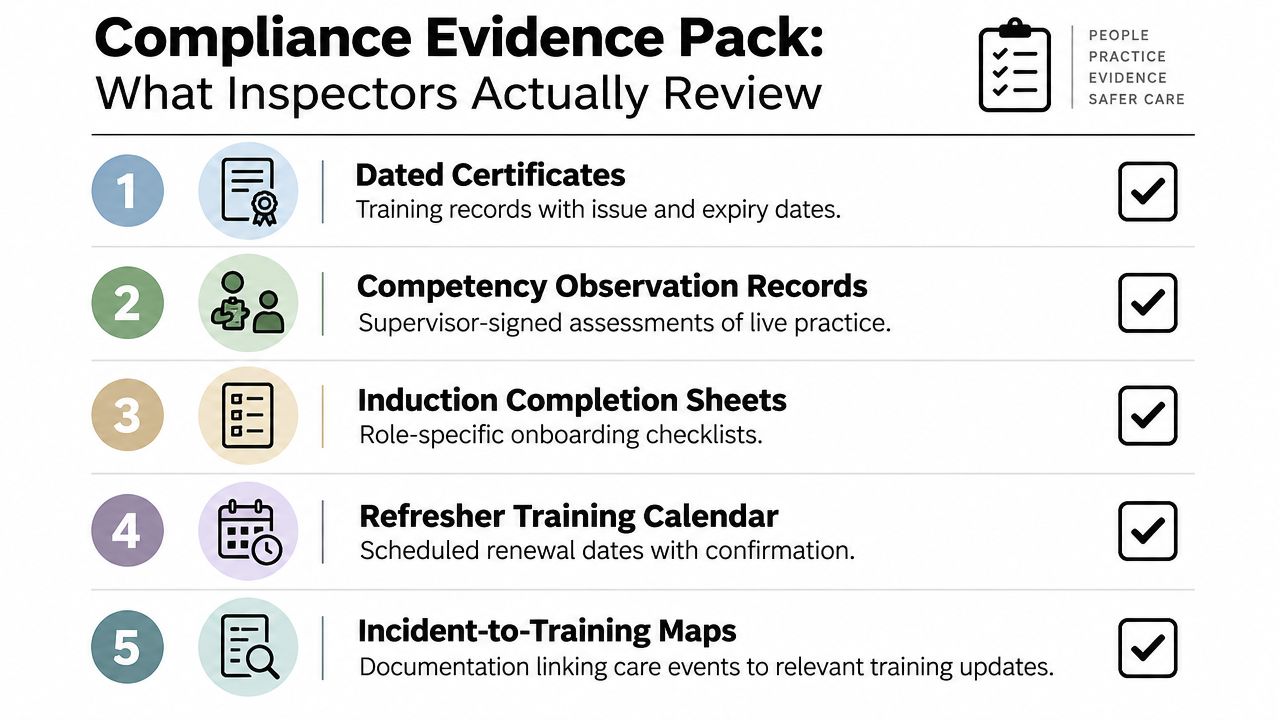
A single live matrix should connect every staff member with every required module. It should show status, evidence location, expiry date, restrictions and the next action. The training matrix template guidance can help structure that record, whether the final system is digital or spreadsheet-based.
Make missing evidence trigger action
If a certificate is missing, don't assume the course was completed. Mark the record as unverified, request evidence and apply supervision controls until the position is clear. If a certificate has expired, book renewal and record what the worker can safely do in the meantime.
Agency workers need the same discipline. If an agency nurse arrives without current safeguarding evidence, the home should confirm the agency's records, provide the local safeguarding briefing and decide whether the worker can safely undertake the planned duties. The decision and its reasoning belong in the record.
A weekly review keeps the system usable. Check new starters, upcoming expiries, overdue observations and agency bookings. A manager should be able to open the matrix, filter for gaps and produce the evidence pack quickly, rather than searching through individual folders the night before an inspection.
For a practical explanation of how the evidence should connect to day-to-day work, watch this short training overview before reviewing your own records.
Building a 90-Day Training Plan Managers Can Actually Run
A training reset works best when it produces usable controls early. The aim isn't to complete every improvement at once. It is to establish a reliable baseline, make delivery easier for different shifts and test whether the evidence survives scrutiny.
Days 1 to 30 establish the foundation
Start with an audit of the current matrix. Compare every staff member against the modules required for their role, then check whether each completion has supporting evidence. Separate verified competence, learning completed but not observed, expired training, and records that are missing.
Next, close the most immediate Care Certificate gaps for new starters. Book overdue practical observations, identify assessors and create restrictions for tasks that haven't been signed off. Schedule mandatory refresher sessions before they collide with annual leave, sickness or a busy inspection period.
The first 30 days should produce a gap analysis that names people, modules, risks and owners. Avoid a general statement such as “training needs updating”. A useful action says who needs which assessment, by whom and by what date.
Days 31 to 60 stabilise delivery
Move recurring theory into a blended format where it suits the subject. Keep practical assessment live, use online learning for knowledge-based content and add short reminders for topics that staff need to revisit regularly, such as fire safety and infection prevention.
Give each employee a refresher calendar that managers can see alongside the rota. This prevents the common failure where a course is technically scheduled but no one has arranged cover.
A subscription platform such as Cura Academy is one possible route for organising Care Certificate learning, mandatory refreshers and role-specific courses in a structured online pathway. Other homes may prefer a spreadsheet paired with a shared calendar, an in-house learning management system or training delivered through a local authority consortium. The right choice depends on budget, connectivity, assessor capacity and how much manual administration the team can sustain.
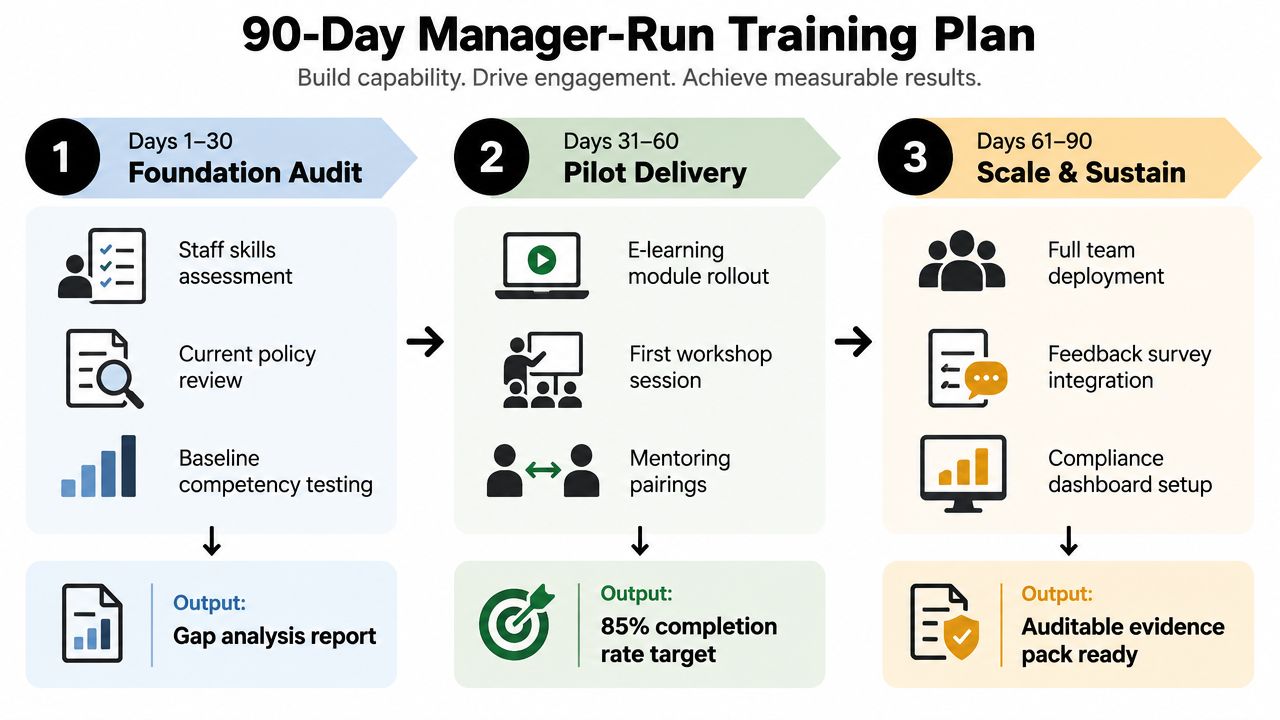
Days 61 to 90 harden the system
Run a mock inspection using the evidence pack. Ask a colleague to select staff records at random and request the certificate, observation, induction checklist, renewal date and any restrictions. If the manager can't retrieve the answer promptly, the system still depends on personal memory.
Formalise agency onboarding before the worker arrives. Send the required evidence request in advance, prepare a short local briefing and state which duties require supervision during the first shift. Then compare the matrix with turnover records. Repeated gaps may indicate that the induction pack, assessor availability or course format needs changing.
By day 90, the manager should have produced:
- A current training matrix with status, evidence and expiry dates.
- A visible refresher calendar connected to rota planning.
- An organised evidence folder with consistent naming and access rules.
- A role-specific induction pack that another deputy can use without explanation.
- A mock-review record showing unresolved risks and completed corrective actions.
The system is ready when it can handle the next new starter without starting again from zero. It should tell the manager what is safe today, what needs supervision and what action comes next.
Cura Academy provides structured access to Care Certificate learning, mandatory refreshers and role-specific care courses that can support a consistent onboarding process. If you want to reduce scattered training records and give new or existing staff a clearer route to job-ready compliance, visit Cura Academy and review the available training options.