
You've registered with two agencies, uploaded your certificates, and cleared your diary for shifts. Then nothing happens. This guide shows you why that silence usually comes down to Care Certificate training, what employers check behind the scenes, and how to build evidence that gets you booked instead of parked on a pending list.
Table of Contents
- The Moment That Decides If You Get Booked
- What the Care Certificate Actually Is
- The 15 Standards Grouped Into Real Work Clusters
- The Realistic Pathway From Enrolment to Sign-Off
- Why Finishing an Online Course Is Not the Same as Being Compliant
- How Cura Academy Fits Into Your Compliance Stack
- Common Questions Care Workers Ask Before They Sign Up
The Moment That Decides If You Get Booked
You arrive early for your first shift at a care home, uniform ready, ID badge clipped on. Before you meet a single resident, the senior on duty asks the agency one question. Has this worker been signed off to work unsupervised, or does she need shadowing today?
That question decides everything. If your file shows completed modules but no observed practice, you'll shadow, cover breaks, and do low risk tasks while another carer picks up the booked hours. If your file shows knowledge, observation, and assessor sign off mapped to the standards, you start properly.
Compliance teams see this pattern weekly. A new carer finishes an online course at midnight, downloads a certificate, and expects shifts the next morning. The agency consultant wants to book her, because the home is short staffed and she sounds keen on the phone.
Then compliance opens the file. There's no record of who observed her hand hygiene, no evidence she can respond to a safeguarding disclosure, and no note about supervision until competence is confirmed. The booking stalls, not because she's unsuitable, but because the evidence trail doesn't answer the risk questions.
What screeners look for first
Screeners don't start with your enthusiasm. They start with trainability, traceability, and risk.
- Knowledge evidence: Completed modules with dates and assessment outcomes, not a single undated certificate.
- Observed practice: Named assessor, activity observed, and outcome recorded against a specific standard.
- Supervision status: A clear statement of what you can do alone, what needs direct supervision, and what you must not do yet.
- Gaps and remediation: Honest notes where you needed prompting, plus what happened next to close the gap.
Practical rule: If your file can't show who saw you do the task, an employer will assume nobody has.
The Care Certificate sits at the centre of this screening moment because it's the common language agencies, care homes, and domiciliary providers use for new frontline staff. It isn't a decorative course. It's the framework they use to decide whether you're safe to deploy, and how closely you need watching until you are.
The fastest route through screening is simple in structure. Build the knowledge half quickly and cleanly online, then turn that learning into workplace evidence through shadowing, observation, and sign off. That's where a structured subscription helps, because agencies check dated, standard by standard completion first before they even ask about observations.
What the Care Certificate Actually Is
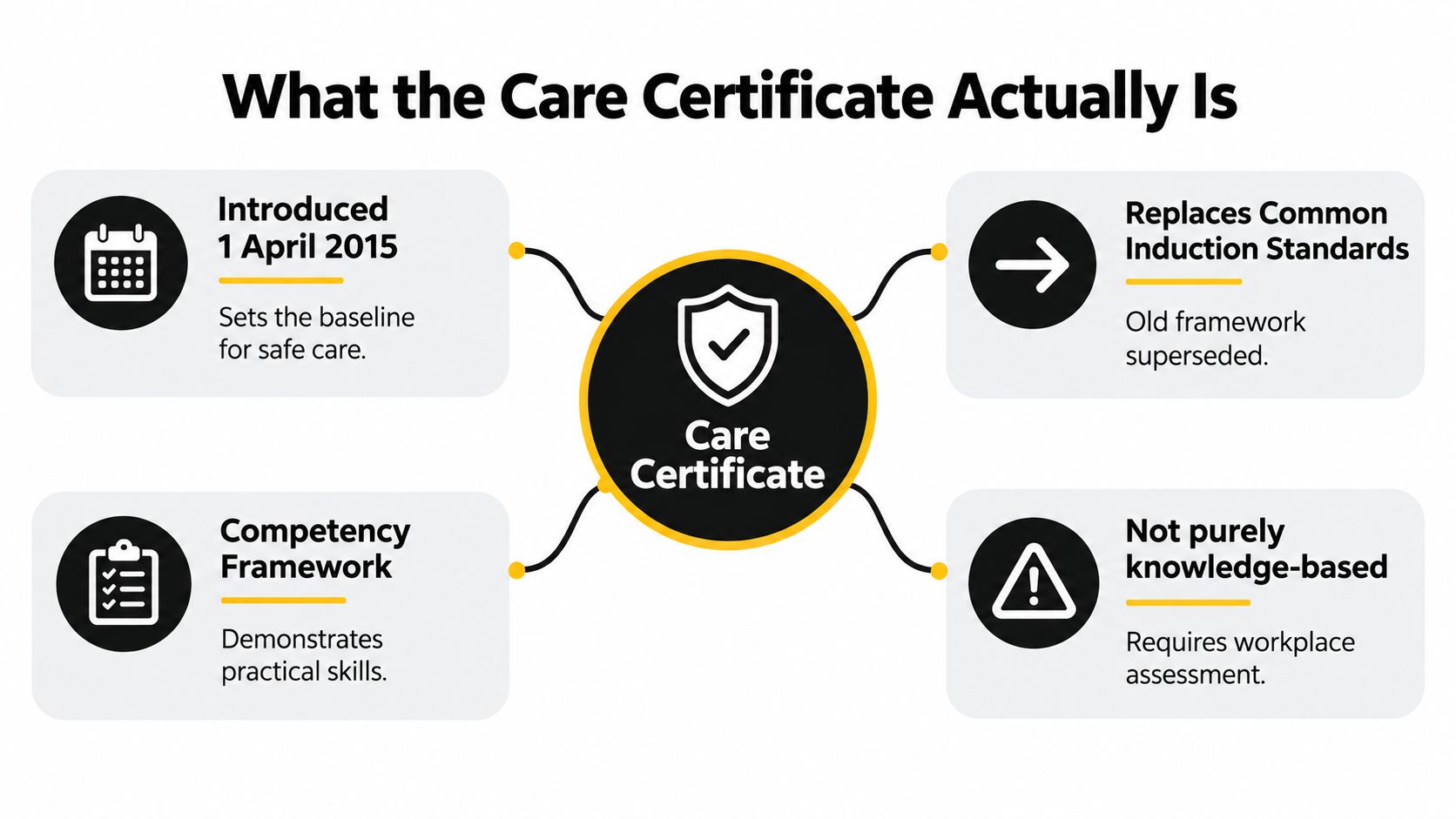
The Care Certificate is a competency framework, not a pass or fail e learning course. Think of it as a driving test rather than a theory test. Knowing the Highway Code matters, but nobody hands you a licence until an examiner has watched you drive.
It was introduced on 1 April 2015 to replace the Common Induction Standards, with the government expecting newly appointed healthcare assistants and social care support workers to complete it within their first 12 weeks of employment. That timescale tells you its purpose. It isn't optional professional development for later in your career, it's an early employment milestone that confirms you can do fundamental tasks safely before you take on more.
Who it's built for
The framework targets people entering frontline roles who may have no previous care experience. That includes healthcare assistants, care assistants, and social care support workers in care homes, domiciliary care, and health care support settings. The original policy also covered workers supporting people with dementia and their carers, which shows it was designed as a broad baseline, not a specialist badge for one client group.
Because different employers use the same baseline, the framework creates portability. A care home, a home care agency, and a staffing agency can all read the same evidence and understand what has been covered. Portability doesn't remove local checks, but it stops every employer starting from zero.
What it is not
Don't confuse the Care Certificate with the Level 2 Adult Social Care Certificate qualification. They're different products with different weight.
- Care Certificate: An induction competency framework assessed in the workplace against agreed standards, expected early in employment.
- Level 2 qualification: An Ofqual regulated qualification requiring observational assessment over a much longer period.
- Online completion certificate: Proof you studied content and passed knowledge checks, which is only one part of the full picture.
Course providers blur these categories because confusion sells. Employers don't blur them, because confusion creates risk on shift. If a provider promises you a fully compliant Care Certificate from your sofa with no workplace element, treat that claim with suspicion.
Skills for Care owns the standards, and the CQC expects providers to use them when assessing new healthcare assistants and support workers. That regulatory link is why employers care. It isn't about collecting paper for a file, it's about demonstrating, if challenged, that a worker was assessed as competent before being left alone with vulnerable people.
That's the standard you're being judged against from day one. Understand it as competence you must show, not content you must consume, and every decision about courses, shadowing, and evidence becomes clearer and faster.
The 15 Standards Grouped Into Real Work Clusters
Listing standard titles helps nobody on a busy shift. You need to know what each cluster asks you to do when a resident refuses care, a relative raises a concern, or a colleague cuts a corner on infection control.
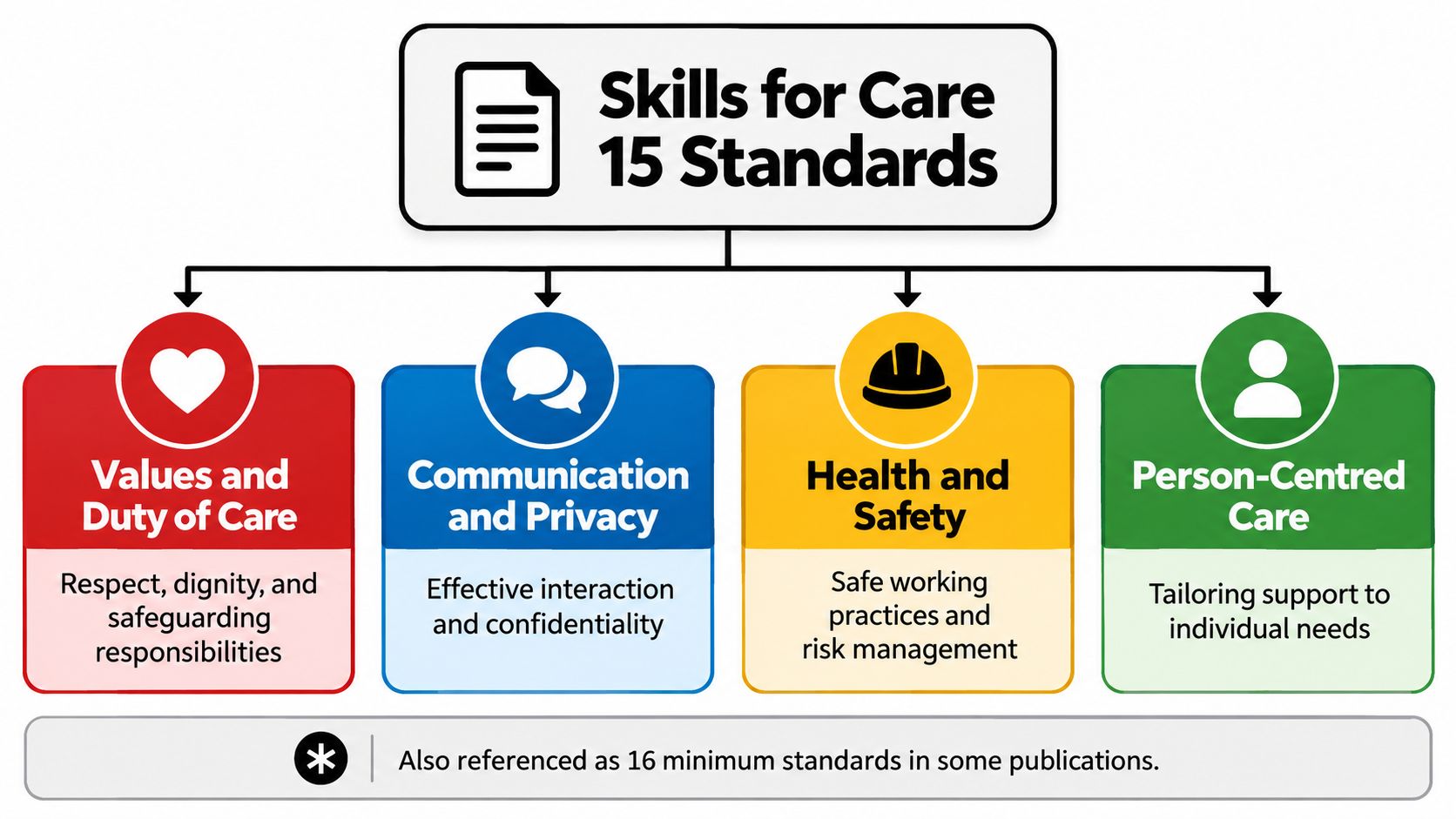
Skills for Care sets out the standards covering duty of care, person centred practice, communication, safeguarding, basic life support, infection prevention and control, handling information, and awareness of dementia, mental health, learning disability, and autism. Some current publications describe the framework as 16 minimum standards and require assessment of both what workers know and what they do. The count matters less than the principle. Knowledge without observed application isn't completion.
Values and duty of care
This cluster covers your role, duty of care, equality and diversity, person centred values, and privacy and dignity. In practice, an assessor wants to see you knock before entering, explain what you're about to do, gain consent, and adapt when someone says no. They also want to hear you explain, in your own words, what you'd do if your duty to keep someone safe conflicts with their wish to take a risk.
You prove this cluster through behaviour, not slogans. Offering choices about clothing, respecting cultural preferences around food and personal care, and recording preferences accurately all count. So does speaking up when you see undignified practice, even when the person doing it is senior to you.
Safeguarding and safety
Safeguarding adults, safeguarding children, health and safety, and handling information sit here. The knowledge element covers types of abuse, signs, and reporting routes. The competence element is what you do in the first five minutes after a disclosure, and whether you record facts without adding opinion.
If you need depth on the reporting side, work through safeguarding adults training guidance alongside your modules and map it to your employer's local procedure. Assessors will test the local route, not a generic national answer. They'll also watch basic safety habits, such as checking identity before sharing information, storing records securely, and reporting hazards instead of stepping over them.
Clinical and infection fundamentals
Basic life support, fluid and nutrition, and infection prevention and control form the practical core many new starters underestimate. You must know the theory, but you must also demonstrate hand hygiene, correct use of personal protective equipment, safe waste disposal, and an appropriate first response in an emergency. These are observable skills with right and wrong performance, which is why they can't be signed off from a quiz score alone.
Communication and information handling
Communication underpins every other cluster. Assessors observe whether you listen, check understanding, use plain language, and adjust for hearing, speech, language, or cognitive needs. They also review your written records for accuracy, legibility, and confidentiality, because a vague entry creates risk for the next carer on shift.
Good records are a care intervention. The next worker can only act safely on what you've clearly written.
Group the standards this way and Care Certificate training stops feeling like fifteen disconnected quizzes. It becomes four kinds of real work, each with knowledge to learn online and behaviour to prove in person, which is exactly how assessors will judge you.
The Realistic Pathway From Enrolment to Sign-Off
Most workers don't fail because the content is hard. They stall because nobody explained the sequence, who owns each step, or what evidence closes the loop. Follow the order below and you'll avoid the common trap of finishing modules with nowhere to record practice.
Step by step sequence
First, enrol and work through the knowledge modules in a sensible order, starting with your role, duty of care, safeguarding, and infection control. Complete the knowledge checks as you go and save dated outcomes. Don't binge everything in one night and expect retention during an observation two weeks later.
Second, arrange shadowing and supervised practice with your employer or placement. Learning becomes evidence here, and parallel onboarding tasks matter too. If you haven't sorted identity and background checks yet, read how to get a DBS check early, because delayed checks delay supervised practice, which then delays sign off.
Third, book observations with an assessor who has direct experience of the activity being assessed. That requirement matters. A well meaning colleague who has never performed the task to standard can't credibly sign you off for it, and a good compliance lead will reject that evidence.
Fourth, write short reflective accounts after key shifts. Keep them factual and specific, covering what happened, what you did, what you'd change, and which standard it evidences. Reflective logs support observations, they don't replace them.
Finally, your supervisor reviews the full portfolio against a standards matrix. Gaps get remediation, extra practice, or a repeat observation. Only then should unsupervised work be authorised, and only for tasks where competence has been recorded.
Stages of Care Certificate Completion and Who Owns Each
| Stage | Worker Action | Employer / Assessor Action | Evidence Type |
|---|---|---|---|
| Enrolment and knowledge | Complete modules and knowledge checks | Provide access, explain local procedures | Dated module outcomes |
| Supervised practice | Shadow, then perform tasks under supervision | Allocate supervisor, set supervision level | Shadowing logs, practice notes |
| Observation | Demonstrate tasks in real care delivery | Observe, give feedback, record outcome | Assessor observation record |
| Reflection | Write reflective accounts linked to standards | Review and challenge where needed | Reflective logs |
| Sign off | Close gaps and repeat observations if required | Verify portfolio, authorise unsupervised tasks | Standards matrix, sign off record |
The original 12 week expectation remains a useful planning window for someone working regular shifts alongside study. Agency workers with irregular bookings may take longer to gather observations, not because they're slower learners, but because evidence depends on access to real care situations. Plan for that, chase observations proactively, and keep your matrix updated after every shift.
Assessor test: If your assessor couldn't defend your sign off to an inspector, it isn't a sign off. It's a favour, and favours don't survive audits.
Keep one folder, digital or paper, with module outcomes, observation records, reflections, assessor names, and dates in standard order. A tidy, auditable portfolio moves faster through compliance than a phone gallery of screenshots, and it shows the professional habits employers want on shift.
Why Finishing an Online Course Is Not the Same as Being Compliant
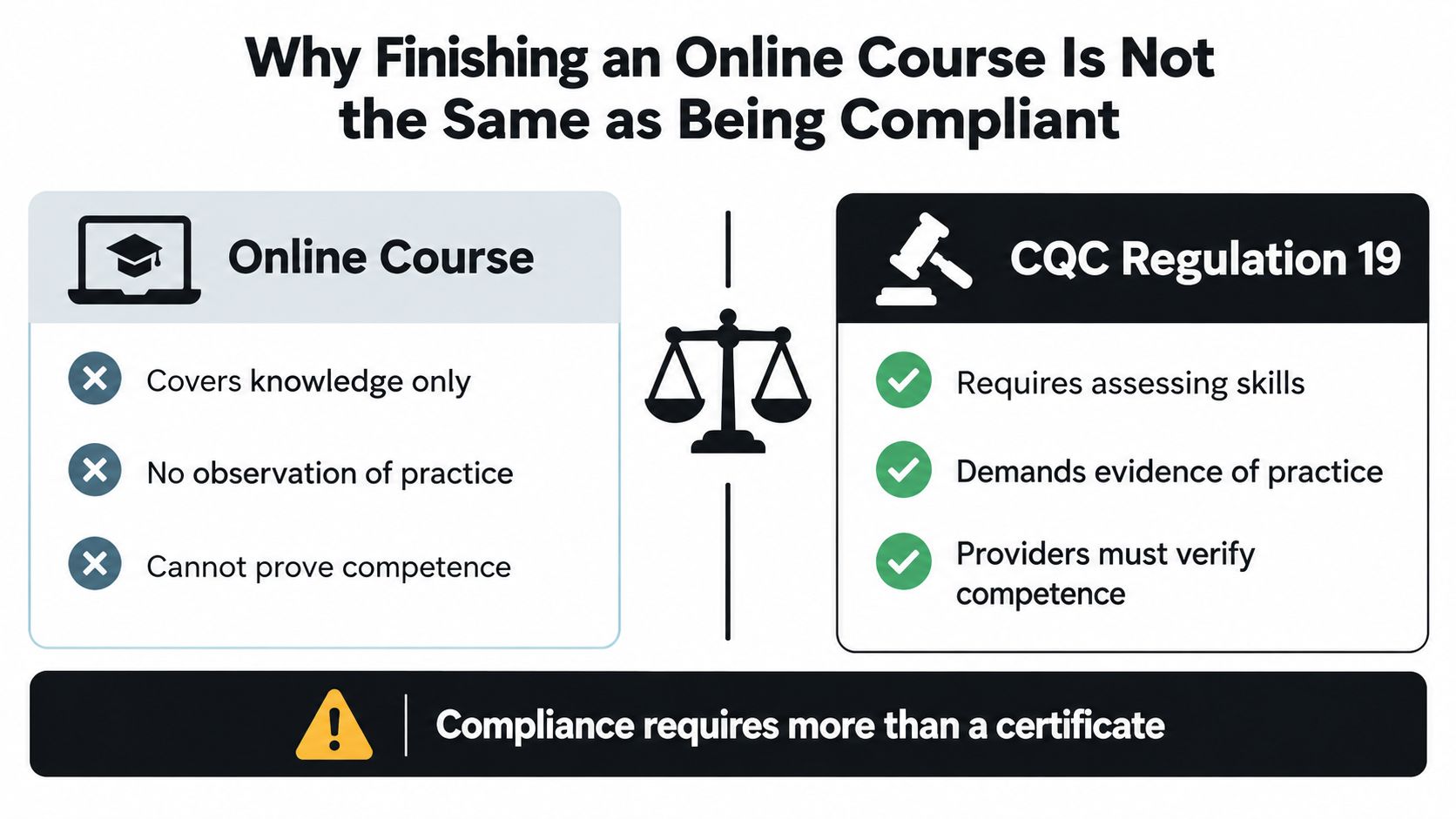
Here's the misconception that costs new carers shifts. A downloadable certificate proves you finished content. It does not prove you can deliver care safely, and employers who treat it as proof are exposing themselves and you.
CQC Regulation 19 requires providers to assess employee competence before staff work unsupervised and to provide supervision until competence has been demonstrated, and CQC guidance expects providers to use the Care Certificate standards when assessing healthcare assistants and social care support workers. That's a direct legal and operational chain. Online learning feeds into it, but it doesn't satisfy it on its own.
What employers must still do
A responsible provider will check what you know, watch what you do, and set your supervision level accordingly. For high risk tasks such as basic life support, safeguarding responses, infection control, and moving and handling, expect closer scrutiny and possibly extra training before you're authorised. That's not bureaucracy. That's risk based rostering protecting residents, patients, and your own registration with the agency.
Use a training matrix template to make this visible. Record module completion, assessment outcome, observed practice requirement, assessor name, date, and review trigger for each standard. When a manager can see gaps at a glance, they can roster you safely instead of refusing the booking outright.
Visual summaries help teams share this distinction with new starters, which is why resources like an infographic for corporate training videos can be useful when you're explaining training design to non clinical managers. The format doesn't change the rule, though. Clear visuals support learning, they don't replace observation.
Agency and bank staff
Portable evidence helps you, but it has limits. A well organised profile reduces duplicated knowledge checks when you join a new agency or provider. The receiving employer must still confirm role specific competence and local procedures before you work unsupervised in their setting, because medication processes, escalation routes, and recording systems differ between services.
Don't take repeat checks personally. A provider that waves you onto a ward or into someone's home without verifying anything is telling you how it handles risk generally. You don't want your name attached to that culture when something goes wrong.
The 2025 position also separates the Care Certificate standards from the regulated Level 2 qualification, which requires observational assessment and typically takes around six to eight months. A short online course shouldn't be marketed as equivalent to that qualification, and you shouldn't present it that way to an employer. Misrepresentation damages trust faster than an honest gap with a plan to close it.
Be precise about what you hold. Say you've completed the knowledge elements, list what's been observed, and name what's outstanding. Compliance leads respect that honesty, because it lets them place you safely today while building your full evidence for tomorrow.
How Cura Academy Fits Into Your Compliance Stack
Your compliance stack has two halves. Online learning builds underpinning knowledge efficiently, and workplace assessment proves you can apply it. Cura Academy is built for the first half, and it's honest about that boundary, which is exactly why it works inside an employer's process rather than pretending to replace it.
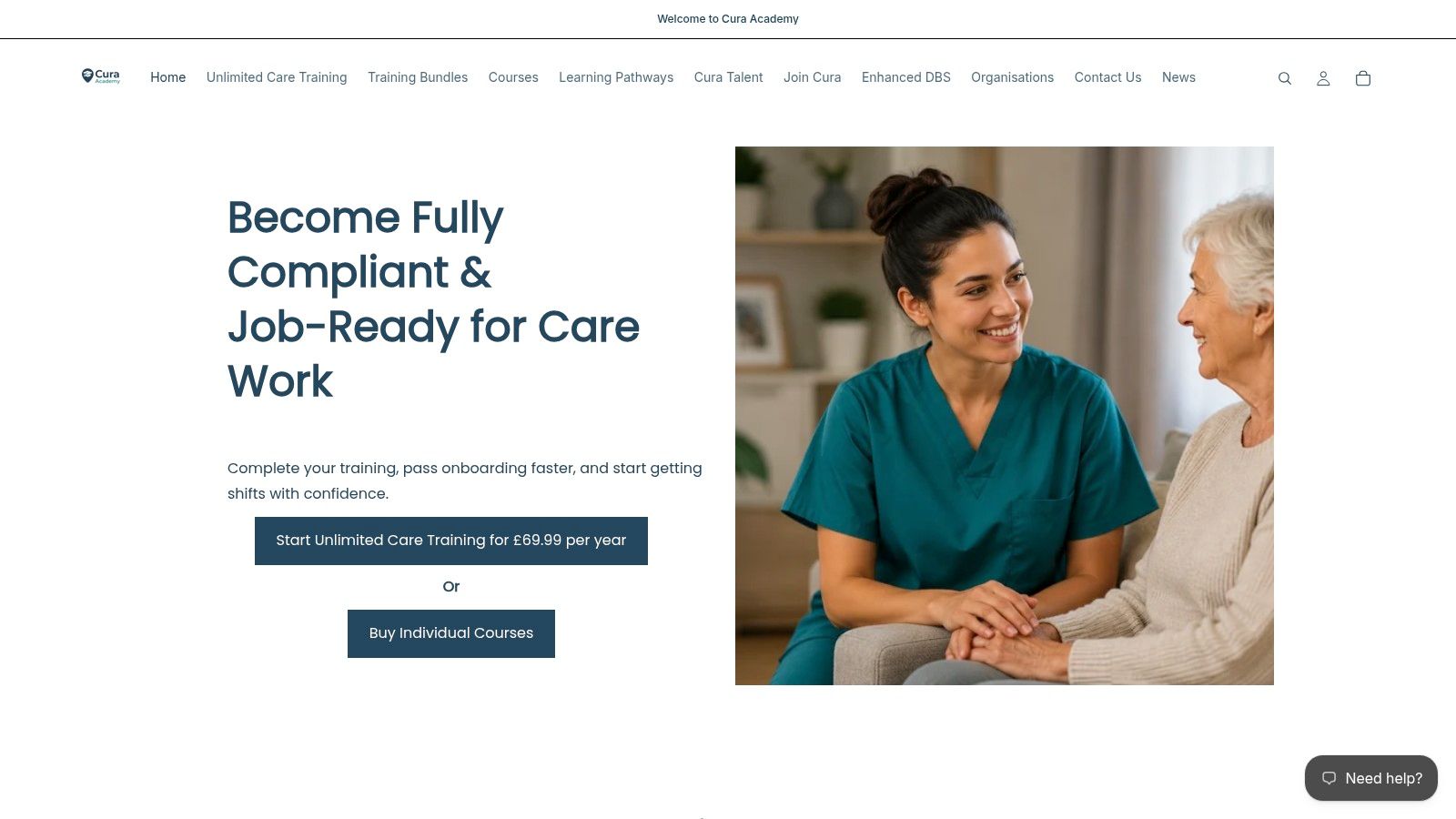
The membership layout below shows how the subscription and bundle routes are presented for learners choosing a pathway.
What the subscription covers
For £10 per month, members get unlimited access to Care Certificate modules plus mandatory refreshers and role specific courses such as Basic Life Support and Dementia Awareness. That matters because Care Certificate training rarely sits alone on a compliance file. Agencies also check refresher dates and role relevant learning, and chasing separate certificates from multiple providers wastes weeks.
Structured pathways guide you from choosing a care route through course completion and building an onboarding profile. If you prefer one off purchases, curated bundles group the relevant standards, including duty of care, person centred care, safeguarding adults, health and safety, infection prevention and control, communication, and privacy and dignity, with knowledge checks and downloadable certificates. Mobile friendly access means you can complete a module between shifts without reserving a training room.
This short video explains how the learning is organised for new and existing care workers.
How it supports employer sign off
Cura Academy also supports Enhanced DBS and Update Service readiness as part of wider onboarding preparation. That doesn't make an employer skip observations, and you shouldn't want it to. What it does is remove the avoidable delays, missing certificates, unclear dates, and scattered records that stop a good candidate reaching the observation stage at all.
Use it this way for the strongest file.
- Complete knowledge first: Finish modules and save dated outcomes in standard order.
- Take evidence to your employer: Present your matrix with outstanding observations clearly marked.
- Close the workplace half: Book shadowing, observations, and assessor sign off with your provider.
- Keep refreshers current: Use the same subscription to maintain mandatory updates instead of restarting the search each year.
The value is speed with traceability. Less time hunting courses, a clearer evidence trail for compliance, and a faster path to a profile an agency can book, while your employer still owns the competence decision that Regulation 19 requires them to own.
Common Questions Care Workers Ask Before They Sign Up
How long does it realistically take
Plan around the 12 week window if you're working regular shifts and studying steadily. The knowledge modules can be completed much faster, but observations depend on shift access and assessor availability. Anyone promising full workplace sign off in a weekend isn't describing the framework employers recognise.
Is it recognised across employers
Yes, as a common baseline across care homes, domiciliary care, and agency work, because the standards are shared. Workforce evidence shows how widespread engagement has become, with Skills for Care reporting that 56% of adult social care posts in 2024/25 were filled by people who had achieved the standards or were working towards them. Expect receiving employers to verify local procedures and any role specific competence before unsupervised work.
That same workforce picture shows Care Certificate engagement and formal qualifications aren't the same measure. Many experienced direct care workers without a relevant qualification have still engaged with the standards, which is why employers treat structured induction and competency evidence as important alongside qualifications.
Does it expire
The Care Certificate itself is an induction milestone, not an annual licence. Your mandatory refreshers, such as basic life support and moving and handling updates set by your employer, do need renewing on their own cycles. Employers may also re observe competence if you change setting, return after a break, or take on new tasks, and that's good practice rather than a penalty.
Will an online certificate be accepted
Accepted as what is the right question. Employers will accept it as evidence of knowledge within your file, alongside observations, reflective records, and assessor sign off in your standards matrix. They shouldn't accept it, and reputable ones won't, as standalone proof of workplace competence.
What's my next action
Start the knowledge half now, in standard order, and build your matrix from the first module. Then secure supervised practice and chase observations early, while the learning is fresh.
Build the knowledge half of your Care Certificate properly with unlimited Care Certificate modules, mandatory refreshers, and structured pathways through Cura Academy, then take a dated, organised evidence trail to your employer for observation and sign off. Start today, close your gaps standard by standard, and put yourself in the file compliance teams can book with confidence.