

You've finished a course. Your certificate is in your inbox. You've told friends you're ready to work in care. Then the silence starts.
An agency asks for mandatory training records. A care home asks whether your Care Certificate work has been assessed properly. Another employer asks about your DBS status, and suddenly you're not sure whether your check is the right type, whether it can be updated, or whether you missed a deadline. None of this means you're unsuitable for care work. It usually means your learning, documents and compliance steps haven't been lined up in the right order yet.
That's where boot care learning makes sense.
In UK care, the goal isn't just fast study. It's synchronised readiness. You need the right induction learning, the right practical topics, and the right compliance timing so an employer can look at your profile and think, “This person is ready to start safely.” For new starters, returners, agency workers and people trying to move quickly into paid work, that difference matters a lot.
Table of Contents
- Introduction to Boot Care Learning and Why It Matters Now
- What Boot Care Learning Really Means in UK Care
- Who Boot Care Learning Is Designed to Help
- Inside a Typical Boot Care Learning Curriculum
- How Boot Care Learning Builds Job Readiness and Progression
- Staying Compliant and Shift Ready With DBS and Ongoing Training
- How Cura Academy Supports Your Boot Care Learning Journey
Introduction to Boot Care Learning and Why It Matters Now
A lot of people come into care with urgency. Some are changing careers after retail, hospitality or warehouse work. Some are already supporting relatives and want to turn that into paid employment. Some have done bits of training before, but still aren't getting shifts because their paperwork looks patchy to recruiters.
Boot care learning speaks to that situation. It takes the idea of a training bootcamp and applies it to care onboarding. Instead of collecting random courses over time, you move through a focused block of essential learning that helps you become safer, clearer and easier for employers to assess.
Why this matters in today's care jobs market
The care sector needs people, but employers still can't take shortcuts on safety. They need evidence that a new worker understands basics such as communication, safeguarding, infection prevention, dignity and person-centred care. They also need staff who can keep their training current instead of scrambling each time a new placement comes up.
That push towards structure isn't new. The Care Certificate was launched in April 2015 in England and replaced the Common Induction Standards, creating a formal baseline for safe and compassionate care practice across health and social care roles, according to the House of Commons Library briefing on the Care Certificate.
Practical rule: Fast onboarding only works when the basics are recognised, recorded and easy to show an employer.
What readers often get wrong at the start
Many new starters think speed means cutting corners. In care, it doesn't. Good boot care learning is more like packing for an early shift. You don't throw random items into a bag and hope for the best. You make sure the essentials are there, in the right place, ready when needed.
That's the mindset to bring into care learning too:
- Learn the baseline first so employers can see a recognised starting point.
- Add mandatory skills that support safe day-to-day practice.
- Keep compliance live so you stay employable, not just trained.
If you've been feeling behind, you're probably not behind. You may need a cleaner route from learner to shift-ready worker.
What Boot Care Learning Really Means in UK Care
People hear the word “bootcamp” and sometimes assume it means rushed. In care, that would be a problem. Safe care can't be rushed. What can be improved is the organisation of learning.
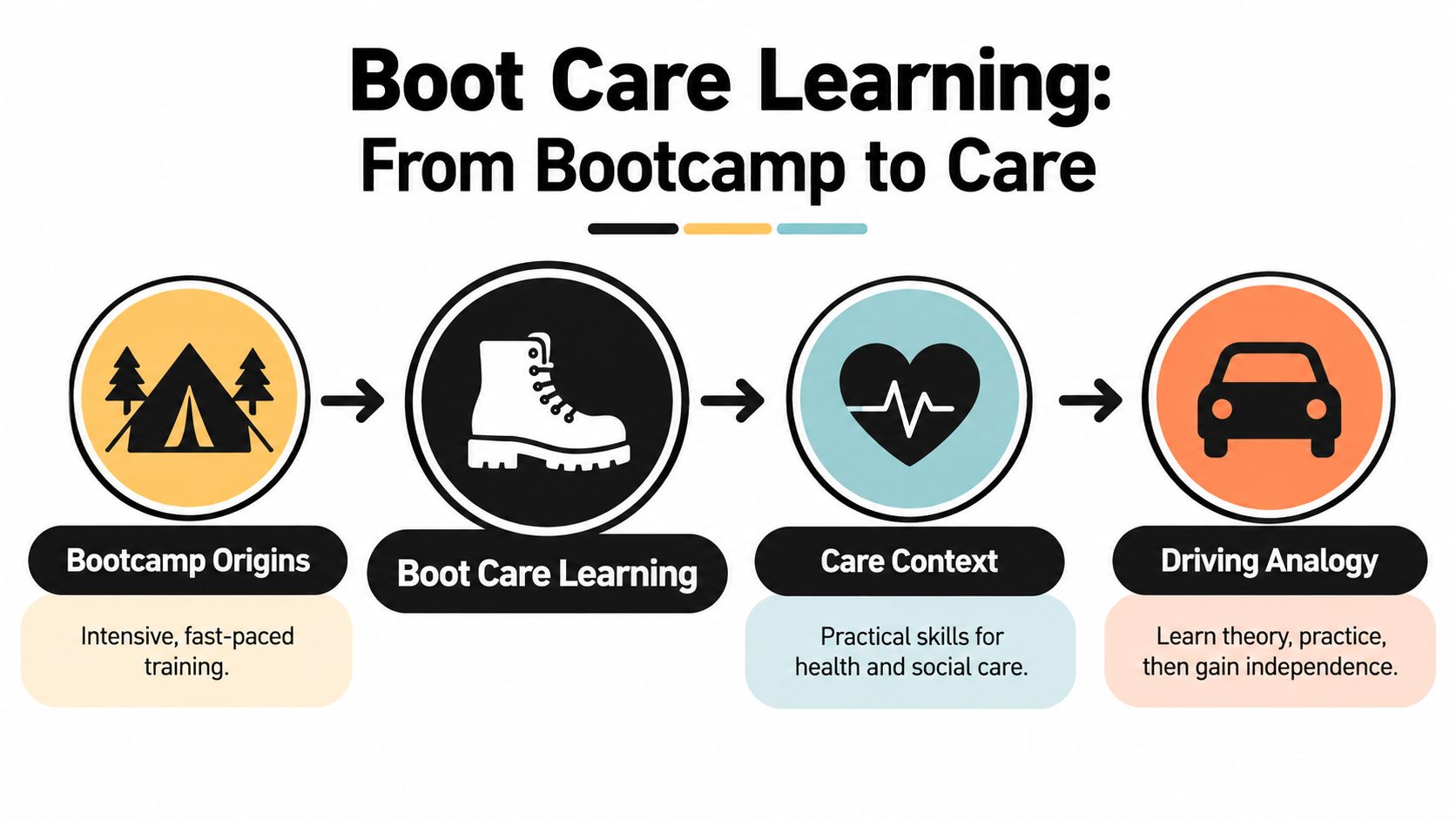
Boot care learning means taking the essential parts of care induction and delivering them in a focused, structured way, so you build readiness without wandering through disconnected courses.
Think of it like learning to drive
Learning to drive is a useful analogy.
First, you study the rules. Then you practise under supervision. After that, you show you can apply what you know safely and consistently. Care learning works in a similar way. You don't become work-ready because you watched one safeguarding video. You become work-ready when your learning fits together into a recognised baseline and can be applied in real settings.
A messy route often looks like this:
- One-off courses completed at different times, with no clear order
- Gaps in core topics such as dignity, duty of care or infection prevention
- No simple record of what has been learned and what still needs assessment
A boot care route is different. It usually follows a clear sequence, groups related topics together, and helps the learner see what each part is for.
Why standardisation matters
In UK care, employers don't just want enthusiasm. They want a baseline they recognise.
The Care Certificate is a 16-standard framework for non-regulated health and social care workers, and the 2025 update aligned it with sector developments and the new Level 2 Adult Social Care Certificate qualification. That update also added Standard 16 on learning disability and autism, according to the Care Certificate standards published by Skills for Care, NHS England and Skills for Health.
That matters because the Care Certificate isn't just a bundle of course titles. It acts as a nationally recognised competency baseline across domiciliary care, residential care and agency settings.
A fast route into care should feel more organised, not less rigorous.
What boot care learning is not
It's not a promise that you'll skip supervision. It's not a replacement for employer checks. And it's not the same as becoming fully qualified in a single step.
It's better to think of it as a tight, purposeful sprint through the essentials, so your first stage of employability is clearer. That's why many learners find it less overwhelming than old-style induction, where training arrives in fragments and nobody explains how the pieces connect.
Who Boot Care Learning Is Designed to Help
Some learners need confidence. Some need consistency. Others need speed because work opportunities appear and disappear quickly. Boot care learning helps different people for different reasons.
New starters with no care background
If you've never worked in care before, boot care learning gives you shape. Instead of guessing which course to take first, you start with a recognised baseline and build from there.
The adult social care workforce in England is large and varied. Skills for Care estimated that the sector employed around 1.52 million people, and found that 45% of the workforce held a relevant social care qualification while 55% had no relevant qualification recorded, according to the adult social care workforce evidence brief.
For a beginner, that tells you something important. Many people enter the sector before they hold a recognised qualification. Structured induction learning helps turn interest into credible job readiness.

Existing care assistants and returners
Some readers already have hands-on experience. They may have worked in support roles, paused work for family reasons, or moved between employers with different training systems. Their problem usually isn't motivation. It's inconsistency.
A focused refresh can help if you need to:
- Rebuild confidence after time away from frontline work
- Update knowledge around safeguarding, infection prevention or communication
- Present learning clearly when an employer asks for evidence
Agency, bank and fast-moving candidates
This group often feels the pressure most sharply. Agency and bank work can move quickly, but only if your documents and training are lined up. If one part is missing, you can stay in the “almost ready” category for too long.
Readiness test: If an employer asked for your training record and compliance documents today, could you send them confidently and without hunting through old emails?
Boot care learning suits this group because it reduces friction. It helps create one coherent starting profile instead of several half-finished ones.
Who may need a slower route
A fast-track format isn't ideal for everyone.
You may benefit from a slower, more supervised approach if you struggle with written learning, need substantial language support, or feel highly anxious about applying theory in practice. There's no failure in that. In care, safe understanding matters more than speed.
Providers can also use boot care learning principles for staff onboarding, especially when they want a more consistent baseline across new starters. The main benefit there is standardisation, not just pace.
Inside a Typical Boot Care Learning Curriculum
When learners hear “intensive care training”, they often picture a pile of slides and quizzes. A good curriculum should feel much more practical than that. It should move from foundation knowledge into workplace behaviour, then into evidence of competence.
The foundation layer
The main backbone is the Care Certificate. It contains 16 standards for non-regulated health and social care workers. Those standards cover the essentials of working safely, respectfully and professionally.
Typical areas include:
- Understanding your role and what good boundaries look like
- Personal development so learning doesn't stop after induction
- Duty of care and how to act when something isn't right
- Equality, diversity and inclusion
- Person-centred working
- Communication
- Privacy and dignity
- Fluids and nutrition
- Mental health, dementia and learning disability awareness
- Safeguarding adults and children
- Basic life support
- Health and safety
- Handling information
- Infection prevention and control
- Learning disability and autism, reflected in the updated Standard 16
That joint development by Skills for Care, NHS England and Skills for Health is one reason employers recognise the framework. It gives a common baseline rather than a random selection of topics.
To see how this usually appears in online training, a Care Certificate online course pathway is a useful example of how standards can be grouped into a more manageable learner journey.
The middle layer of mandatory skills
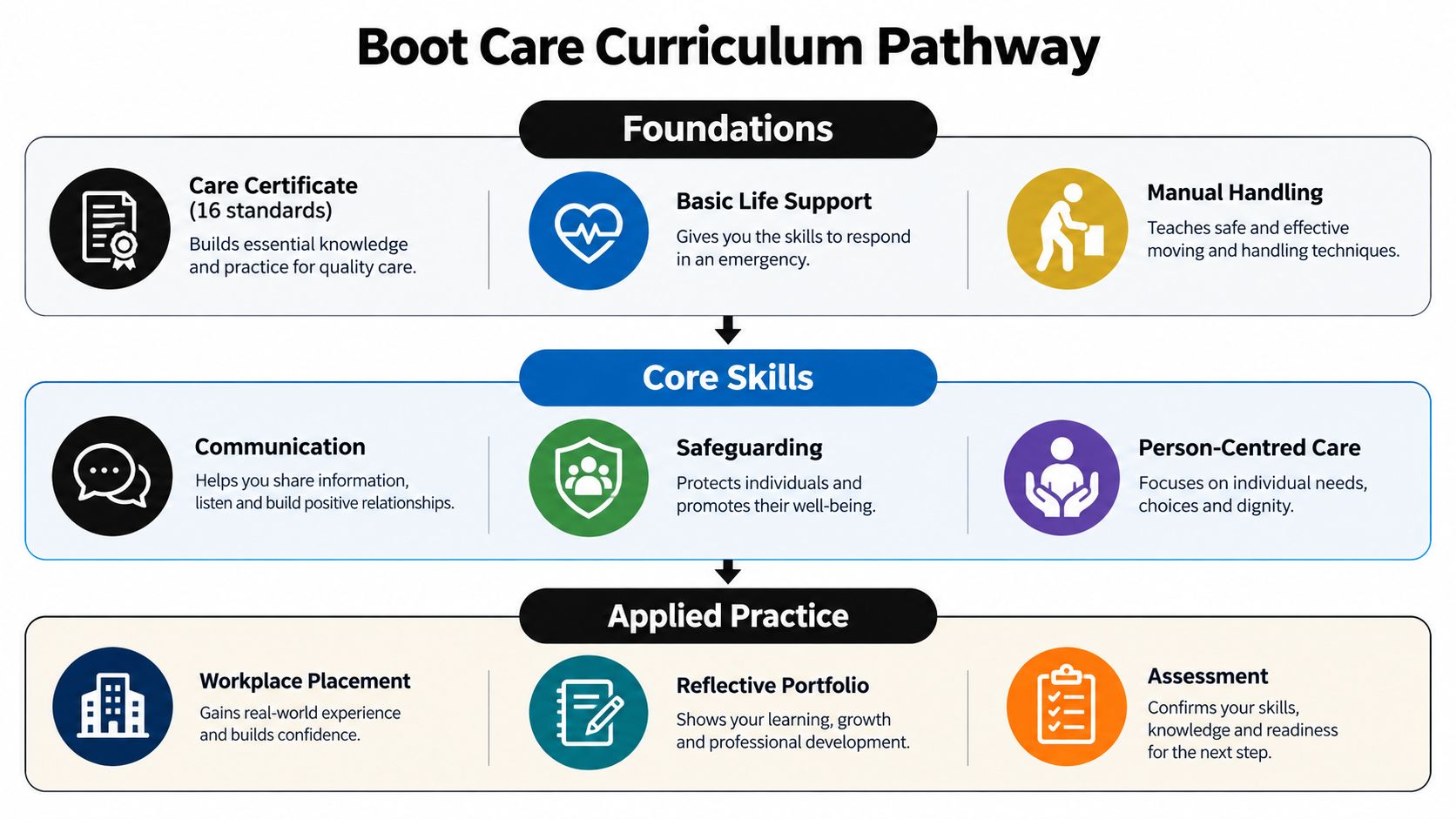
Mandatory learning often sits alongside the Care Certificate. People sometimes get confused. They assume the certificate covers everything an employer might ask for. It doesn't always cover every provider-specific requirement in the same way.
A typical boot care curriculum often adds:
-
Basic Life Support
This supports confidence in urgent situations and links directly to safe frontline response. -
Manual handling awareness
Especially relevant where moving and assisting people forms part of the role. -
Dementia awareness and mental health awareness
These topics help learners understand behaviour, communication and support needs, not just labels. -
Fire safety, health and safety, and infection prevention refreshers
These are part of the daily reality of care settings, not background admin.
This short video helps visualise how training can connect to real workplace expectations.
How learning becomes usable
The strongest programmes don't stop at theory. They use scenarios, short assessments and workplace observations where needed.
For example, it's one thing to read about dignity. It's another to think through a real situation where a person needs personal care, feels embarrassed, and communicates very little. Scenario learning helps you practise decisions before you're under pressure on shift.
Good induction learning should answer two questions at once: “What is the rule?” and “What would I do on a real Tuesday morning shift?”
That's what makes boot care learning useful. It turns content into applied judgement.
How Boot Care Learning Builds Job Readiness and Progression
Completing training feels productive. But in care, training only becomes valuable when it supports employability and progression. That's why mapped pathways matter more than scattered certificates.
The problem with fragmented learning
Skills for Care's national workforce report shows a gap between training activity and recognised qualification depth. In 2024/25, 54% of direct care staff in England did not hold a relevant social care qualification, yet 69% of those without a qualification had engaged with the Care Certificate standards and 81% had completed non-statutory training, according to The state of the adult social care sector and workforce in England 2025.
That pattern tells a clear story. Many workers are learning, but not always through a pathway that shows employers where they are now and what comes next.
What a mapped route does better
A mapped route helps you answer four employer questions quickly:
- Have you covered the core induction baseline?
- Can you show current mandatory learning?
- Are you ready for supervised practice and onboarding?
- Do you have a sensible next step for development?
That last point matters. A stronger early profile can support movement towards recognised progression routes, including a level-based qualification pathway. For readers thinking ahead, this overview of jobs linked to Health and Social Care Level 3 shows why early structure matters later too.
Choosing Your Fastest Credible Route to Employability
| Pathway Option | Best For | Speed to Shift Ready | Recognition and Next Step |
|---|---|---|---|
| Boot care learning built around Care Certificate standards and mandatory training | New starters, returners, agency and bank workers needing a clean baseline | Fast, because learning is focused and ordered | Recognised induction baseline, then progress into supervised work and further qualification |
| Random one-off short courses | People exploring care casually without immediate job plans | Unclear, because gaps often remain | Limited as a pathway, often needs reorganising later |
| Full regulated qualification route | Learners planning a deeper formal route from the outset | Slower to immediate shift readiness, but stronger for long-term progression | Directly supports recognised qualification development |
Progression matters from day one
The workforce strategy direction matters here too. Skills for Care states a new expectation that 80% of direct care staff should be competent to level 3 within three years, as referenced in the same national report above. That doesn't mean every new worker must arrive fully developed. It means your first training step should make the second and third steps easier, not messier.
The Level 2 Adult Social Care Certificate also now has a defined funding value in England, with a maximum reimbursement amount of £1,540 for qualifications paid for between 1 April 2025 and 31 March 2027, according to Skills for Care's training support information. That creates a useful benchmark when comparing low-cost learning subscriptions with full qualification routes.
Boot care learning works best when it doesn't pretend to be the final destination. It works when it gives you a credible first platform.
Staying Compliant and Shift Ready With DBS and Ongoing Training
A lot of learners think employability ends when the last module is complete. In practice, that's only half the job. The other half is staying ready when an employer needs to place you quickly.
DBS timing is part of job readiness
The DBS Update Service is one of the most misunderstood parts of care onboarding.
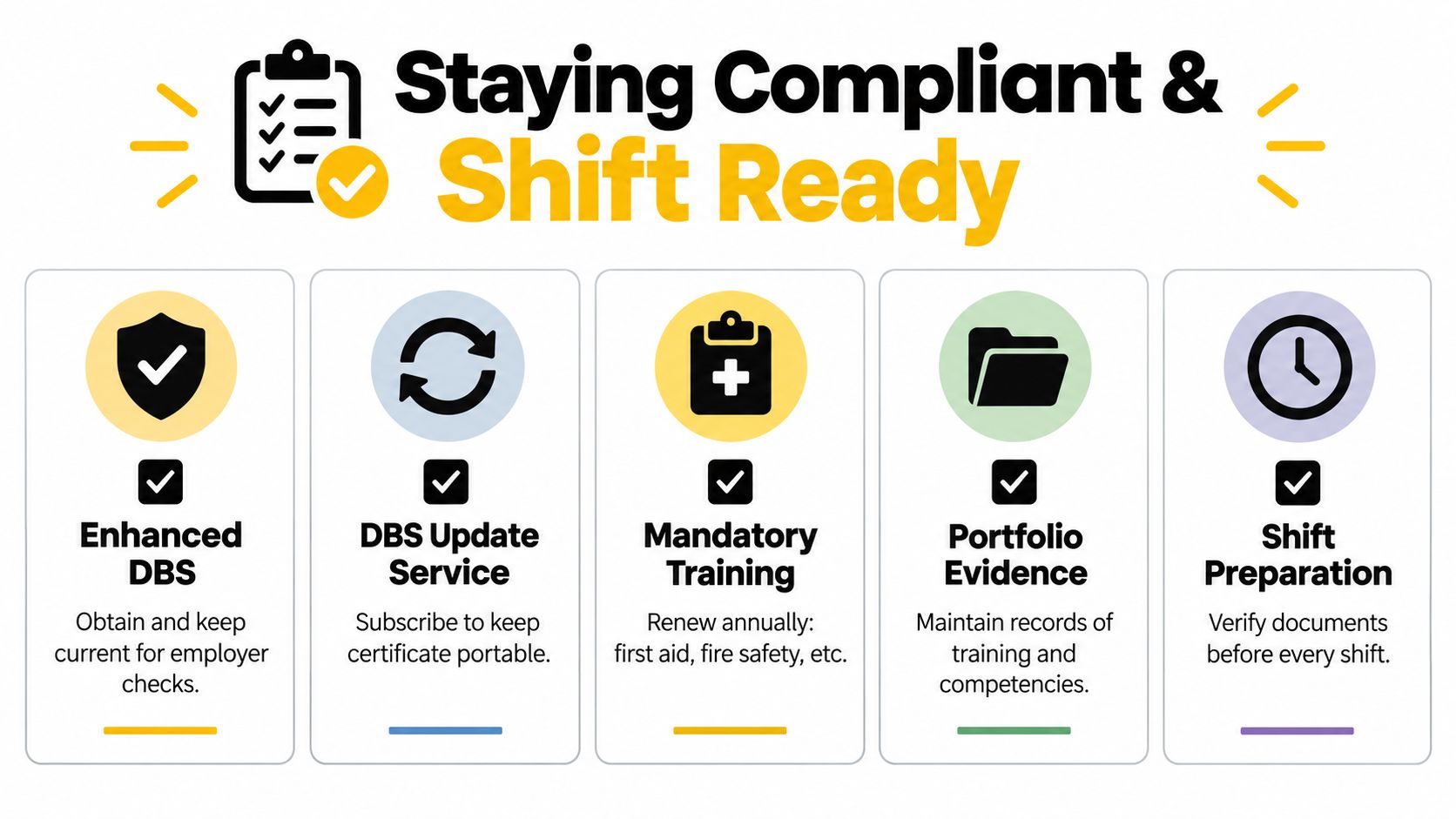
According to the GOV.UK DBS Update Service guidance, the service is only for standard and enhanced DBS checks, costs £16 per year, and you must join within 30 days of your certificate being issued. It isn't available for a basic check.
That matters because many care roles depend on enhanced checking. If you miss the joining window, you can't add the certificate later to the Update Service. For workers moving between employers, agencies or temporary roles, that can slow things down.
If you want a plain-English walk-through, this guide on how to get a DBS check helps make the process less confusing.
A practical sequence that keeps you hireable
The simplest approach is to think in sequence, not in separate admin tasks.
-
Complete your core training first
Get your induction learning and mandatory topics into one organised record. -
Apply for the right DBS route for the role
Check whether the employer or agency is arranging this, and what level is required. -
Join the Update Service on time if eligible
Don't leave this until weeks later. -
Store your evidence properly
Keep certificates, dates and names consistent across documents. -
Review refreshers before they expire
Last-minute renewals can block start dates and shift bookings.
Missing a compliance deadline doesn't always make you unqualified. It often just makes you slower to place than someone whose records are current and easy to verify.
The habit that matters most
Continuous readiness is a habit. It's the care-worker version of laying out your uniform and ID the night before an early shift. You do it because it removes avoidable stress.
That's the lesson of boot care learning. Speed isn't only about finishing fast. It's about keeping training, certification and DBS status aligned so you remain ready when work appears.
How Cura Academy Supports Your Boot Care Learning Journey
The hardest part for many learners isn't motivation. It's trying to work out what to do first, what to group together, and what employers are likely to ask for next. A training platform works best when it removes that confusion.
Cura Academy is built around that practical need. Instead of treating care learning as a pile of separate purchases, it gives learners a more organised route through induction topics, refreshers and role-specific training. That suits people who want to move quickly but still need a clear structure.
Why the model fits boot care learning
The platform is designed around subscription-based access, with £10-per-month membership that gives learners access to essential care training, including Care Certificate standards, mandatory refreshers and role-specific courses such as Basic Life Support and Dementia Awareness. That setup can make sense for people who need ongoing readiness rather than a single burst of learning.
The key benefit is not just price. It's having core topics in one place, with a route that helps learners build a stronger onboarding profile instead of collecting disconnected certificates.
What that looks like in practice
A useful support model for boot care learning usually needs several things working together:
- Structured pathways that help you choose a route instead of guessing
- Unlimited access to refreshers so staying current feels normal, not stressful
- Role-specific options for learners who need more than the basics
- DBS and Update Service readiness support so compliance steps aren't left until the end
Some learners prefer one-off purchases rather than membership. Curated bundles help there too, because they reduce the “Which course now?” problem that slows many new entrants.
Why this matters for confidence
When people struggle with onboarding, they often blame themselves. Usually the issue is the system around them. Their training is in one inbox, their DBS documents are somewhere else, and they aren't sure whether they've covered enough for the role they want.
A centralised learning and compliance approach makes that easier to manage. It helps learners across domiciliary care, residential care and agency settings show readiness more clearly and maintain that readiness over time.
If your aim is to become shift-ready fast, the best support won't just help you complete a course. It will help you stay organised, current and easier for employers to say yes to.
If you want a practical route into care work without the usual confusion, Cura Academy brings Care Certificate learning, mandatory refreshers and compliance support into one place. It's designed to help you move from “nearly ready” to shift-ready, with a clearer path for training, DBS preparation and ongoing progression.