

A support worker is alone on shift when a resident becomes distressed. The person shouts, pushes a table and refuses support. The worker tries to calm the situation by instinct, but nobody has shown them how to recognise the trigger, reduce demands or avoid turning a tense moment into a restrictive intervention.
That's where a behaviour management course earns its place. In UK care settings, behaviour management isn't a list of classroom tips or a certificate to file away. It's a competence pathway that helps staff understand what behaviour communicates, respond safely, document decisions and show that support meets the person's needs.
The right course looks different in a care home, a learning-disability service, an autism service or a school. It also needs to fit the learner's role, the provider's policies and the evidence expected during supervision, audits and inspection.
Table of Contents
- Why Behaviour Management Training Matters in UK Care
- What a Behaviour Management Course Actually Covers
- How the Curriculum Builds From Assessment to Action
- Who the Course Is Designed For in Care Settings
- Formats, Duration and How Completion Is Validated
- Why One-Off Training Is Rarely Enough
- How to Choose the Right Behaviour Management Course
- Embedding Behaviour Management Into Onboarding and CPD
Why Behaviour Management Training Matters in UK Care
A distressed person may be communicating pain, fear, confusion, sensory overload, boredom or a need for control. If a carer treats the behaviour as deliberate defiance, they may increase demands, raise their voice or reach too quickly for physical intervention. If they assess what happened first, they have a better chance of reducing risk while preserving dignity.
This is why behaviour management has moved beyond optional professional development. NICE guidance for learning-disability services describes a process that starts with assessment, moves to formulation and results in a written behaviour support plan. It also expects competent staff, supervision, monitoring, outcome measures and checks that agreed interventions are being followed. NICE-aligned behaviour support guidance for care teams shows why competence matters more than simple attendance.
Confidence doesn't prove competence
England's National Behaviour Survey for the 2024 to 2025 academic year found that 95% of teachers felt confident managing misbehaviour, including 32% who were very confident and 63% who were fairly confident. Yet only 54% said they could access behaviour-management training and development support relevant to their needs, while 28% said they couldn't and 18% didn't know. The National Behaviour Survey report provides a useful UK benchmark, even though the survey concerns schools rather than adult social care.
The lesson transfers to care: a worker can feel capable and still lack structured support for the situations they meet. A certificate matters only when it connects to observed practice, supervision and safe decision-making.
Practical rule: A course should help you explain why behaviour occurred, what you changed, how you reduced risk and how you'll review the outcome.
For managers, this links behaviour training to governance. The care governance resource from Pauline Vuyelwa Muswere-Enagbonma is useful when you're considering how staff development, quality assurance and frontline practice fit together. The question isn't just whether staff completed a module. It's whether the service can show that people receive suitable support, staff learn from incidents and restrictive responses are not being used as a substitute for understanding.
What a Behaviour Management Course Actually Covers
For a care worker, behaviour management training means learning how to prevent avoidable distress, recognise meaning and respond proportionately when risk rises. It combines proactive support with reactive skills, rather than teaching staff to control people.
Proactive work happens before an incident. It may include building trust, adjusting lighting or noise, offering meaningful choices, using accessible communication, changing routines and applying trauma-informed principles. Reactive work begins when distress is already visible. It can include low-arousal communication, de-escalation, safe withdrawal, breakaway skills where relevant, incident reporting and following a person's behaviour support plan.
The course needs the right setting
A school-based programme usually focuses on classroom conduct, boundaries, lesson routines and managing disruption across a group. A care-focused course deals with person-centred support, capacity, consent, restrictive practice, communication and the relationship between health, environment and behaviour.
The care audience may include:
- Adult social care workers, who need practical skills for daily support, recording and escalation.
- Learning-disability and autism teams, who often work with Positive Behaviour Support plans and restrictive-practice reduction.
- Dementia-care staff, who need to explore unmet needs, pain, confusion, environment and communication.
- Mental-health support workers, who may need trauma-aware de-escalation and risk planning.
- Managers and senior carers, who must assess competence, review incidents and provide supervision.
Core modules commonly include understanding the function of behaviour, identifying triggers, person-centred planning, the Mental Capacity Act, Deprivation of Liberty Safeguards, the Liberty Protection Safeguards, restraint reduction and accurate reporting. The course should connect with the Care Certificate and relevant Skills for Care expectations rather than sit separately from the learner's wider development.
For practical examples of preventative support, proven PBIS strategies can help learners understand how reinforcement, consistent environments and clear communication work together. You can also compare related ideas in this guide to behaviour support strategies.
A short course may introduce the language, but staff still need to apply it in the service where they work. A carer supporting a person with dementia won't use exactly the same plan as a worker supporting an autistic adult in supported living.
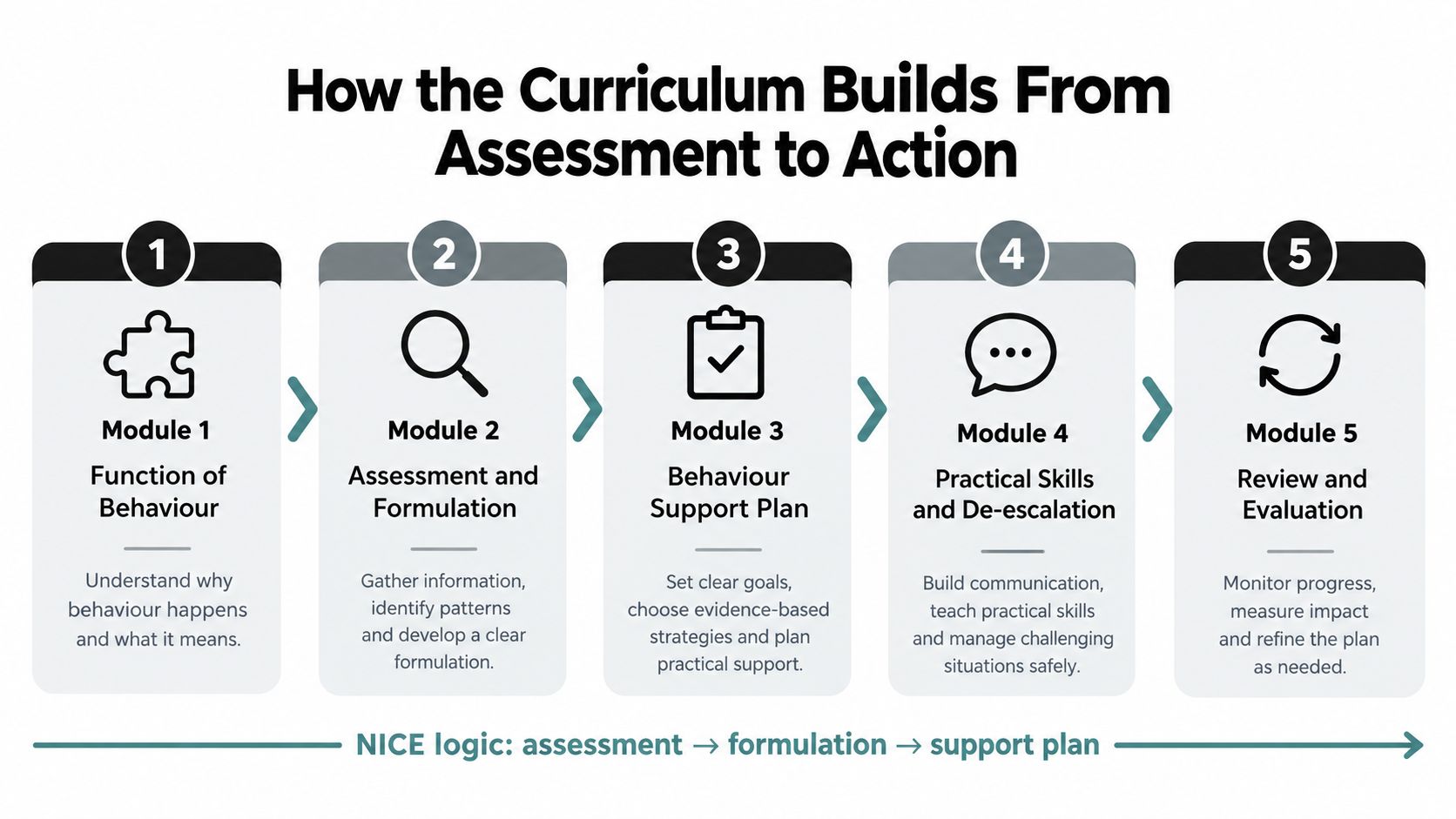
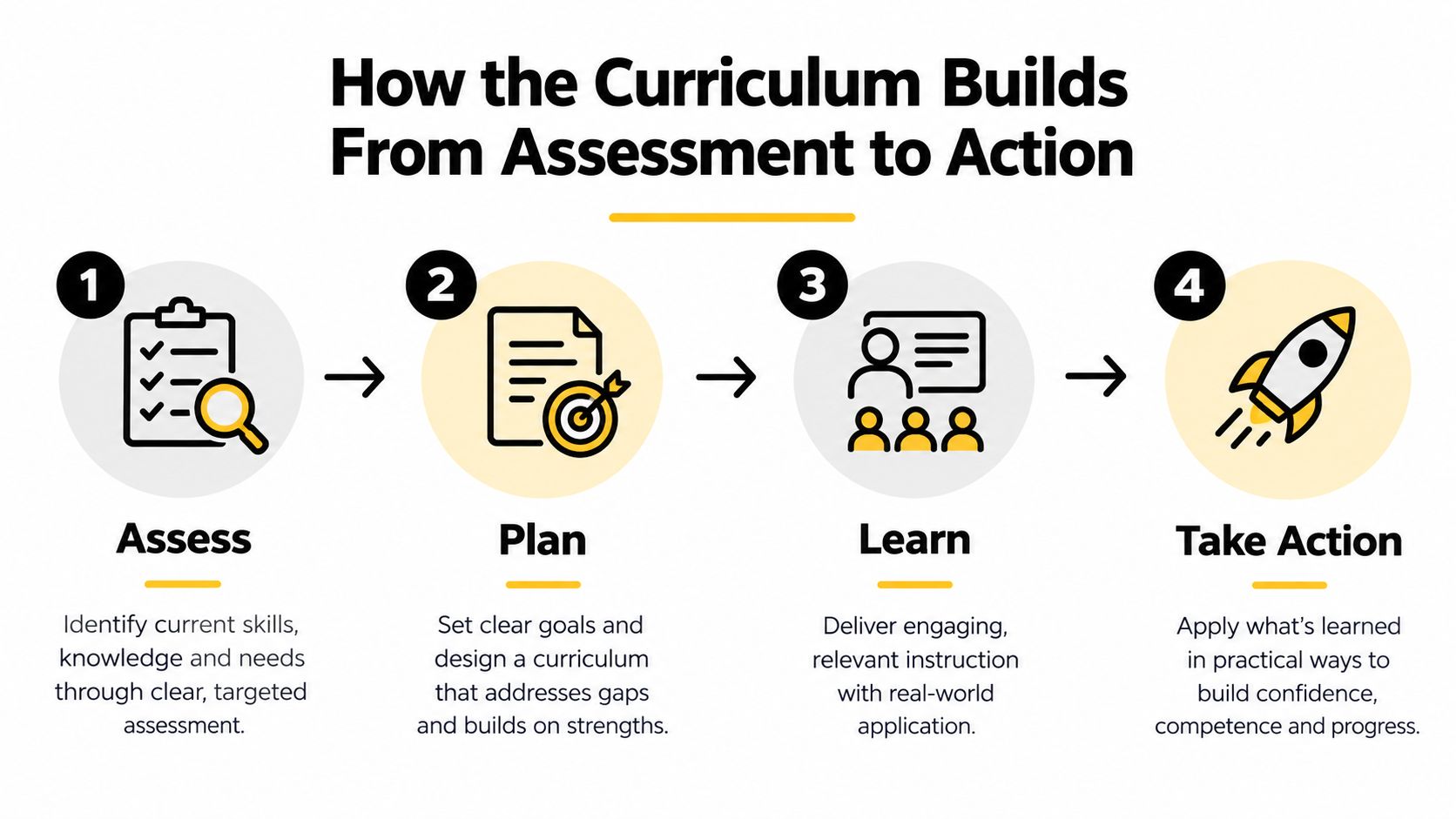
How the Curriculum Builds From Assessment to Action
A sound curriculum follows the same logic as good care practice. It doesn't begin with a collection of physical techniques. It begins by asking what the person may be communicating and what information the team needs before choosing an intervention.
Start with function and evidence
The first module introduces the function of behaviour. Learners consider what happens before and after an incident, how communication needs influence behaviour and why “behaviour that challenges” describes an interaction with the environment, not a fixed identity.
The next stage is assessment. Staff may use ABC recording, where they document the antecedent, the behaviour and the consequence. They may map patterns involving time, people, activities, noise, personal care, transitions or unmet physical needs. Risk screening and functional assessment add structure, but staff should avoid treating a form as a diagnosis.
Formulation turns observations into a working explanation. For example, a person may repeatedly refuse personal care because the task is rushed, communication is unclear and the person associates the room with a previous frightening experience. That hypothesis must be discussed with the person where possible and shared consistently across the team.
Turn the formulation into a plan
The behaviour support plan then describes prevention, early responses and action when risk increases. Prevention might include visual prompts, a slower routine, pain checks, preferred staff or a quiet space. Early responses could involve reducing language, offering a choice and pausing the task. Reactive guidance should be specific, lawful and proportionate, with clear instructions about when to seek help and how to report an incident.
Evaluation completes the cycle. Supervisors review records, observe practice, check whether staff followed the plan and consider whether the plan still explains what's happening. NICE guidance specifically supports regular supervision, monitoring, routine outcome measures and adherence checks, so review isn't an optional extra.
A de-escalation technique only makes sense when staff understand the situation it's being used in.
That's why de-escalation techniques should be taught alongside assessment, formulation and support planning. A phrase that helps during sensory overload may not help someone experiencing pain or paranoid distress. The worker's job is to make a defensible, person-centred decision, not to recite a script.
Who the Course Is Designed For in Care Settings
The best course matches the learner's responsibility. A new care worker doesn't need the same depth as a senior practitioner who writes support plans, coaches colleagues and reviews restraint data.
New starters need usable foundations
For someone completing the Care Certificate, the priority is recognising early signs of distress, recording events accurately, communicating respectfully and understanding why de-escalation comes before intervention. The learner should practise describing what they observed without labelling a person as “aggressive” or “difficult”.
Established carers in learning-disability or autism services need a more structured pathway. Their work may involve implementing Positive Behaviour Support plans, reducing restrictive practices, identifying environmental triggers and contributing to multidisciplinary reviews. They need to understand not only what to do, but why the plan recommends it.
Dementia-care workers face a different emphasis. Distress may relate to pain, constipation, fatigue, unfamiliar surroundings, fear or difficulty expressing a need. A course that focuses only on compliance and control won't prepare staff for this context.
Managers and team leaders need a supervisory version of the subject. They should be able to observe practice, give feedback, review incidents, identify gaps and act when a worker isn't progressing. Agency workers, bank staff and family carers may benefit from a concise induction module, but they'll still need local orientation and a named person to contact.
Some learners need another course
Teachers looking for classroom routines and pupil conduct should choose a school-based programme. Nurses and support workers seeking PMVA or breakaway certification need a course specifically approved for that intervention and their workplace. A generic online certificate can't replace role-specific practical assessment where physical skills are part of the job.
Formats, Duration and How Completion Is Validated
UK providers offer a wide range of delivery formats. Public course listings include one-day, twilight and short online options, but the advertised duration doesn't tell you whether learners can transfer the skill into practice. NASUWT's behaviour-management course information illustrates the market's focus on practical skills and a whole-school approach, while other formats include follow-up support because an initial session may not embed learning by itself.
| Format | Duration | Delivery | Validation |
|---|---|---|---|
| Awareness module | Short online session | Self-directed learning | Quiz or attendance record |
| Practical workshop | Half-day or one day | Face-to-face scenarios and role-play | Tutor observation during activities |
| Supported programme | Several weeks | E-learning, practice and supervision | Workplace observation and supervisor sign-off |
| Qualification route | Set by the awarding organisation | Structured study and assessment | External quality assurance and award evidence |
A downloadable PDF certificate normally proves attendance or completion. It doesn't necessarily show that a worker can interpret an ABC record, follow a behaviour support plan or respond safely during a live situation.
Choose evidence, not just a calendar slot
A one-day face-to-face session can be valuable because learners rehearse conversations, notice body language and receive immediate feedback. It's still limited if nobody observes the worker afterwards. A short online module may suit an induction refresher, but it shouldn't be presented as full competence for complex support.
A regulated Level 2 or Level 3 award mapped to the Regulated Qualifications Framework can offer external quality assurance. The strongest evidence is often practical: a competent senior practitioner observes the learner applying agreed strategies in the workplace, discusses the decision and records the outcome.
Validation matters: Ask what the certificate proves, who assessed the learner and where the provider records workplace competence.
The appropriate choice is the lightest format that genuinely meets the role, risk level and audit requirement. A basic refresher shouldn't be dressed up as specialist training, while a complex service shouldn't rely on attendance alone.
Why One-Off Training Is Rarely Enough
A single classroom session can introduce useful ideas, but it rarely changes practice on its own. The UK workforce-development review cited in the available evidence found weak evidence that training alone changes staff behaviour or improves service-user outcomes. It found that combining in-service training with coaching appears more effective, while structured and sustained training has stronger support in dementia care for reducing behavioural disturbance and restraint use. The workforce-development evidence on training, coaching and restraint reduction supports a longer implementation view.
The reason is practical. Behaviour depends on the person, the environment, the relationship and the task. A worker may understand de-escalation in a classroom, then freeze when a familiar resident becomes distressed during personal care on a busy shift. Without feedback, the worker may return to rushed instructions, repeated demands or unnecessary physical prompting.
Build a practice loop
Effective programmes add support after the teaching day:
- Coaching: A competent practitioner observes real interactions and gives precise feedback.
- Supervision: The manager connects incidents to the person's behaviour support plan and explores the worker's decisions.
- Review: The team checks records, patterns, outcomes and whether staff followed agreed strategies.
- Reinforcement: Learners revisit the material when they move into dementia, learning-disability, autism or mental-health services.
A service can measure more than attendance. It can review the quality of ABC records, the consistency of support plans, incident themes and the use of restrictive interventions. The exact measure should fit the service and the person, and it should help the team decide whether support is working.
The training problem is usually structural, not motivational. Staff may want to respond well, but they need protected time, competent supervision and permission to discuss mistakes without turning every reflection into blame.
How to Choose the Right Behaviour Management Course
Start with the job, not the course title. Ask what the learner will be expected to do after training. A domiciliary care worker supporting people with dementia needs a different course emphasis from a senior practitioner implementing Positive Behaviour Support in supported living.
Check alignment and content
Look for a clear connection to the Care Certificate, Skills for Care guidance, relevant diploma units or the care framework used by your nation of the UK. Check the trainer's professional and teaching credentials, as well as their experience in the setting where learners work.
The syllabus should cover assessment and behaviour support planning, not just de-escalation phrases. It should address communication, triggers, person-centred practice, restrictive-practice reduction, recording, escalation and review. If the provider can't explain how learners move from observation to a written plan, the course is probably too shallow for complex care.
Test the delivery model
Ask these questions before booking:
- Role fit: Is the course written for adult social care, dementia, learning disability, autism or mental-health support?
- Practical assessment: Will a tutor or supervisor observe the learner applying the learning?
- Follow-up: Does the provider include coaching, reflective discussion or workplace review?
- Trainer competence: Can the trainer explain the legal and ethical limits of intervention?
- Evidence: Will the organisation retain assessment records in supervision files or e-portfolios?
- Refreshers: Does the provider recommend a review cycle based on role and risk?
- Outcomes: Can managers compare learning with incident records, support-plan reviews or staff confidence checks?
A course that promises a certificate quickly may still be useful for basic awareness. It shouldn't be used as evidence of specialist competence unless the assessment supports that claim.
When comparing health and social care training providers, include the organisation's own policies and supervision process in the decision. A provider may offer suitable online mandatory training, but your service remains responsible for making sure workers can apply behaviour support safely.
Embedding Behaviour Management Into Onboarding and CPD
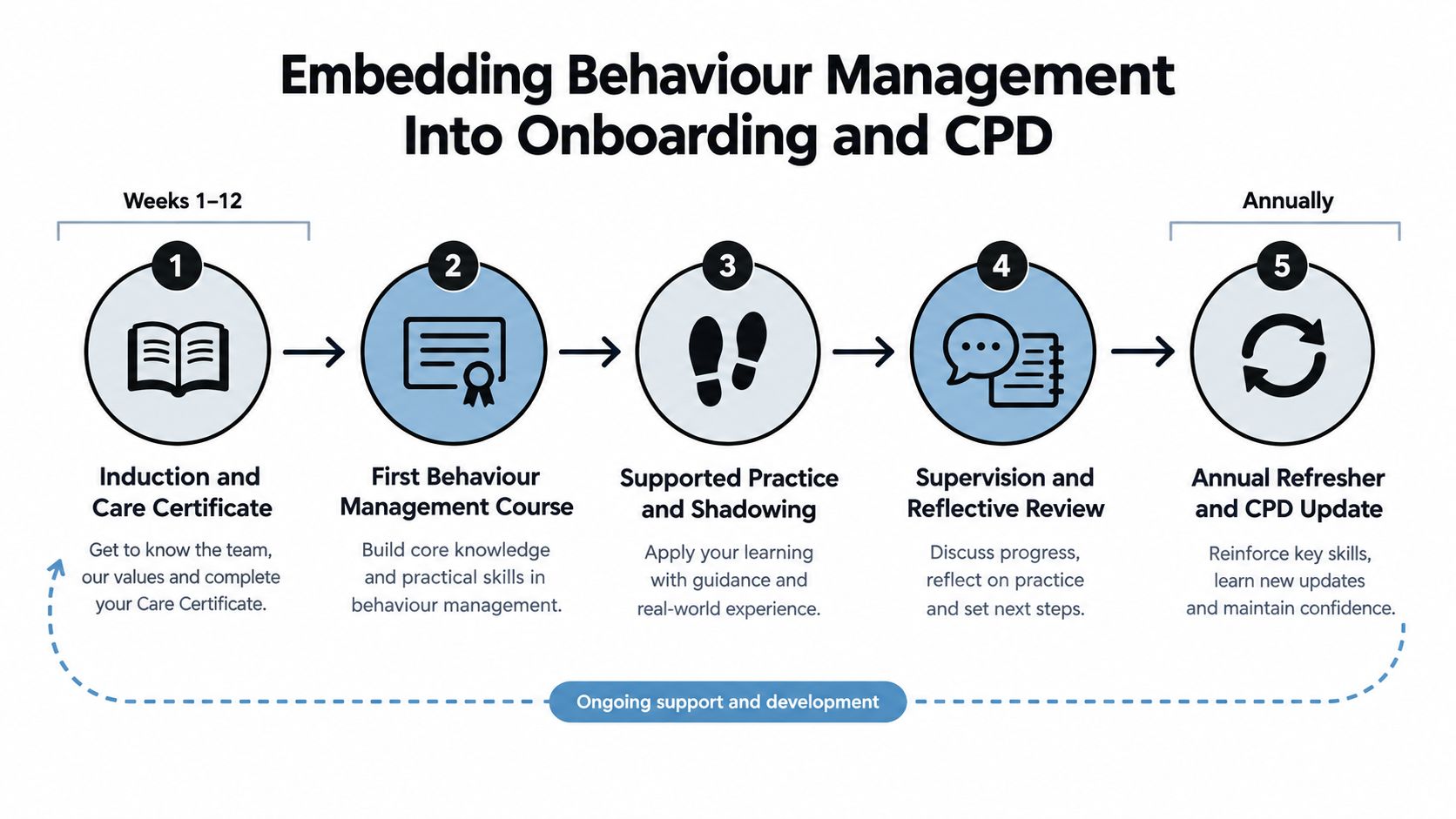
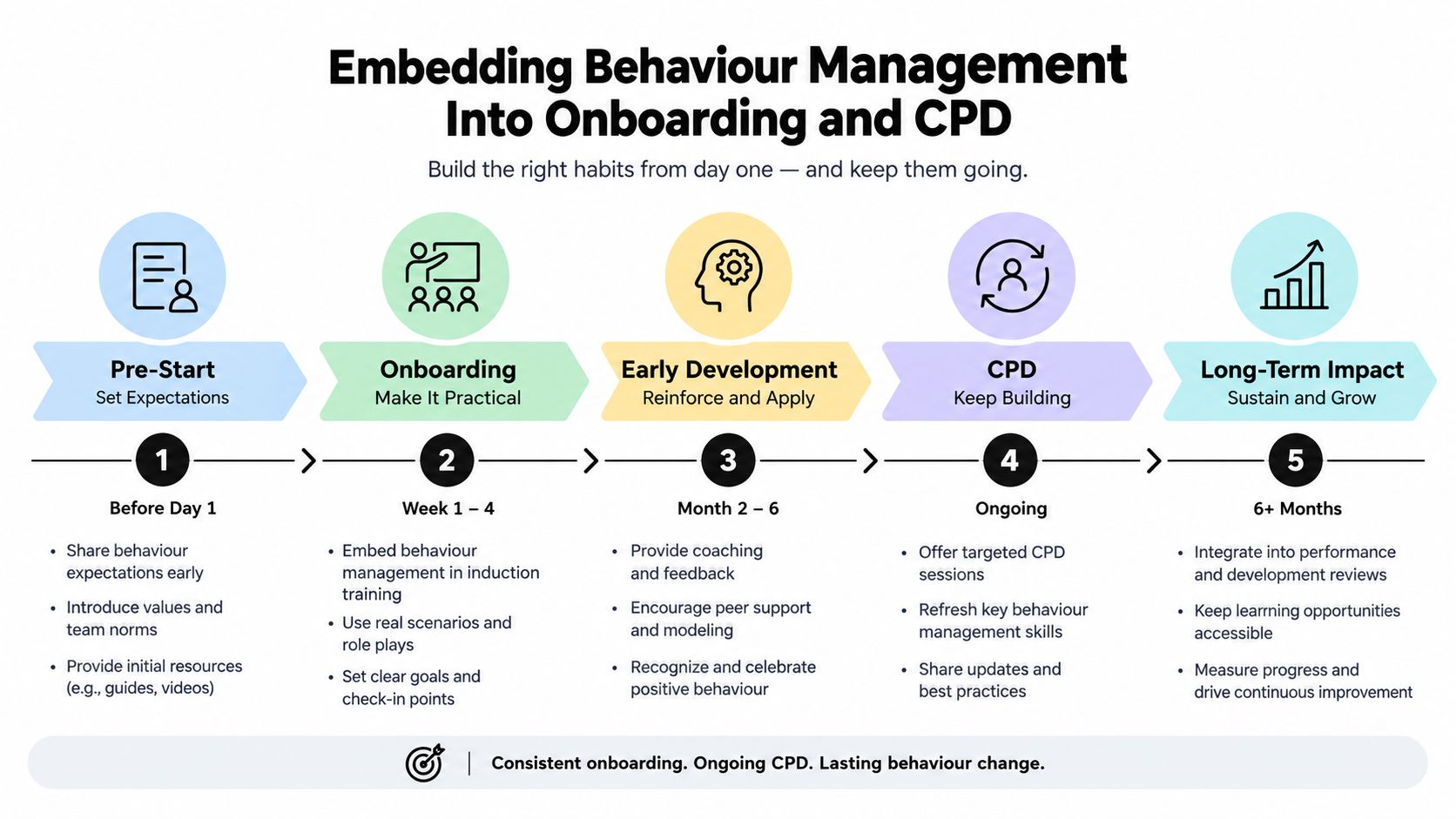
A behaviour management course works best as one point in a wider competence cycle. It should appear in onboarding, supervised practice, refresher planning and role changes, rather than sitting alone in a training spreadsheet.
A new worker might begin with induction and Care Certificate learning, then complete behaviour-management foundations before working without direct support. The manager can follow this with observed practice, reflective supervision and a review of the learner's recording. When the worker moves into dementia, learning-disability, autism or mental-health support, the service can add targeted learning instead of assuming the original course covers every context.
Keep the evidence connected
Supervision notes should record what the worker observed, which strategy they chose, what happened next and what they'll try differently. An e-portfolio can hold certificates, observation records, reflective accounts and links to relevant behaviour support plans.
Managers can use ABC chart reviews, incident themes, service-user feedback and plan reviews to identify whether someone needs more than a standard refresher. The focus should remain on learning and safer support, not on collecting documents that nobody revisits.
Before you book, take four actions:
- Match the course to the service user group and the worker's duties.
- Schedule supervision after training, not months later.
- Plan an observed practice review and record the result.
- Connect the learning to a specific support-plan or service-user outcome.
Cura Academy provides online mandatory care training, Care Certificate learning, refresher content and role-specific courses through its membership platform. Visit Cura Academy to review its current health and social care training options, then confirm with your employer whether additional behaviour-management assessment or workplace sign-off is required.