

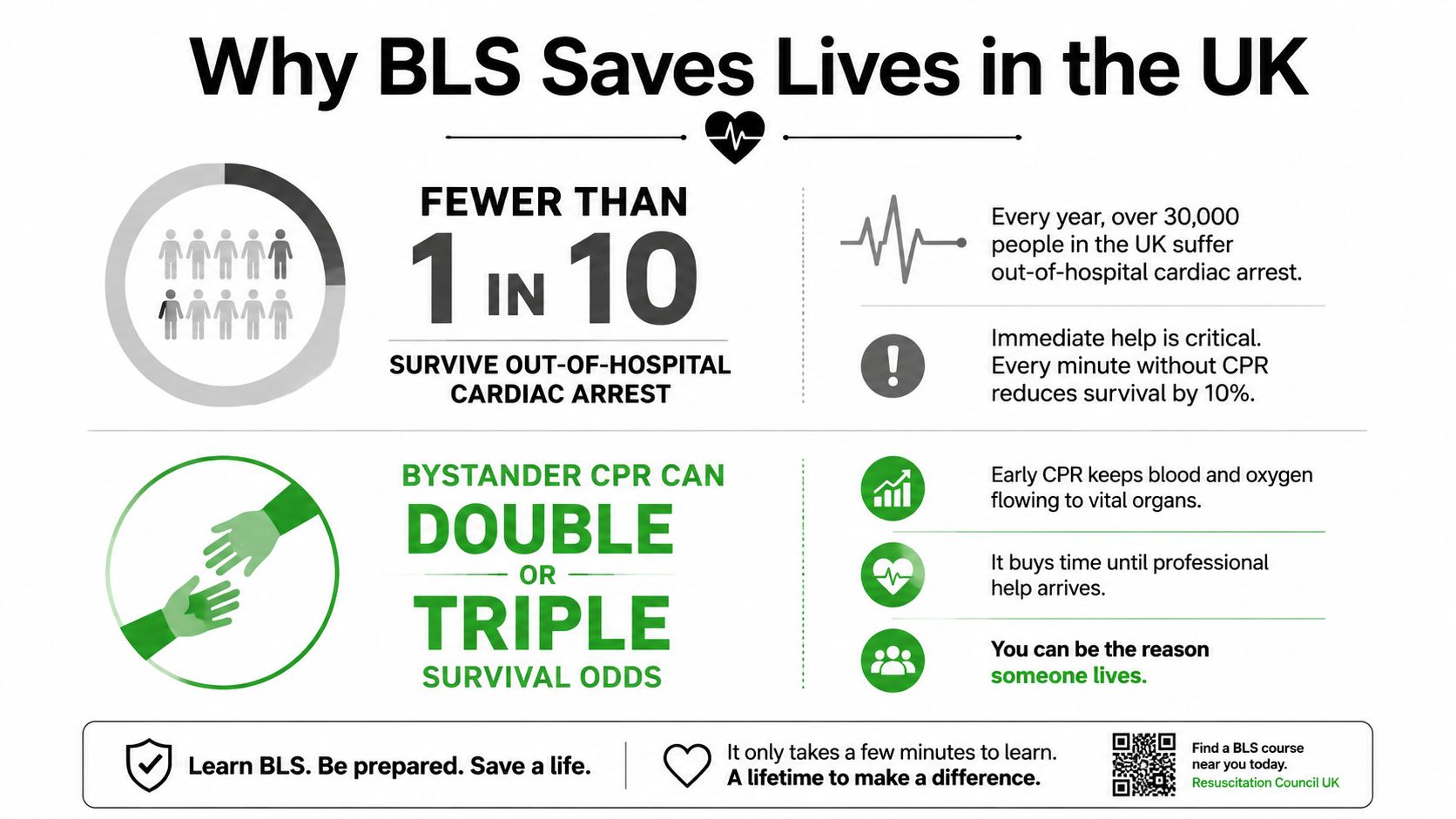
Around 8% of people in England survived 30 days after an out-of-hospital cardiac arrest in 2022, while public CPR was provided in over 70% of cases and a public-access defibrillator was used in fewer than 10%, according to Resuscitation Council UK's adult basic life support guidance. Those figures make basic life support UK training more than a compliance topic. For care workers, it's the practical skill that can keep a person alive while an ambulance is on its way.
Table of Contents
- Why Basic Life Support Matters in UK Care Settings
- Current UK BLS Guidelines and Step-by-Step Algorithms
- Legal Requirements and Training Obligations for Care Workers
- Choosing the Right BLS Training Route for Your Role
- Practical Tips for Learners and Employers
- How Cura Academy Supports BLS Compliance and Career Readiness
- Your Next Steps to Becoming BLS Certified
Why Basic Life Support Matters in UK Care Settings
A care worker starts morning rounds and finds a resident unresponsive in bed. The room is familiar, the resident is known, and the worker may already understand their usual breathing pattern. That familiarity can help with recognition, but it can also create hesitation. Is the resident asleep? Has there been a fall? Is the breathing normal?
BLS training gives the worker a structured answer. Check the environment, assess responsiveness, call 999, assess breathing, and begin CPR immediately when breathing is abnormal. Resuscitation Council UK guidance specifically identifies slow, laboured, agonal, or panting breathing as signs of cardiac arrest. A care worker shouldn't wait for complete certainty before acting.
What BLS means in practice
Basic Life Support is the immediate response provided before advanced medical help arrives. It includes recognising cardiac arrest, contacting emergency services, opening the airway, checking breathing, performing chest compressions, giving rescue breaths when trained and able to do so, and using an automated external defibrillator, or AED, as soon as one is available.
It doesn't replace paramedic or hospital treatment. It creates the bridge between collapse and professional intervention. In a care home, that bridge may be provided by a support worker, senior carer, nurse, colleague, or another person who reaches the resident first.
Care environments also involve emergencies beyond cardiac arrest. Staff may encounter choking during meals, a sudden collapse in a communal area, or a person who stops breathing after an acute illness. A calm, rehearsed response matters because panic can delay the first essential actions.
Practical rule: If an adult is unresponsive and breathing appears abnormal, call 999 and start CPR rather than waiting for a perfect diagnosis.
Why structured training changes behaviour
A real emergency feels different from a training room. The person may be someone the worker knows well. Other residents may be watching. A colleague may be calling for help while another searches for the emergency grab bag or AED. BLS training reduces the number of decisions a worker has to invent under pressure.
The national figures also show why AED access and confidence matter. The British Heart Foundation's summary of England's out-of-hospital cardiac arrest data reports bystander CPR in about seven out of ten cases, public-access defibrillator use in fewer than one in ten cases, and overall survival to hospital discharge around 8.6% to 9%. The same source explains that survival falls by roughly 7% to 10% for every minute without CPR and defibrillation, while defibrillation within 3 to 5 minutes can produce survival rates as high as 50% to 70%.
That's why BLS belongs in induction, refresher planning, supervision, and shift readiness. The rest of this guide connects the clinical algorithm with the training evidence and workplace systems care workers need.
Current UK BLS Guidelines and Step-by-Step Algorithms
UK BLS follows a standardised sequence. Staff still need practical training, but knowing the order helps prevent delays when several people are speaking and moving around the scene.
Adult basic life support sequence
The adult approach can be remembered through DRABC, while following the current Resuscitation Council UK instruction to activate 999 immediately when an adult is unresponsive and abnormal breathing is suspected.
- Danger: Check that you, the person, and other people nearby are safe. Don't rush into traffic, smoke, electrical hazards, or an unsafe room.
- Response: Speak to the person and gently stimulate their shoulders. If there's no response, call for help.
- Airway: Open the airway using a head tilt and chin lift unless a specific clinical situation requires a different approach.
- Breathing: Look, listen, and feel for normal breathing. Gasping, panting, slow, laboured, or agonal breathing isn't normal breathing.
- Call 999: Use a mobile phone on speaker if possible. Ask another worker to bring the AED.
- Circulation and CPR: Start chest compressions in the centre of the chest. Aim for 100 to 120 compressions per minute and a depth of 5 to 6 cm, as specified in Resuscitation Council UK's adult basic life support guidelines.
- Ventilation: If trained in adult resuscitation and able to provide rescue breaths, use a 30:2 compression-to-ventilation ratio. If you can't give breaths, continue chest compressions while following the emergency call handler's instructions.
- AED: Attach the AED as soon as it becomes available. Follow its spoken and visual prompts, and don't touch the person while the device analyses or delivers a shock.
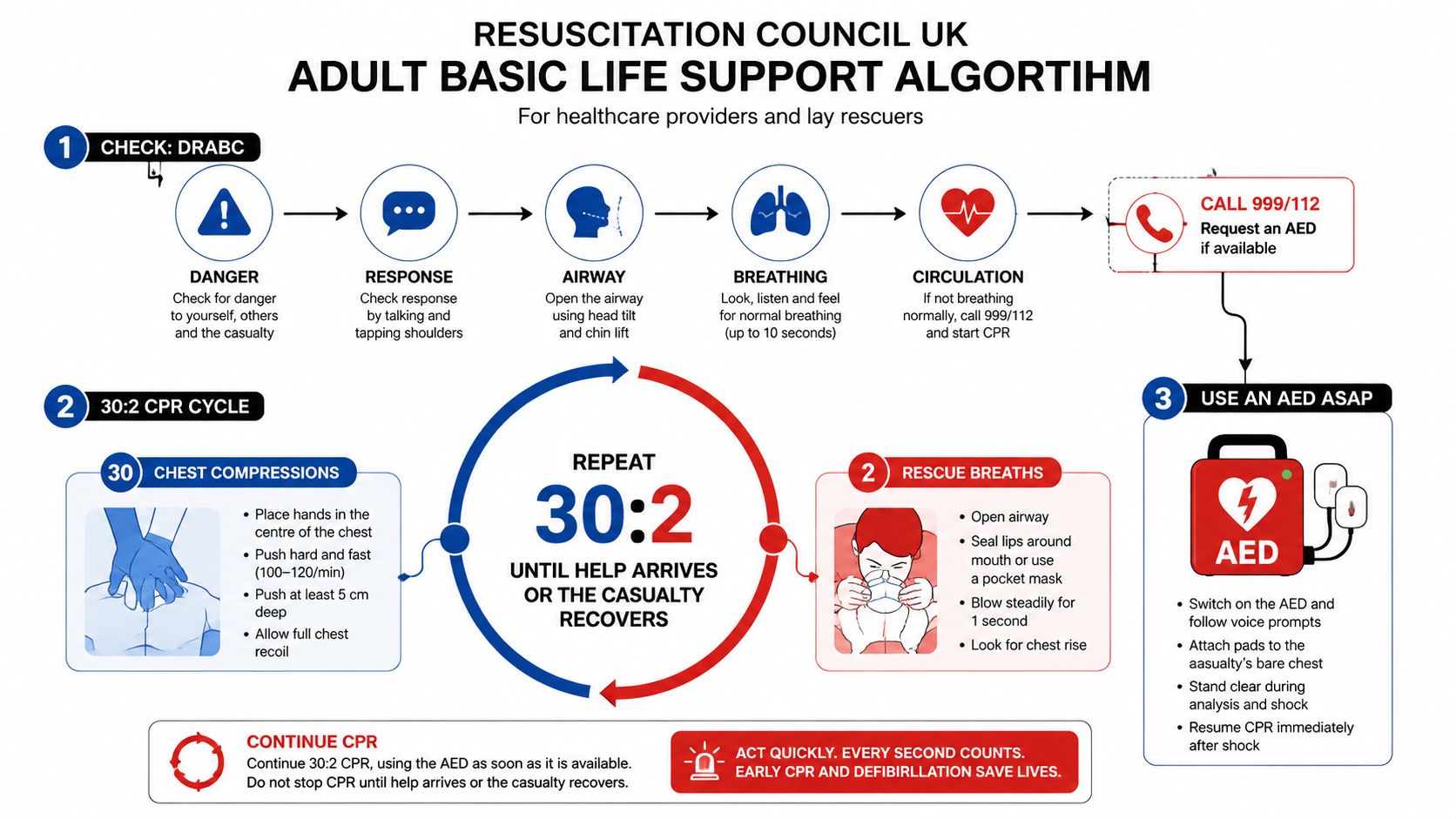
The AED decides whether a shock is advised. You don't need to diagnose the rhythm. Keep interruptions to compressions as short as possible, change compressors when fatigue affects quality, and continue until the person shows clear signs of life, trained help takes over, you become exhausted, or the emergency service tells you to stop.
Paediatric differences
Children and infants need a paediatric approach. A paediatric-trained rescuer uses 15:2 compressions to breaths, while the adult-trained ratio is 30:2. Paediatric BLS also includes five initial rescue breaths. For a smaller child, one hand may be appropriate for compressions, depending on the child's size and the rescuer's ability to achieve the correct depth.
The setting matters. A choking child may deteriorate quickly, so staff must recognise ineffective coughing and act promptly. Give back blows first. If the obstruction remains, use abdominal thrusts for a child where appropriate, then call 999 and transition to CPR if the child becomes unresponsive. Paediatric courses should demonstrate the technique on suitable manikins because force, positioning, and body size all affect performance.
Choking, recovery position, and stopping
For a responsive adult or child with severe choking, encourage effective coughing if it's working, then use back blows and abdominal thrusts according to the person's age and the course guidance. Don't perform blind finger sweeps, as they can push an obstruction further into the airway.
If someone is unresponsive but breathing normally, place them in the recovery position, call 999, and continue monitoring their breathing. If breathing is abnormal, treat the situation as cardiac arrest and begin CPR. BLS attempts stop when qualified clinicians take over, the person shows reliable signs of life, the rescuer is unable to continue, or emergency services instruct the rescuer to stop.
An embedded demonstration can help learners connect the written sequence with physical movement.
Legal Requirements and Training Obligations for Care Workers
A BLS certificate alone does not establish compliance. The relevant questions are whether the worker's role requires BLS, what the employer's risk assessment identifies, which care setting they work in, and whether training demonstrates the competence needed for that role.
Skills for Care's Statutory and Mandatory Training Guide, December 2025 states that formal basic life support training is required when identified, or at least annually. It distinguishes recognising and responding safely to accidents and sudden illness from providing basic life support. A short awareness module may therefore address general recognition without meeting the practical requirements of an assessed BLS course.
Awareness knowledge versus practical competence
An online awareness course can introduce the BLS algorithm, explain cardiac arrest recognition, and show why AEDs matter. It may prepare a new recruit for further training, but completion alone usually does not demonstrate the ability to position hands correctly, deliver compressions, coordinate breaths, or use an AED safely.
Practical assessment is similar to a driving test. Knowing the sequence matters, but an assessor must also see the learner perform it. On a manikin or equivalent equipment, the assessor can identify shallow compressions, long pauses, poor airway positioning, or hesitation during AED analysis. A multiple-choice quiz cannot reveal those physical errors.
| Requirement | Online Awareness Module | Assessed BLS Qualification |
|---|---|---|
| Theory | Explains key principles and the emergency sequence | Covers the theory alongside practical application |
| Physical technique | Usually not observed | Demonstrates compressions, airway actions, ventilation, and AED use |
| Evidence of competence | Course completion or CPD record | Assessor records observed practical performance |
| Employer acceptance | Depends on role and employer policy | More suitable where practical competence is expected |
| Refresher planning | May support knowledge revision | Allows the employer to track formal assessment and renewal requirements |
The Cura Academy guidance on mandatory training for care workers highlights the records employers need to manage. A manager should be able to confirm what the worker completed, whether practical skills were assessed, when training requires review, and how it relates to the person's duties.
What providers should be able to evidence
Care managers should retain certificates, assessment records, course dates, learner identities, and renewal information. They should also check that course content reflects the worker's responsibilities. A generic CPD certificate can record learning activity, yet it does not by itself demonstrate hands-on BLS competence.
For CQC-regulated providers, shift readiness includes the ability to respond safely to foreseeable emergencies. A gap between course completion and physical performance can make it difficult to show that staff are prepared for a real incident. Employers should therefore treat BLS as a competency process requiring documented practical evidence.
Choosing the Right BLS Training Route for Your Role
The right BLS route starts with the worker's duties, the employer's policy, and the evidence required for a safe shift. A domiciliary carer working alone, a new residential care recruit, and an experienced agency worker may need different delivery arrangements, although the underlying BLS principles remain standardised.
Three routes compared
| Factor | Online Only | Blended Learning | Classroom |
|---|---|---|---|
| Flexibility | High, learners study remotely | High for theory, with a planned practical session | Lower, because attendance is required at a set time |
| Hands-on practice | Limited or absent | Included through practical assessment | Included through practical teaching and assessment |
| Employer acceptance | Must be checked carefully | Often aligns better with roles requiring observed competence | Commonly suitable where full practical assessment is required |
| Time away from shifts | Minimal | Concentrated practical attendance | Entire course requires classroom attendance |
| Learning experience | Convenient for theory | Combines preparation with physical skills | Immediate trainer feedback throughout |
| Record keeping | Completion record may be available | Theory and assessment records can be kept together | Attendance and assessment records are usually produced by the provider |
Matching the route to the worker
Online-only learning may suit general awareness or preparation before a practical course. The employer should confirm that it meets the role's training requirement before booking, particularly where staff may need to respond alone during a home visit or out-of-hours shift.
Blended learning gives a new recruit time to study course material before attending a practical session. It can also reduce time away from work while retaining a scheduled opportunity for instructor feedback and assessment. This arrangement may suit care providers that need consistent records across several workers.
Classroom training suits teams that need a shared session and workplace-focused discussion. A trainer can build scenarios around a resident collapsing in a dining room or a person becoming unresponsive during personal care. The provider can observe each learner directly, identify technique issues, and record the outcome for the employer.
Check the course against employer requirements
Before enrolling, ask which route the organisation accepts, whether the provider follows current UK guidance, and what documentation the manager needs for training records. Check the course duration, practical attendance arrangements, assessment process, and renewal expectations. These details help prevent a worker from completing a course that cannot support their role or the provider's compliance records.
What matters more than the certificate's wording is the evidence of practical assessment it represents. The certificate should identify the learner, course, completion date, and provider, while the employer should know what training outcome it records.
For a flexible route, review the Cura Academy basic life support courses alongside classroom providers and employer-approved options. The final choice should match the worker's duties, shift pattern, organisational policy, and the level of evidence needed for CQC-regulated care.
Practical Tips for Learners and Employers
BLS skills become easier to recall when learners prepare deliberately and employers reinforce them after the course. The most effective preparation is practical, simple, and connected to the environment where the worker may need to act.
Learner checklist
- Review the algorithm: Read the relevant Resuscitation Council UK sequence before the course, including the response to abnormal breathing.
- Practise the rhythm: Use a metronome app to become familiar with the target compression rate of 100 to 120 per minute. This doesn't replace manikin practice, but it can make the pace feel less unfamiliar.
- Learn the difference: Adult and paediatric approaches aren't interchangeable. Know that paediatric-trained rescuers use a 15:2 ratio and five initial rescue breaths.
- Wear suitable clothing: Choose clothing that allows you to kneel, reach the manikin, and perform compressions without restriction.
- Ask about assessment: Confirm whether the course observes CPR, rescue breaths, AED use, choking management, and recovery position technique.
- Practise communication: Rehearse clear instructions such as asking a colleague to call 999, bring the AED, meet the ambulance crew, or keep other residents away.
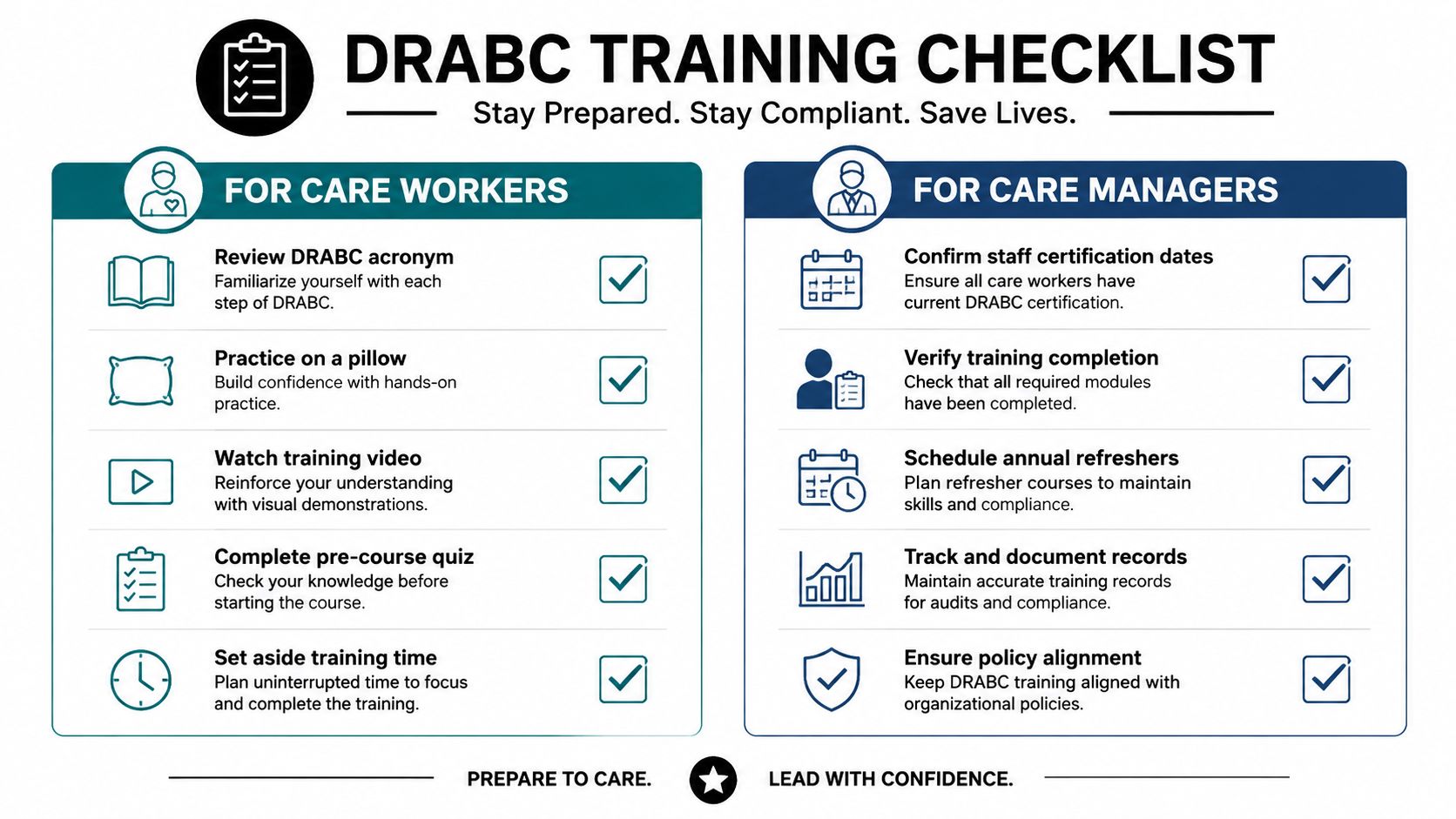
Employer checklist
Managers need a reliable system rather than a spreadsheet checked only when an inspection is approaching.
- Maintain a training matrix: Record each worker's course, assessment status, certificate date, role, and next review point.
- Check practical evidence: Keep the assessment record, not only the completion certificate.
- Plan before expiry: Arrange refreshers early enough to avoid workers becoming non-compliant between shifts.
- Include every site: Agency, bank, relief, and staff who move between homes need clear records accessible to the relevant manager.
- Use supervision well: Discuss where the AED is stored, who calls 999, and how staff manage residents during an emergency.
- Review incidents: After a real emergency or drill, identify communication, equipment, and training issues without blaming staff.
For managers: A current certificate shows a training event happened. A current competency record shows what the worker was assessed to do.
Common failures include expired certificates going unnoticed, reliance on unaccredited awareness modules, and inconsistent records across multiple locations. BLS isn't a tick-box task completed once and forgotten. Skills deteriorate when people don't practise, so organisations should create regular opportunities to discuss and rehearse the response.
How Cura Academy Supports BLS Compliance and Career Readiness
Care workers often face two competing pressures. They need flexible access to theory, but employers may also need evidence that practical skills have been assessed. A training route that addresses only one side leaves the worker or manager to solve the remaining gap.
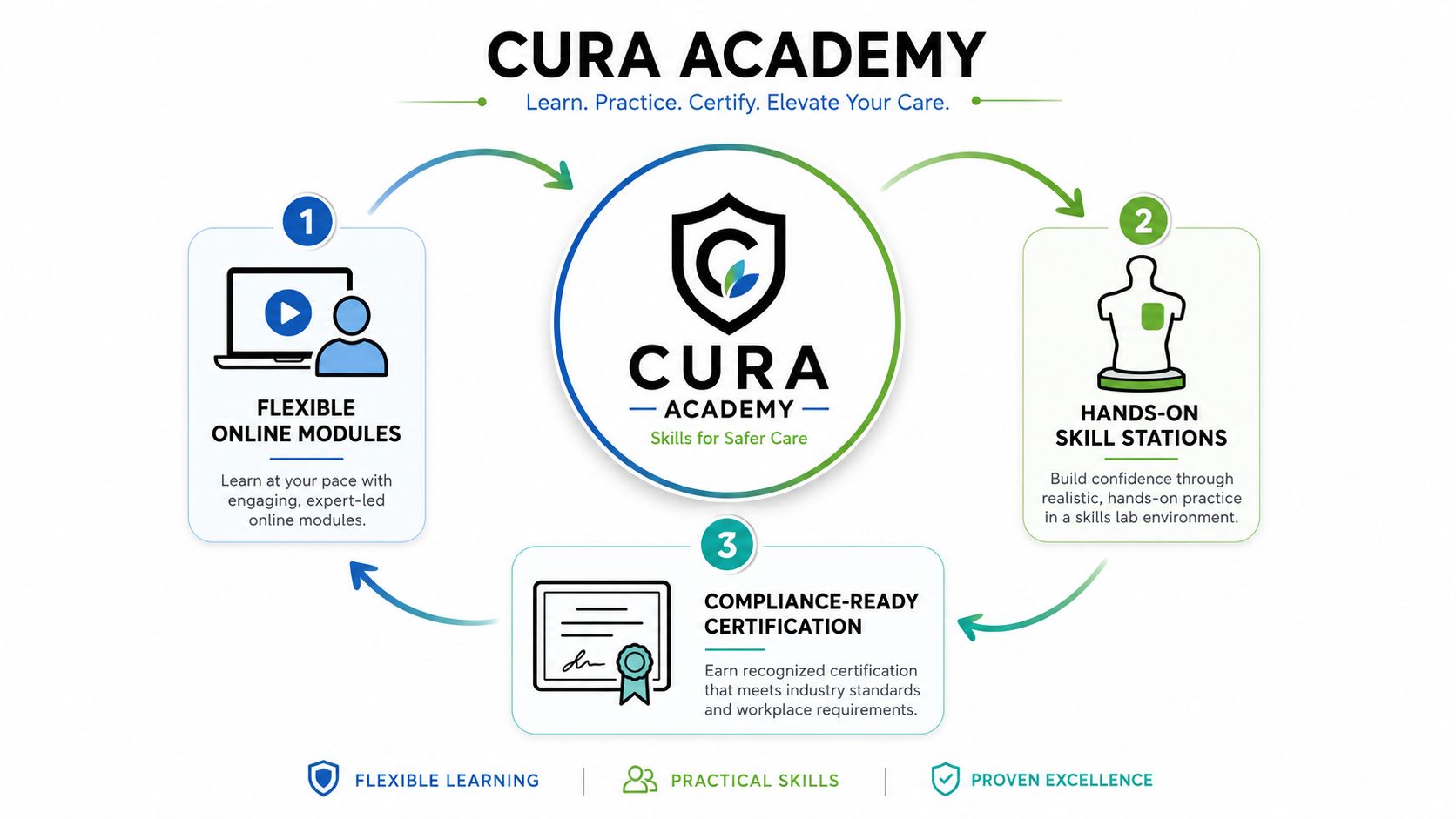
Cura Academy presents its BLS course as part of a broader health and social care training platform. Its offering combines online learning with a practical assessment route, giving learners a way to prepare around work and then demonstrate the physical skills required for BLS. Employers can use the resulting records when reviewing workforce readiness, subject to their own policies and acceptance requirements.
Connecting training features with workplace needs
The online element helps learners access core information without beginning with a full classroom day. That's useful for new starters who need to understand DRABC, abnormal breathing, CPR, choking, recovery position, and AED principles before practising.
The practical element addresses the weakness of theory-only completion. Learners can receive feedback on compression technique, positioning, ventilation, and emergency actions rather than relying on a quiz result as evidence of physical competence.
For managers, centralised learning records and renewal reminders can reduce manual chasing. For individual workers, a clearly documented qualification can support conversations with employers about induction, shift readiness, and progression into related training. Cura Academy also provides wider care training pathways, including Care Certificate-related learning, mandatory refreshers, and role-specific courses.
Explore the Cura Academy Basic Life Support course and confirm that its practical assessment and certificate format meet your employer's requirements before enrolling. That final check matters because providers and roles can set different evidence requirements.
Your Next Steps to Becoming BLS Certified
BLS competence starts with the ability to recognise an emergency and act without unnecessary delay. It becomes professionally useful when the worker can also demonstrate the physical skills, understand the relevant adult or paediatric pathway, and keep the qualification current under workplace policy.
Use this action plan:
- Check your current status. Find your certificate and identify whether it records practical assessment, not only online completion.
- Compare the course with your role. A worker supporting adults may need adult BLS, while staff responsible for children require training appropriate to paediatric emergencies.
- Ask your employer what evidence is required. Confirm whether the organisation accepts online theory, blended learning, classroom training, or only a particular approved provider.
- Choose training aligned with UK guidance. Check that the course reflects current Resuscitation Council UK principles and includes the skills your role requires.
- Book the practical assessment. Don't treat theory completion as the final step if your employer expects observed competence.
- Record the renewal point. Add it to your own calendar and ask the manager to include it in the organisation's training matrix.
- Keep practising communication. Know who calls 999, where the AED is, how colleagues share tasks, and how residents or visitors are protected during the response.
Employers should run the same process at workforce level. Audit the training matrix, identify staff without practical evidence, centralise records across sites, and choose a learning pathway that limits avoidable disruption to shifts.
BLS is a foundation for trusted care. Workers who can recognise cardiac arrest, begin CPR, use an AED, and show current practical competence are better prepared for emergencies and clearer about their professional responsibilities.
Cura Academy offers flexible health and social care learning with a Basic Life Support pathway designed to connect online preparation with practical competence and compliance records. Visit Cura Academy to review the available training options for your role or organisation and take the next step towards shift-ready BLS skills.