
A lot of readers land on this topic because they've got a practical problem, not an academic one. You may be starting a care role, updating mandatory training, or trying to make sense of what your manager expects you to do if somebody collapses in front of you. That's where the confusion starts. Many course pages reduce basic life support to CPR, AED, and choking. In real UK care settings, that's only part of the job.
The test is whether a worker can recognise that something is wrong, respond without delay, stay within their competence, and hand over safely. Those are the behaviours assessors look for, managers document, and regulated services rely on when an emergency happens on shift.
Table of Contents
- When a Shift Goes Quiet and the Real Objectives Begin
- What Basic Life Support Training Objectives Actually Cover
- The Five Objective Categories Every UK Course Should Hit
- Care Certificate Standard 12 and the Assessment Criteria
- How Objectives Change by Setting and Service User
- Measurable Objectives You Can Use on a Course Page
- Refresher Frequency and Recency Rules in the UK
- How Cura Academy's BLS Course Maps to These Objectives
- Why Recognition and Limits Matter as Much as CPR
- Quick Reference Card of Objectives and Evidence
- Frequently Asked Questions About BLS Objectives
When a Shift Goes Quiet and the Real Objectives Begin
It's a normal late shift. The lounge is calm. A senior carer notices that Mr A has gone oddly still in his chair and hasn't answered when offered his tea. She speaks to him, checks for a response, sees that his breathing is abnormal, calls for help, tells a colleague to get the AED, and starts chest compressions while another worker phones emergency services.
That sequence is what basic life support training objectives are really about.
Not just whether someone can remember the CPR ratio in a classroom. Not just whether they know what AED stands for. The objective is whether they spot deterioration early, make a rapid decision, act in the right order, communicate clearly, and keep going until handover.
What frontline staff are actually being judged on
In the workplace, nobody marks you on tidy theory alone. They look at whether you can:
- Recognise collapse quickly and distinguish normal breathing from absent or abnormal breathing
- Escalate fast by calling for help, contacting emergency services, and following local procedure
- Start effective basic life support without freezing or waiting for someone more senior if immediate action is needed
- Use available equipment safely including an AED where one is provided
- Give a clean handover to paramedics or senior clinicians
In care, the first failure often isn't poor compressions. It's late recognition, hesitation, or a muddled escalation call.
That broader workflow matters because UK guidance treats resuscitation readiness as an organisational responsibility as well as an individual skill. Resuscitation Council UK notes that community CPR and AED quality standards are intended to improve out-of-hospital cardiac arrest outcomes, and its UK guidance states that in England around 30% of cardiac arrest victims did not receive CPR before emergency services arrived when bystander CPR could have been started. The same guidance ties training to response rates, quality of instruction, equipment, and clear procedures across services and settings in Resuscitation Council UK guidance.
What Basic Life Support Training Objectives Actually Cover
Training objectives aren't slogans. They're observable statements of what a learner must know, do, and evidence after training. If the wording is too vague to assess, it isn't a useful objective.
A proper objective usually contains three parts:
- An action verb such as identify, demonstrate, place, escalate, record
- A visible behaviour that somebody can watch or verify
- An evidence method such as observed simulation, written answers, reflective account, or workplace sign-off
What separates an objective from a topic list
“CPR and AED” is a topic list. It tells you the subject area, but not what success looks like.
“Demonstrate a safe approach to an unresponsive adult, check responsiveness and breathing, call for help, and begin chest compressions in the correct sequence” is a training objective. It gives the learner, trainer, and assessor something concrete to work with.
That distinction matters under Care Certificate Standard 12. Skills for Care states that Standard 12 requires learners to provide basic life support by completing practical training that meets Resuscitation Council UK guidelines, so alignment with nationally recognised procedures isn't optional content. The standard points toward demonstrable competence in chest compressions, airway management, and emergency response as part of workplace readiness in the Care Certificate standards document.
What weak objectives miss
The most common weakness I see is a course that teaches technique but not context. Staff leave able to describe CPR, yet still aren't clear on:
- When to escalate
- What to say on the phone
- How to use the recovery position appropriately
- What to document afterwards
- When a situation is beyond their competence
That's why basic life support training objectives should cover the full emergency-response workflow, not a narrow skills checklist.
The Five Objective Categories Every UK Course Should Hit
A sound UK course should cover five categories. If one is missing, the training is incomplete for care practice.
Recognition
The learner must be able to identify when someone is unresponsive, when breathing is absent or abnormal, and when the situation requires urgent action. In adult social care, this also includes noticing the lead-up to collapse, not only the collapse itself.
Response and escalation
The worker needs to summon help properly. That includes calling 999 when indicated, alerting colleagues, asking for the AED if available, and following local emergency arrangements.
Resuscitation
This is the practical core. The learner must perform chest compressions effectively, give rescue breaths where trained and appropriate, and operate an AED by following prompts.
Record and handover
A worker should be able to report what happened in sequence. Emergency responders need timings, actions taken, and any relevant background. Managers need an incident record that reflects the event accurately.
Debrief and limits
After the event, competent practice includes debrief, reflection, and recognising personal capability boundaries. A staff member who knows when to escalate is safer than one who tries to do too much.
| Objective Category | Measurable Behaviour | Evidence for Assessment |
|---|---|---|
| Recognition | Identifies unresponsiveness and abnormal or absent breathing during simulation | Direct observation and verbal questioning |
| Response and escalation | Calls for help, directs a colleague, and follows local escalation route | Observed scenario and assessor checklist |
| Resuscitation | Performs chest compressions, gives rescue breaths if trained, and uses AED safely | Practical skills assessment |
| Record and handover | Gives a clear verbal handover and completes incident documentation | Handover exercise and written record review |
| Debrief and limits | Explains own role boundaries and identifies when to seek senior help | Reflective account and assessor discussion |
Why these categories matter in care settings
Public summaries often stop at CPR and defibrillation. NHS training guidance used in this area frames BLS more broadly. It includes recognising clinical deterioration, using the recovery position, operating an AED safely, documenting the event, and understanding personal capability boundaries. Skills for Care's statutory and mandatory training guidance also states that formal basic life support training is required at least annually when identified. That's one reason course objectives need to describe the whole workflow, not just resuscitation technique as outlined in NHS practical BLS training information.
Care Certificate Standard 12 and the Assessment Criteria
In most care workplaces, Standard 12 is where this becomes formal. It isn't enough for a learner to say they understand BLS. The employer needs evidence that they can perform the required actions in line with guidance and workplace expectations.
What Standard 12 turns into on the ground
In practice, assessors usually want to see safe sequencing. They're watching whether the learner checks for danger, assesses response, manages the airway appropriately, checks breathing, calls for help, and responds according to training. They also want to see that the learner understands when to place someone in the recovery position and when to continue active resuscitation steps.
The paperwork tends to come from three directions:
- Direct observation of a practical scenario
- Knowledge questions to confirm understanding
- Workplace evidence such as induction sign-off or supervised competency records
If you're trying to understand how this sits inside the wider induction framework, it helps to read Standard 12 alongside the broader overview of the Care Certificate.
Common failures during assessment
Most failed observations aren't dramatic. They're small sequencing errors that become unsafe in a real emergency.
Typical problems include:
- Skipping the danger check and moving straight to the casualty
- Delaying the emergency call because the learner focuses on the manikin first
- Unclear delegation such as shouting for help without assigning a task
- Poor hand position or shallow compressions
- Forgetting post-event recording once the practical part ends
Practical rule: If the assessor can't observe it or verify it in evidence, they can't sign it off as competence.
| Standard 12 Criterion | BLS Objective | Evidence Type |
|---|---|---|
| Provide basic life support in line with guidance | Perform correct emergency response sequence | Observed practical assessment |
| Summon appropriate help | Escalate promptly to emergency services and workplace support | Scenario observation and verbal questioning |
| Use basic techniques safely | Deliver CPR and related immediate actions within competence | Skills demonstration |
| Maintain safety during the response | Check environment and act without avoidable risk | Assessor checklist |
| Record and report appropriately | Complete incident details and handover clearly | Written account or workplace documentation |
How Objectives Change by Setting and Service User
The wording may look similar across courses, but the actual objective changes once you place the learner in a real setting. A domiciliary care worker responding alone in someone's flat doesn't work the same way as a healthcare assistant on a ward.
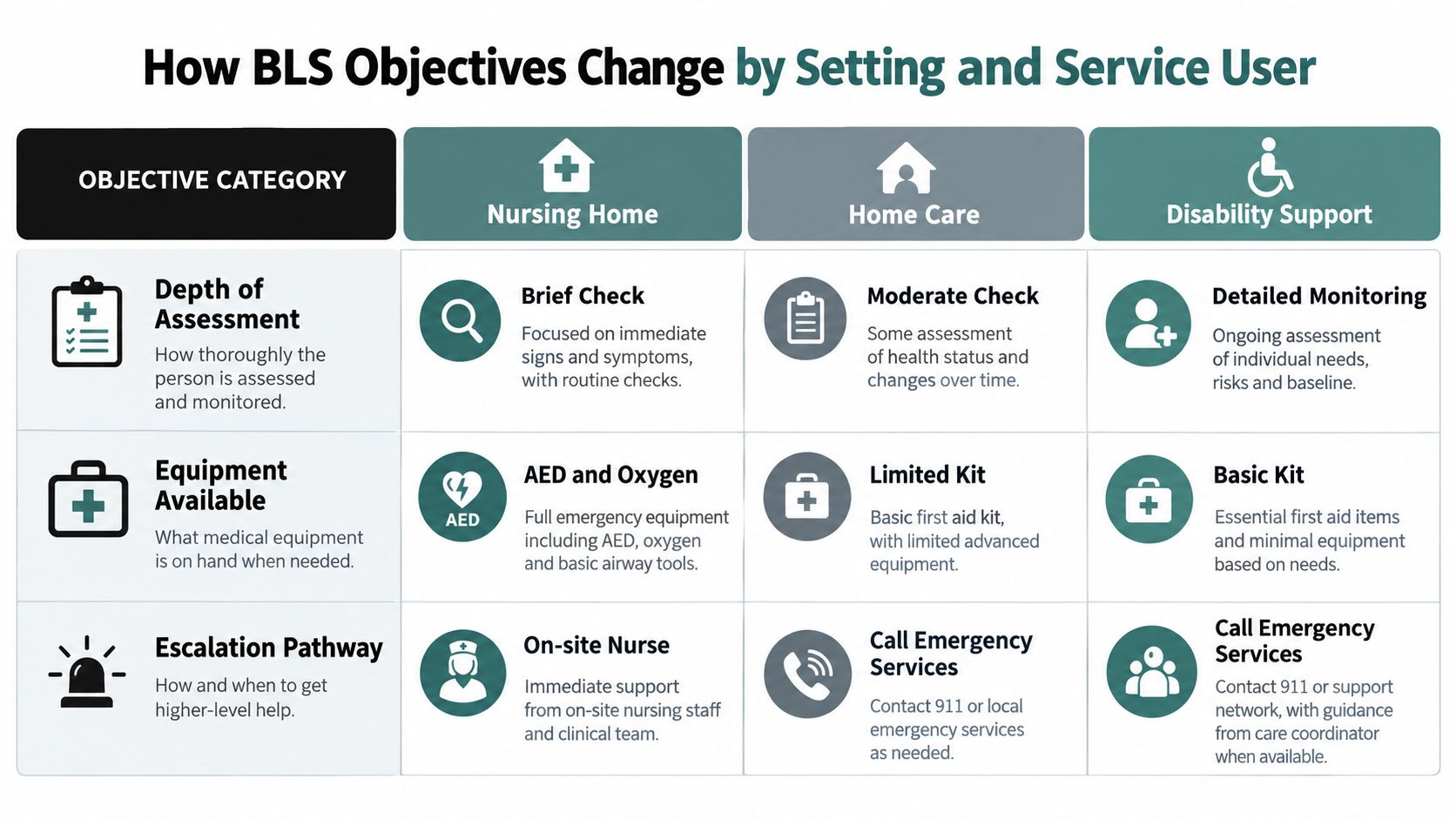
Setting changes the workflow
In a care home, the objective often includes recognising deterioration in a resident whose baseline is already complex. Staff may need to respond to subtle changes first, use the emergency bell system, and coordinate with senior carers or on-site nursing staff depending on the service.
In domiciliary care, the worker is often alone. Objectives should include using speakerphone to call emergency services, opening the door for access, and giving clear location details. That's different from team-based response and should be taught as such.
In hospital support roles, BLS sits inside a wider escalation system. The learner may need to trigger a crash response, communicate with clinical staff using structured handover, and work around more equipment.
Adult and paediatric aren't interchangeable
Paediatric objectives need separate handling. The compression technique, recognition cues, and escalation context differ from adult care. Training should say so plainly.
Skills for Care's Standard 12 guidance distinguishes adult basic life support for health and social care workers and ties it to Resuscitation Council UK guidance. NHS hospital-facing content also includes objectives around handover, SBAR, and applying DNACPR or anticipatory care decisions in context. UKHSA's 2025 minimum standards for immunisation training require basic life support training within the last 12 months for relevant practitioners, which underlines the importance of recent, setting-specific competence rather than a one-off course as reflected in Skills for Care Standard 12 guidance.
Measurable Objectives You Can Use on a Course Page
Most course pages waste space on broad promises. If you want a page that helps learners and assessors, write objectives that can be seen, tested, and signed off.
What strong wording looks like
Good objective wording starts with a clear verb and avoids fluffy phrases like “gain awareness of” or “understand the importance of” unless you're pairing them with an assessment method.
A stronger set for UK care staff would look like this:
- Demonstrate a safe approach and primary survey for an unresponsive person during a simulated emergency
- Recognise absent or abnormal breathing and state when emergency help must be called
- Perform chest compressions correctly and continue until relieved, advised to stop, or the situation changes
- Use an AED in line with training and follow voice prompts safely
- Place a breathing but unresponsive casualty in the recovery position
- Record the event and give a concise handover to emergency responders
- Identify the limits of own competence and escalate without delay
Add the evidence method on the same page
This is the part many providers leave out. If your course page includes the evidence method, managers know what they're buying and learners know what they'll be asked to prove.
Use simple labels such as:
- Direct observation
- Scenario-based assessment
- Knowledge questions
- Reflective account
- Workplace supervisor sign-off
That turns a marketing page into a usable assessment summary.
Refresher Frequency and Recency Rules in the UK
This question comes up constantly. Staff want to know how often they need BLS training, and managers want to know what evidence to keep when inspectors ask.
The practical answer is that many UK services work on an annual refresher cycle for BLS where the role requires it. That expectation is reinforced in sector guidance for relevant settings and duties. Recent UK guidance also points toward tighter recency standards in some areas, not a one-time certificate that lasts indefinitely in practice.
What to retain as evidence
A certificate by itself rarely tells the whole story. In care settings, it's safer to keep a clearer competency trail:
- Training date
- Learner name
- Assessor or trainer name
- Type of assessment completed
- Observed practice sign-off where applicable
- Refresher due date
Competence is what the worker can still do on shift. Attendance is only proof that they sat through training.
A simple retention guide
| Setting | Minimum Refresher | Evidence to Retain |
|---|---|---|
| Residential or domiciliary care | Usually annual where identified by role and service need | Certificate, competency sign-off, refresher due date |
| Clinical support roles | Often annual, with local policy sometimes requiring closer review | Practical assessment record and manager oversight |
| Specialist roles with additional emergency duties | Set by employer policy and risk profile | Training log, scenario assessment, local compliance record |
How Cura Academy's BLS Course Maps to These Objectives
One delivery model that fits this workflow approach is a blended one. Learners complete knowledge elements online, then complete observed practical assessment separately so the employer still gets real evidence of competence.
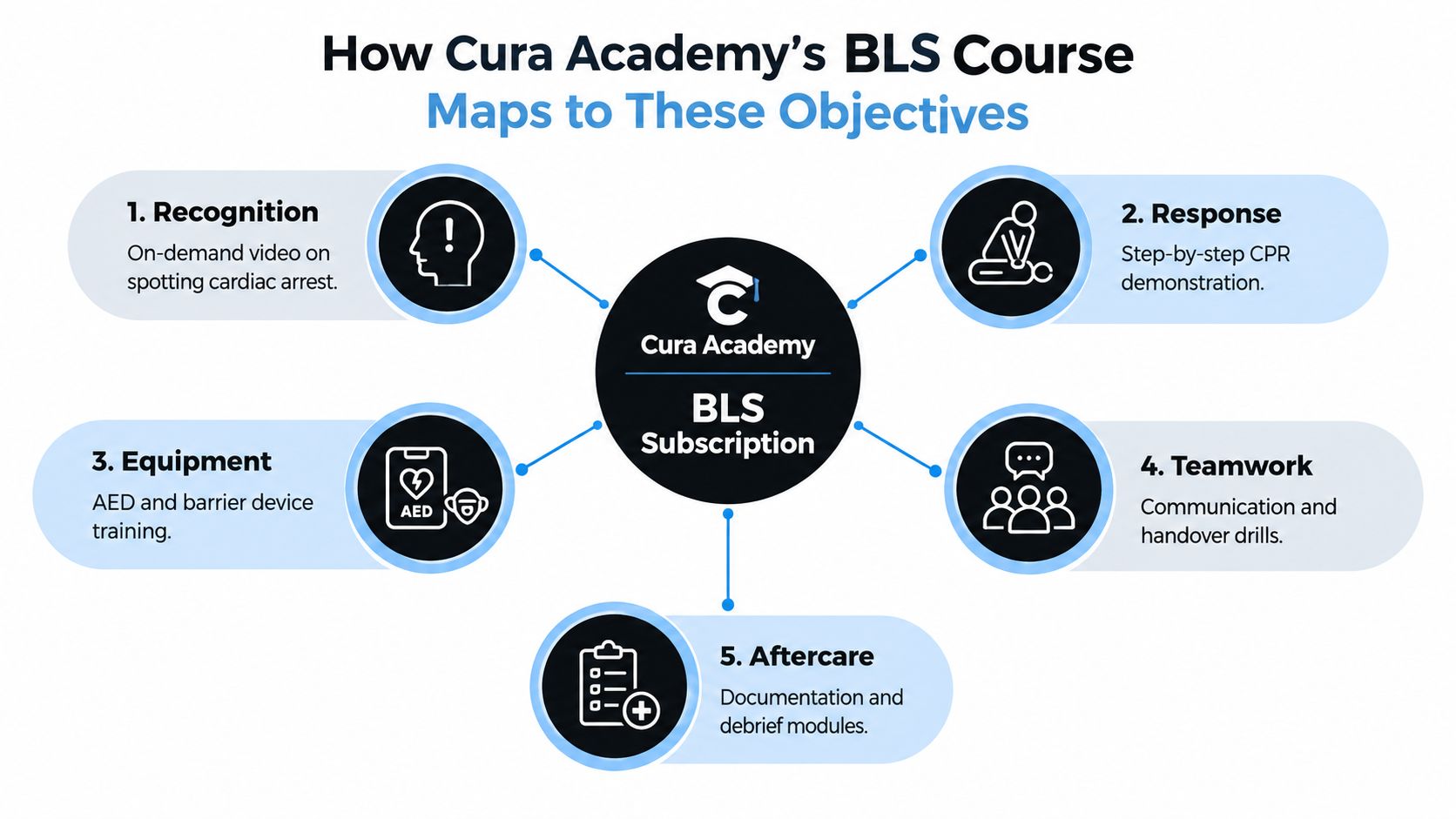
How the mapping works
For example, an online module can cover recognition, early escalation, recovery position, and incident understanding. A practical session can then assess compressions, airway steps within role limits, and AED use. That split usually works better than pretending practical skills can be fully verified through online theory alone.
Within Cura Academy's basic life support courses online, the useful part from a workforce point of view is that the learning path can be tied back to workplace evidence rather than treated as standalone e-learning. That matters for managers who need to show induction progress, mandatory training status, and role readiness.
A sensible course map for Standard 12
A course aligned to the objective categories should include:
- Recognition content covering collapse, responsiveness, and breathing checks
- Escalation content covering emergency calls, local procedure, and getting help quickly
- Practical CPR and AED assessment with an observed demonstration
- After-action content on incident recording, handover, and reflection
- Role-boundary guidance so learners know what sits inside and outside their competence
That approach doesn't dilute rigour. It usually improves it, because the knowledge and the practical evidence are separated cleanly.
Why Recognition and Limits Matter as Much as CPR
Workers often assume the dramatic part is the most important part. It isn't always. In many care settings, the stronger safeguard is earlier recognition and earlier escalation.
A resident who is unusually drowsy, grey, not responding normally, or breathing in an abnormal pattern may be in trouble before cardiac arrest occurs. A carer who notices that change and calls for urgent help promptly may prevent a worse outcome than the person who only performs well once the arrest has already happened.
Staying within role is part of competence
This also links directly to professional limits. A care worker doesn't become a nurse because they've completed BLS training. A domiciliary worker shouldn't improvise beyond training. A support worker should know when to step back, when to call 999, and when to hand over to somebody with a broader clinical role.
Safe practice includes knowing the line between immediate life-saving action and actions that require senior clinical judgement.
That isn't a weakness. It's one of the most important basic life support training objectives in UK care.
Quick Reference Card of Objectives and Evidence
Use this as a working checklist for induction folders, supervision prep, or staff self-audit. If a learner can't point to evidence for each row, the competency picture is incomplete.
| Objective | Action Verb | Evidence | Cura Academy Module |
|---|---|---|---|
| Recognise deterioration or collapse | Identify | Scenario observation, verbal questioning | Recognition and emergency response |
| Call for help appropriately | Escalate | Simulated emergency call, assessor checklist | Escalation and emergency actions |
| Deliver immediate life support safely | Demonstrate | Practical CPR and AED assessment | Practical BLS skills |
| Use recovery position when appropriate | Place | Observed demonstration | Recovery position and monitoring |
| Record event and hand over clearly | Record | Incident form, reflective account, handover exercise | Documentation and post-event actions |
| Stay within competence and seek support | Identify | Reflective discussion and supervisor sign-off | Role boundaries and safe practice |
Turn the card into a supervision tool
Managers can drop these lines straight into a staff tracker or induction file. If you're already building one, a training matrix template makes it easier to track who has theory only, who has observed practice, and who is due a refresher.
Frequently Asked Questions About BLS Objectives
How often should UK care staff refresh BLS
In practice, annual refreshers are the common expectation where the role requires BLS competence, and some settings apply tighter local recency rules. Managers should check role risk, local policy, and whether practical competence has been observed recently.
Does a certificate mean I'm fully competent
Not by itself. A certificate usually shows attendance or completion. In regulated care, competence is stronger when there's practical observation, workplace sign-off, and evidence that the learner can perform safely on the day.
How do paediatric objectives differ from adult ones
They aren't just smaller versions of adult BLS. The recognition cues, technique, and context differ, so paediatric competence should be taught and assessed separately when the service supports children or young people.
What counts as competence in assessment
Competence means the learner can perform the required sequence safely, communicate properly, and stay within role limits. Online knowledge checks help, but they don't replace observed practical skill for Standard 12 purposes where hands-on ability must be demonstrated.
If you need training that matches the reality of care work, Cura Academy offers UK health and social care learning that connects theory, mandatory updates, and role-specific courses such as BLS in one place. It's designed for learners and employers who need clear evidence of readiness, not just another certificate. You can explore the platform at Cura Academy.