
Can you prove you're caring, or can you only say it? That question matters because the 6Cs in health and social care are Care, Compassion, Competence, Communication, Courage and Commitment. They're not personality traits. They're observable behaviours that managers assess, interviewers probe and CQC inspectors look for in records.
The framework was formally promoted when England's senior nursing leaders announced Compassion in Practice on 4 December 2012, as set out in the Government announcement of the compassionate care strategy. Employers still use it because it gives domiciliary, residential and agency teams one shared language. Each section below gives you a clear definition, a shift-floor example, and the evidence you can show in supervision.
Table of Contents
- 1. Care
- 2. Compassion
- 3. Competence
- 4. Communication
- 5. Courage
- 6. Commitment
- The 6Cs at a Glance
- Living the 6Cs Every Day and Proving It
1. Care
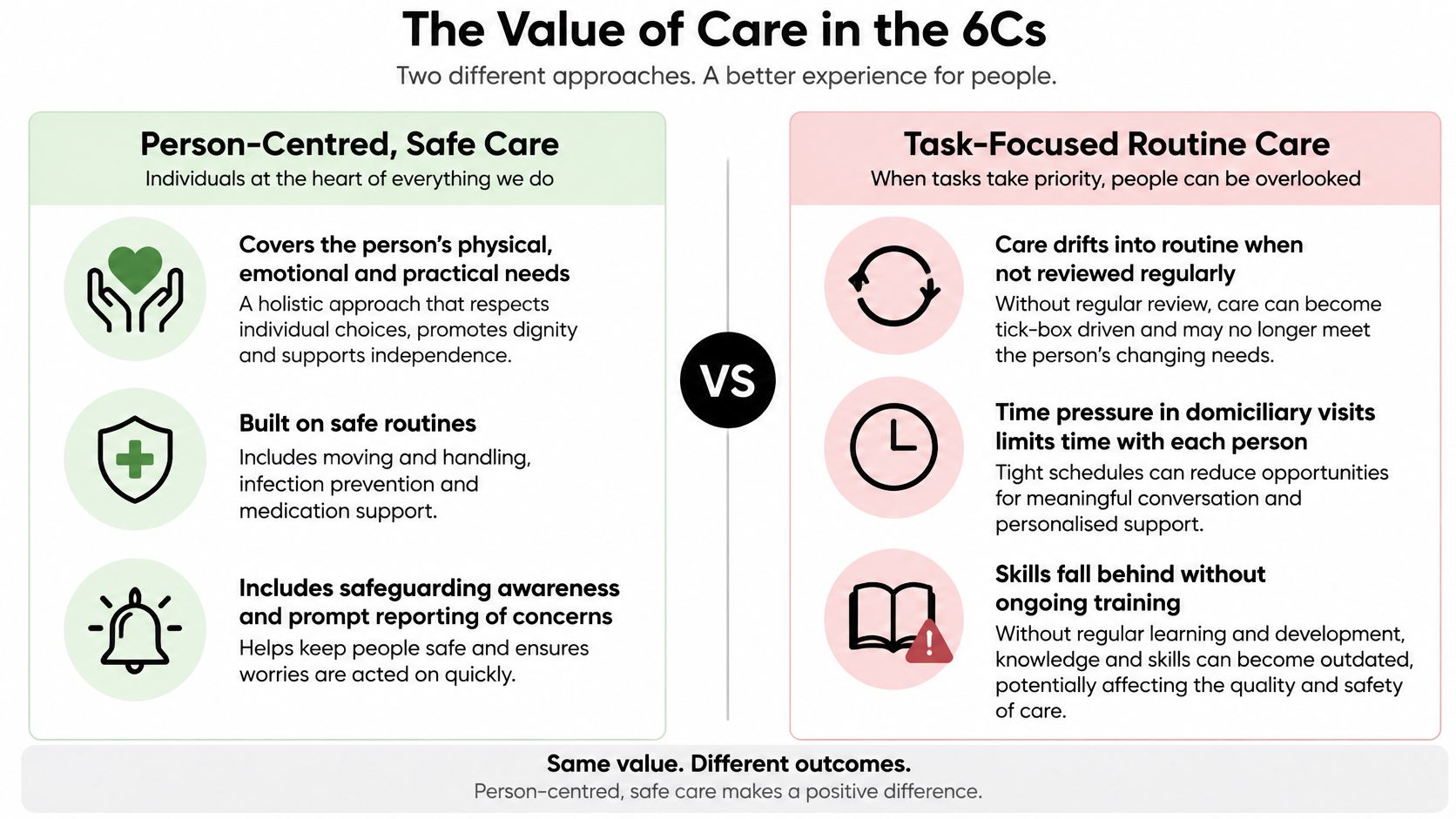
Care means practical, attentive support that meets a person's individual needs safely, not just completing tasks on time. It covers personal care, medication support, nutrition, mobility and safeguarding, judged by the outcome for that person. You've done the wash, but did you notice the skin change, check they'd eaten, and leave them comfortable?
Task done isn't the same as need met. Record what changed for the person, not only what you did.
What Good Care Looks Like on Shift
Say you're on a domiciliary round. You read the person-centred care plan before entering, provide personal care as agreed, spot new redness over the sacrum, record it at the time, and report it to your supervisor before the next visit. In a residential home, the same standard shows up when staff review a care plan promptly as mobility declines and adjust transfers instead of carrying on with an outdated routine.
- Read Before You Act: Check the care plan and risk assessments before every visit, then confirm changes with the team.
- Record Promptly: Write observations clearly when they happen, including refusal, pain or appetite changes.
- Link to Standards: Connect daily tasks to Care Certificate expectations on person-centred care and safeguarding.
That approach reflects the NHS Constitution for England, which expects care that's safe, effective and centred on patient experience. The discipline is old, even if the language is modern. Practical, person led support under pressure also runs through the nurse's travel memoir, where good care is shown through action, not intention.
2. Compassion

Compassion is noticing distress and acting to ease it with empathy, respect and dignity. It's not being soft about boundaries, and it isn't doing what feels kind without consent. It's responding to the person in front of you, in a way they'd choose.
Say a person with dementia becomes unsettled during a morning routine. You slow down, use their preferred name, explain one step at a time, and put on a familiar song that usually settles them. You don't rush personal care to recover time. You note what helped in the daily record so the next carer can repeat it, not guess.
How to Evidence Compassion
- Name and Explain: Use the person's preferred name and explain each task before you begin.
- Notice and Adjust: Pause to check mood, pain or anxiety, then change your pace or positioning.
- Reflect After Hard Shifts: Use supervision or peer support to discuss emotional pressure before it turns into detachment.
Teams sustain this through reflective meetings where staff can talk through difficult interactions without blame. That's practical, not indulgent. If you're depleted and unsupported, you'll start protecting yourself by going through the motions.
I judge compassion by small, repeatable behaviours, not by a warm interview answer. For a fuller look at how these behaviours sit alongside wider professional expectations, see our guide to care values in health and social care. Keep compliments, family feedback and supervision notes that describe specific actions, as they're stronger evidence than a generic claim that you're a caring person.
3. Competence
Competence means you have the knowledge, skills and judgement to work safely within your scope, and you know when to stop and ask for help. Caring intentions don't make an unsafe transfer safe. Neither does a certificate you earned once and never refreshed.
Evidence a Manager Can Check
Say a support worker completes Basic Life Support refresher training before starting a new domiciliary round and asks for an observed medication competency check. A bank worker does something similar by completing Care Certificate modules, keeping certificates dated, and giving an agency clear evidence before taking shifts with people whose needs they haven't supported before.

Treat 6Cs training as workplace behaviour you can assess. The NHS 6Cs map from Health Education England describes competence as including the expertise and clinical and technical knowledge needed to deliver effective, evidence based care. That means scenario tasks, observed practice and feedback matter as much as course completion.
- Keep a Training Log: Record certificate dates, renewal deadlines and observed assessments in one place.
- Ask to Be Observed: Medication, moving and handling, and personal care competencies should be seen, not assumed.
- Plan Refreshers Early: Book updates before expiry so you don't lose shifts over lapsed training.
Build those dates into clear personal development objectives and review them in supervision. If a task sits outside your training, say so clearly and escalate. That's competence, not weakness.
4. Communication
Good communication hasn't happened just because you spoke. It's happened when the other person understands, can respond, and the right colleagues have the information they need. That includes listening, plain language, accessible formats, accurate records and timely escalation.

Say you support a person with a learning disability before a health appointment. You use pictures and simple phrases, check understanding by asking them to explain it back, and record their communication preferences for the team. For person centred dementia support, stage-aware communication for caregivers makes the same point in a different setting. You adapt to the person, you don't just repeat yourself louder.
Make Information Usable
Culturally safe communication also means checking language needs, faith preferences, consent and reasonable adjustments, rather than treating a language support need as a competence concern. That matters in a diverse workforce, and the Compassion in Practice strategy document frames communication as central to caring relationships and teamwork.
Watch the short video below and compare it with your own handover habits.
- Check Understanding: Summarise key points back and invite correction.
- Record Plainly: Separate facts, observations and actions in clear English.
- Escalate With Structure: Use SBAR for situation, background, assessment and recommendation.
Domiciliary teams that use a structured handover template lose less information between visits. Read our practical guide to communication in health and social care if your records tend to say plenty but prove little.
5. Courage
Courage is speaking up when care is unsafe, undignified or discriminatory, even when the person responsible is senior, popular or short staffed. It's not picking arguments. It's raising a specific concern through the right route, with facts, and following it up if nothing changes.
Pressure doesn't remove that duty. England's adult social care workforce still had around 111,000 vacant posts and a 23.1% turnover rate in 2024/25, according to Skills for Care's state of the workforce report for 2025. Short staffing explains risk, it doesn't excuse silence about missed care.
What Speaking Up Looks Like
Say a colleague repeatedly misses visits or uses unsafe moving and handling because they're rushing. You record dates, times and what you observed, report it to the registered manager, and ask what action will be taken. If a safeguarding concern is minimised internally, you escalate to the safeguarding lead or an external body such as the CQC.
Practical rule: If you wouldn't accept it for your own family member, don't walk past it because the rota is tight.
- Know the Routes Early: Read safeguarding and whistleblowing policies before you need them.
- Stick to Facts: Record what happened, who was present and what you did next.
- Advocate Clearly: Challenge discriminatory language and culturally unsafe assumptions calmly and directly.
Anonymous reporting channels can help staff raise early concerns, but they don't replace your record. I recommend keeping your own factual note of when you escalated and to whom. That protects the person receiving care and shows you acted professionally.
6. Commitment
Commitment is what keeps the other five Cs going on an ordinary Tuesday, not just during induction week. You turn up reliably, follow through on care plans, keep learning, and treat the fiftieth visit with the same attention as the first. It doesn't mean accepting unsafe workloads or unpaid emotional labour without challenge.
Say a bank care worker keeps training current, updates availability, and accepts only shifts they're competent to cover. Agencies notice that pattern quickly because it's low risk. The worker gets regular offers not by saying yes to everything, but by being dependable where they've committed.
Commitment You Can Show
- Set a Development Plan: Choose clear goals for the next 6 to 12 months, then review progress in supervision.
- Keep Your Profile Current: Update training status, availability and compliance documents before employers chase you.
- Protect Recovery Time: Raise unmanageable workloads early, because exhaustion erodes compassion and competence.
Providers show commitment differently. They invest in staff development, recognise long serving staff, and fix recurring rota problems instead of relying on goodwill. If your employer talks about commitment but never releases you for training or supervision, that's a warning sign about the service, not your attitude.
Commitment isn't staying silent and absorbing pressure. It's staying engaged, current and honest about what safe care requires.
Your evidence is straightforward. Keep a supervision record showing goals met, refreshers completed on time, and reflective accounts where you changed practice after feedback. That trail speaks louder than claiming you're dedicated in every application.
The 6Cs at a Glance
| The C | Core focus | Key workplace behaviour | How it is evidenced |
|---|---|---|---|
| Care | Meeting each person's physical, emotional and practical needs safely | Follow person-centred care plans, observe changes and report concerns | Safe daily practice, clear records and regular care plan reviews |
| Compassion | Responding to people's feelings with empathy, kindness and respect | Notice distress, listen patiently and protect dignity and privacy | Reassuring interactions, feedback from people receiving care and reflective team discussions |
| Competence | Having the knowledge, skills and judgement to work safely | Stay within scope of practice, keep skills current and ask for help when needed | Training records, observed practice, supervision and reflection |
| Communication | Sharing and understanding information clearly and respectfully | Listen actively, adapt communication and provide accurate handovers | Clear records, confirmed understanding and timely escalation of concerns |
| Courage | Speaking up for safety, rights and good practice | Report concerns, challenge unsafe practice and advocate for people | Factual reports, use of safeguarding or whistleblowing routes, and early action on concerns |
| Commitment | Providing consistent, reliable care and continuing to develop | Follow through on care plans, attend reliably and keep learning | Consistent care delivery, current training and ongoing professional development |
Living the 6Cs Every Day and Proving It
The 6Cs only work as a set. Competence without compassion can feel cold and transactional. Compassion without competence can create safety risks. Communication without courage leaves concerns polished but unraised, and commitment without boundaries burns people out.
Start with your own evidence this week. Create a simple log with one column for each C and add one dated example beside each value. Under Care, note a care plan change you spotted and escalated. Under Compassion, record an adjustment that reduced distress. Under Competence, list assessed skills and renewal dates. Under Communication, keep an example of a clear handover or SBAR escalation. Under Courage, note a concern raised and the outcome. Under Commitment, record training completed and goals reviewed.
Take that log into supervision and interviews. It turns vague answers into accountable practice that a manager or inspector can follow. It also exposes gaps early, which is useful, not embarrassing.
If you're new to care or your certificates have lapsed, structured training gives you the clearest route to evidence Competence and Commitment. At Cura Academy, our courses are aligned with CQC and Skills for Care standards, our Care Certificate Bundle is for people new to care, and our £10 per month membership gives you access to mandatory training you can keep current. Choose one gap from your log, complete the relevant module, ask for observed practice where it applies, and update your evidence. That's how the 6Cs stop being a poster and start describing your shift.
Build evidence for every C with current, UK aligned training you can show to employers and agencies. Visit Cura Academy to explore the Care Certificate Bundle for newcomers or start the £10 per month membership for unlimited access to mandatory training. Pick your next course today and add the certificate to your 6Cs log.